Scalds and Burns in Toddlers: First Aid at Home
A practical guide for parents on first aid for scalds in babies and toddlers: cooling, bandaging, recognizing severity, and when to go to the hospital immediately – a common concern for young parents.

Author: Dr. med. univ. Daniel Pehböck, DESA
Specialist in Anesthesiology and Intensive Care Medicine, AHA-certified ACLS/PALS Instructor, Course Director Simulation Tirol
Reading time approx. 8 min
Scalds and burns are among the most common accidents in early childhood – and among the situations parents fear the most. A knocked-over cup of tea, a grab at a hot pot on the stove, pulling on the kettle cord: it can happen in a split second. The good news: if you know what to do, you can make a crucial difference in the first few minutes, helping to reduce the severity of the injury and ensuring your child receives the best possible care. This article gives you a clear, practical guide – from immediate first aid to recognizing severity levels to knowing when you absolutely must go to the hospital.
Why Children's Skin Is So Sensitive
The skin of babies and toddlers is significantly thinner than adult skin. What might only cause slight redness on you can already lead to a deep burn on your child. Liquids as low as about 52 °C can cause severe damage to a child's skin within seconds – a freshly brewed cup of tea is typically over 90 °C.
On top of that, the ratio of body surface area to body weight is much greater in toddlers than in adults. This means that even a seemingly small scalded area on a baby can account for a significant portion of their total body surface area. This directly impacts the severity and the need for hospital treatment.
Scald or Burn – What's the Difference?
Both terms are often used interchangeably in everyday language, but there is a difference:
- Scald: Caused by hot liquids or steam. This is by far the most common cause in toddlers – typically from hot tea, coffee, soup, or hot bath water.
- Burn: Caused by direct contact with hot objects (stovetop, iron, oven door), open flames, or also by electricity and friction.
For first aid purposes, the distinction is less important – the immediate measures are essentially the same. What matters is how deep the damage goes and how large the affected area is.
Immediate Measures: What You Should Do in the First Few Minutes
The first few minutes after a scald or burn are critical. Here is your step-by-step plan:
1. Stay Calm and Remove the Source of Danger
As hard as it is – try to stay calm. Your child can sense your panic. Immediately remove the source of heat: move your child away from the danger, don't knock over any more hot liquids, turn off the stove.
2. Remove Clothing – But Carefully
Remove soaked or hot clothing as quickly as possible, because the heat continues to act through the fabric. Important: If clothing is stuck or fused to the skin, leave it in place. Never pull it off forcefully – you would tear skin away with it and make the injury worse.
3. Cool – But Do It Right
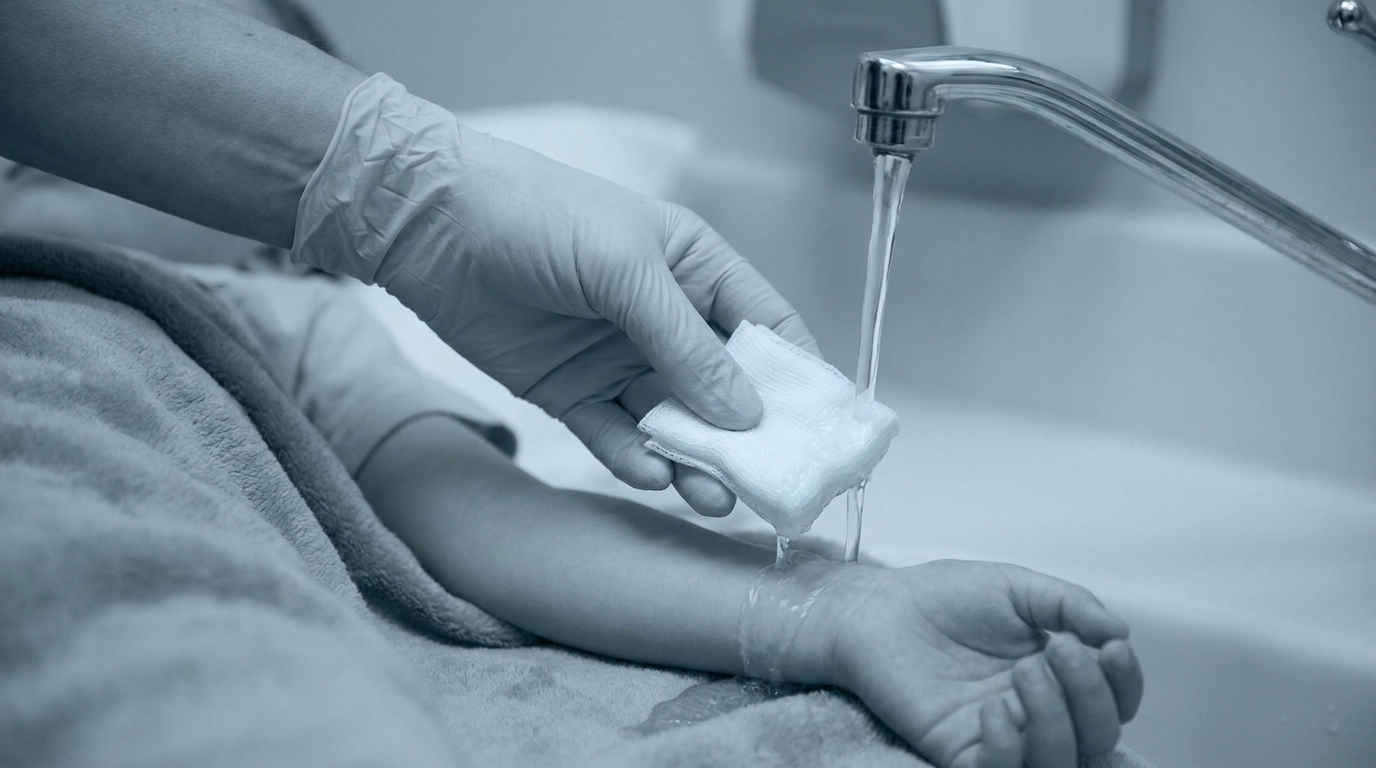
Cooling is the most important immediate measure. It relieves pain and can limit the depth of tissue damage. But: Cooling the wrong way can do more harm than good.
How to cool correctly:
- Use lukewarm to cool tap water (approximately 15–20 °C)
- Hold the scalded area under running water for 10 to a maximum of 20 minutes or gently apply damp cloths
- Cool only the affected area, not the entire child
What you should absolutely NOT do:
- No ice water, no ice cubes, no cold packs directly on the skin – this can cause additional cold injury and impair blood circulation
- Do not submerge the entire child in cold water – especially with babies and small children, this risks hypothermia, which can significantly worsen their condition
- No home remedies such as butter, flour, toothpaste, curd cheese, or oil on the wound – they contaminate the wound surface and make later medical assessment more difficult
4. Cover Sterile and Keep Warm
After cooling, loosely cover the wound with a clean, lint-free cloth – for example, a fresh dish towel, a sterile compress, or a metallic burn dressing from your first aid kit. Wrap the cloth loosely around the affected area without applying pressure.
Afterward, it is important to keep your child warm. Wrap them in a blanket or put warm clothing on the unaffected parts of the body. Hypothermia – especially in babies – is a real danger that puts additional strain on the circulatory system.
5. Take Pain Seriously and Comfort Your Child
Scalds are extremely painful. Hold your child in your arms (as much as possible without pressing on the wound) and speak to them in a soothing voice. Breastfeeding or offering a pacifier can provide additional comfort for babies. If you want to give a pain reliever: Paracetamol or Ibuprofen in the age-appropriate dosage are generally suitable, but when in doubt, discuss this with a doctor before giving any medication.
Recognizing Severity: How Bad Is It Really?
Not every scald needs to be treated in a hospital – but you need to be able to judge when it becomes serious. The classification is based on the depth of skin damage:
Grade 1 – Superficial
- Appearance: Skin is red, slightly swollen, no blisters
- Pain: Severe, but the skin is intact
- Comparison: Similar to a mild sunburn
- Healing: Usually heals within a few days without scarring
Grade 2a – Superficial, Partial Skin Layer Affected
- Appearance: Redness and blister formation, the base beneath the blisters is pink and moist
- Pain: Very severe (this is actually a good sign – the nerve endings are still intact)
- Healing: Usually heals within two to three weeks, scarring possible
Grade 2b – Deeper Skin Layers Affected
- Appearance: Blisters, the base is more whitish or yellowish, less moist
- Pain: Less than Grade 2a (because nerve endings are already damaged)
- Healing: Often requires surgical treatment, scarring likely
Grade 3 – All Skin Layers Destroyed
- Appearance: Skin appears white, gray, leathery, or even charred
- Pain: Little to no pain in the affected area (nerves are destroyed)
- Healing: Always requires intensive medical treatment, skin grafting often necessary
Important to know: In an acute situation, it is not always easy to assess the exact grade of a scald – especially in children. When in doubt: it's always better to get it checked by a doctor one time too many.
When Do You Need to Go to the Hospital Immediately?
There are clear situations where you must take your child to the hospital immediately – if in doubt, call emergency services at 144 (in Austria) or 112 (Europe-wide):
- The scald or burn is larger than your child's palm – the child's palm (including fingers) corresponds to approximately 1% of their body surface area. From about 5% of body surface area, inpatient treatment may already be necessary in children.
- Blister formation – any scald with blisters (Grade 2 and above) should be medically assessed in children.
- Affected body areas: Face, neck, hands, feet, genital area, or joints – these regions always need specialist care.
- Signs of deeper burns: White, gray, or leathery skin areas.
- Your child is younger than one year – for babies, there is a particularly low threshold at which hospital treatment is necessary.
- Your child appears lethargic, pale, is shivering severely, or is vomiting – these can be signs of shock.
- Circumferential scalds that wrap entirely around an extremity or the torso – they can impair blood circulation.
- Inhalation of hot steam – if your child has inhaled hot steam, the airways can swell. Watch for hoarseness, barking cough, or difficulty breathing.
- Electrical burns or chemical burns – these always require hospital treatment.
Rule of thumb: For any baby or toddler with a scald that goes beyond mild redness, you should seek medical advice.
What You Should Absolutely NOT Do
Some well-meaning advice can make the situation worse. Here is a summary:
- No home remedies on the wound (butter, flour, toothpaste, honey, oil, aloe vera gel) – they can promote infections and make medical assessment more difficult
- Do not pop blisters – the blister is a natural wound protection. Opening it significantly increases the risk of infection
- No tight bandages – swelling can increase, and a bandage that is too tight can cut off blood circulation
- No ice and no ice-cold water – risk of hypothermia and additional tissue damage
- Do not tear off clothing stuck to the skin
Prevention: The Most Common Hazards in the Home
The best first aid is the kind you never need. The vast majority of scalds in toddlers can be prevented with simple precautions:
- Hot beverages: Never place tea, coffee, or hot soup at the edge of the table or on a tablecloth your child could pull. Don't drink hot beverages while your child is sitting on your lap.
- Kettles and cords: Position the kettle so your child cannot reach the cord and pull the device down.
- Cooking: Use the back burners and turn pot handles toward the back. A stove guard is a worthwhile investment.
- Bath water: Always check the water temperature with your elbow or a thermometer before putting your child in the water. The recommended bath temperature is 36–37 °C. Always turn on the cold water first, then the hot.
- Heaters and fireplaces: Secure open fireplaces, stoves, and portable heaters with a safety guard.
- Irons: Never leave a hot iron unattended when your child is nearby.
Summary: Your Emergency Plan at a Glance
So you can act immediately in an emergency, here are the key steps in a nutshell:
- Remove the source of danger – move the child away from the heat source
- Remove soaked clothing – only if it is not stuck to the skin
- Cool with lukewarm water (15–20 °C) for 10–20 minutes – only the affected area
- Cover the wound loosely and sterile
- Keep the child warm – prevent hypothermia
- Comfort and relieve pain
- Seek medical help – for blisters, large-area scalds, affected face/hands/genitals, for babies under one year, for signs of shock
Print out this plan and hang it on the fridge or in the kitchen. In a stressful situation, it helps enormously to have a clear action plan in front of you.
Practical Training
Knowing what to do in an emergency gives you a sense of security as a parent – but being able to actually recall that knowledge under stress is a different thing entirely. In our Baby Resuscitation Course at Simulation Tirol, you will learn not only infant and toddler CPR but also the practical first aid management of typical childhood emergencies such as scalds, choking, and breathing difficulties. You practice on realistic simulation models, receive direct feedback, and go home with the confidence that you can take action in a real emergency. Because the most important thing you can give your child is someone who knows what to do.
Want to practice this hands-on?
In our Baby-Reanimationskurs you practice this topic hands-on with high-tech simulators and experienced instructors.
More Articles
Respiratory Distress Syndrome in Newborns: Causes and Initial Management
Transient tachypnea, meconium aspiration, and surfactant deficiency – how healthcare professionals and parents can distinguish the most common causes of neonatal respiratory distress and which immediate measures can be lifesaving.
Airway Obstruction in Infants: Back Blows and Chest Thrusts
Detailed lay-rescuer guide for choking emergencies in babies under 1 year: positioning, blow technique, alternating measures, and when to call emergency services.
Baby Not Breathing: Infant CPR for Laypeople
A clear, easy-to-understand guide to cardiopulmonary resuscitation (CPR) for babies under one year of age. This article explains how to check breathing, perform rescue breaths, and give chest compressions with the correct hand position – specifically designed for parents and grandparents with no medical background.