Baby Not Breathing: Infant CPR for Laypeople
A clear, easy-to-understand guide to cardiopulmonary resuscitation (CPR) for babies under one year of age. This article explains how to check breathing, perform rescue breaths, and give chest compressions with the correct hand position – specifically designed for parents and grandparents with no medical background.

Author: Dr. med. univ. Daniel Pehböck, DESA
Specialist in Anesthesiology and Intensive Care Medicine, AHA-certified ACLS/PALS Instructor, Course Director Simulation Tirol
Reading time approx. 10 min
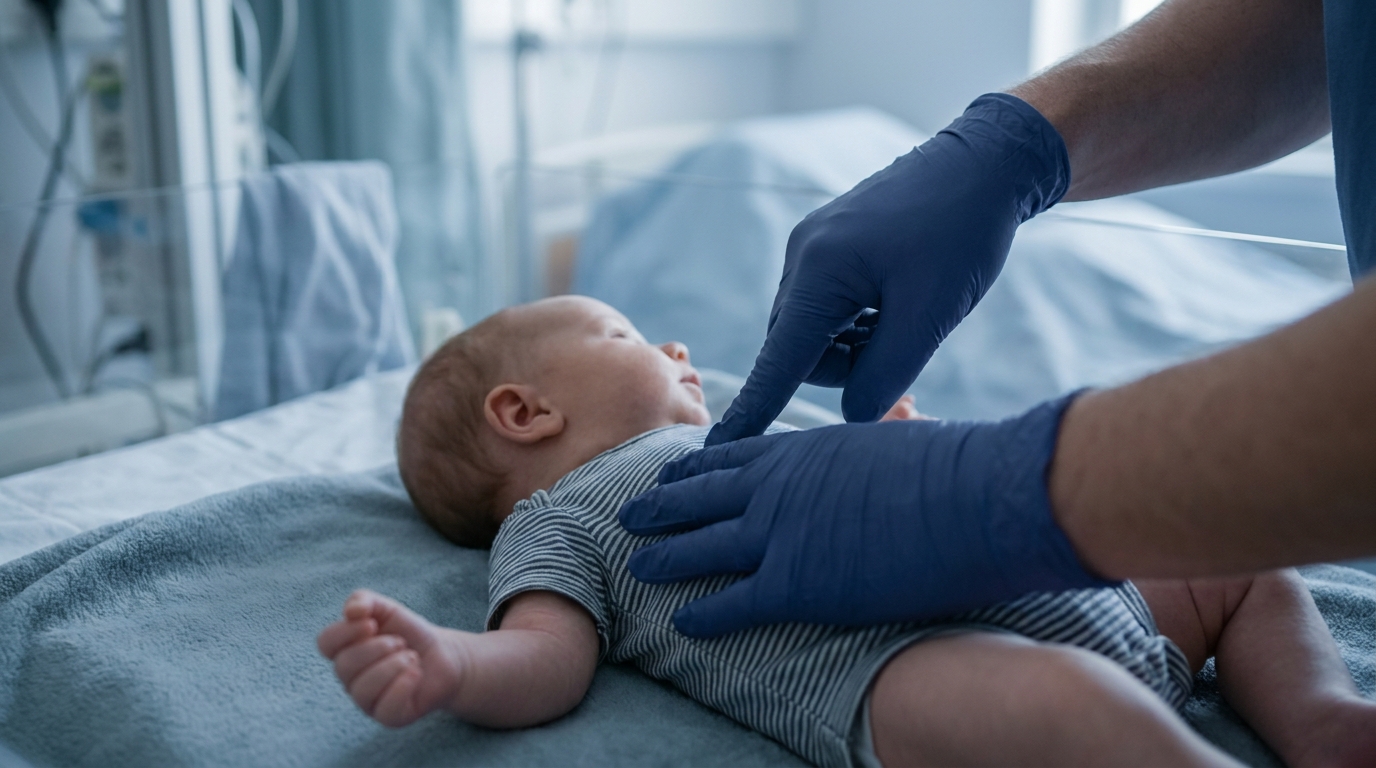
Few thoughts trigger more fear in parents than this: the baby isn't breathing. Perhaps you opened this article because you want to be prepared – or because you've just had a scare and want to know what to do in an emergency. Both reasons are good and valid. Because the few minutes between the moment a baby stops breathing and the arrival of emergency services are critical. In those minutes, you – as a parent, grandparent, or caregiver – are the most important rescuer in the world. The good news: the techniques can be learned, and you don't need any medical background. This article guides you step by step through cardiopulmonary resuscitation (CPR) for infants under one year of age.
Why Babies Are Resuscitated Differently Than Adults
Infants are not small adults. Their bodies are built differently in many ways, and this directly affects how resuscitation is performed:
- The head is large and heavy relative to the body. When you lay the baby on its back, the head can easily tilt forward and block the airway. That's why the head is only tilted back very slightly in infants – not as far as in adults.
- The airways are very narrow. Even minor swelling, a small piece of food, or mucus can completely obstruct them.
- The heart sits in a slightly different position and the chest is soft and flexible. For chest compressions, two fingers are therefore sufficient instead of the whole palm of the hand.
- The most common cause of cardiac arrest in babies is respiratory arrest. In adults, it's usually the heart itself. That's why resuscitation in infants always begins with rescue breaths first – this is an important difference.
When Do You Need to Act?
You need to act if your baby:
- is not responding, meaning it shows no reaction to being spoken to or gently touched,
- is not breathing normally, meaning no regular chest movements are visible, or
- is only gasping – these are isolated, irregular, convulsive breaths that are not real breathing.
Trust your gut feeling: if something seems "not right" and your baby appears lifeless, start the following steps immediately. You cannot cause harm by performing CPR – but you can lose precious time by hesitating.
Step by Step: Infant CPR
Step 1 – Check for Safety and Response
Before you do anything, take a brief moment (really just one to two seconds) to make sure there is no immediate danger to you or the baby – for example from electricity, traffic, or falling objects.
Then check whether the baby responds:
- Speak to it loudly: "Hello, sweetheart! Can you hear me?"
- Touch it gently: Stroke the sole of the foot softly or tap lightly on the shoulder.
Important: Never shake the baby! This can cause severe brain injuries in infants.
If the baby does not respond – no crying, no movement, no eye opening – move on to Step 2.
Step 2 – Call for Help
If a second person is nearby, ask them immediately to call the emergency number 144 (in Austria) or 112 (Europe-wide). The second person should stay on the phone and switch to speakerphone so the dispatch center can listen in and give instructions.
If you are alone: Begin with CPR first (Steps 3–5) and perform it for two minutes before calling the emergency number. The reason: in babies, the most common trigger is a breathing problem – and two minutes of rescue breaths plus chest compressions can already be lifesaving during that time. After that, make the call, ideally on speakerphone so you can continue CPR.
Step 3 – Open the Airway and Check Breathing
Place the baby carefully on a firm, flat surface – for example on the floor, a table, or a changing mat.
Opening the airway:
- Place one hand gently on the baby's forehead.
- Lift the chin slightly with one finger of your other hand (on the bony part, not the soft tissue under the chin).
- Bring the head into a neutral position – tilted back only very slightly. Imagine the baby is sniffing a flower. That's approximately the right angle. Tilting the head back too far can actually kink the small airways.
Check breathing (maximum 10 seconds):
Lean down with your ear and cheek close to the baby's mouth and nose while looking at the chest:
- Look: Is the chest rising and falling?
- Listen: Can you hear breathing sounds?
- Feel: Can you feel a breath of air on your cheek?
If the baby is breathing normally: Carefully place it in the recovery position (more on that below) and call the emergency number.
If the baby is not breathing or is only gasping: Move on immediately to Step 4.
Step 4 – Five Initial Rescue Breaths
In babies, resuscitation begins with rescue breaths – because the underlying problem is usually a lack of oxygen. These first five breaths are called "initial rescue breaths."
Here's how to do it:
- Keep the head in the slightly tilted-back position (head tilt–chin lift).
- Place your mouth over the baby's face so that you cover both the mouth and nose at the same time. Babies have very small faces – with most infants this is easily possible. If the baby is larger and you cannot cover both mouth and nose together, breathe only into the mouth while pinching the nose shut (or alternatively, only into the nose with the mouth closed).
- Blow air gently into the baby's lungs. Each breath should last about one second. You only need a small amount of air – roughly the amount you would puff into your own cheeks. A baby's lungs are tiny. Too much air can inflate the stomach or injure the lungs.
- Watch the chest: if it rises visibly, the breath was successful.
- Remove your mouth briefly, let the air flow out (the chest will fall again), and give another breath.
- Repeat until you have given five rescue breaths.
What if the chest doesn't rise?
- Check the head position: perhaps the head is tilted too little or too far back. Adjust the angle.
- Look inside the mouth: can you see a foreign object that you can easily remove with a finger? Then remove it. But: never blindly poke around in the mouth – you could push the foreign object deeper.
- Try again. Even if not all five breaths are successful, move on to Step 5 after a maximum of five attempts.
Step 5 – Chest Compressions and Rescue Breaths in Alternation
After the five initial rescue breaths, begin chest compressions alternating with further rescue breaths. The ratio is:
30 chest compressions – then 2 rescue breaths – then 30 chest compressions again – then 2 rescue breaths …
Repeat this cycle without interruption until emergency services arrive or the baby shows clear signs of life (movement, crying, normal breathing).
The correct hand position for chest compressions:
- Imagine a line between the baby's two nipples.
- Place two fingertips (index and middle finger) directly below this line on the breastbone – in the center of the chest, just slightly below the imaginary nipple line.
- The fingers should be perpendicular to the breastbone.
How to compress:
- Press the breastbone down approximately 4 centimeters with your two fingers. This is roughly one-third of the chest depth. It may feel deeper than you expect – but this pressure is necessary to pump blood to the brain.
- Allow the chest to come back up completely after each compression, without lifting your fingers off. This release is just as important as the compression, because only then can the heart refill with blood.
- Compress fast: approximately 100 to 120 times per minute. As a memory aid: this matches the rhythm of the song "Stayin' Alive" by the Bee Gees. If you count internally, it helps to count quickly and evenly: "1 and 2 and 3 and 4 …"
After 30 compressions: Open the airway again (head tilt–chin lift), give 2 rescue breaths, and immediately continue with the next 30 chest compressions.
How Long Do You Need to Keep Going?
As long as it takes until one of the following happens:
- Emergency services arrive and take over.
- The baby shows clear signs of life: It moves, cries, or breathes normally again. In this case: place the baby in the recovery position and monitor breathing until emergency services arrive.
- You are physically so exhausted that you can no longer compress. (Still try to keep going as long as possible. Every minute counts.)
If a second person is available, take turns performing chest compressions approximately every two minutes to avoid fatigue. The changeover should be as quick as possible – every second of interruption reduces effectiveness.
The Recovery Position for Infants
If your baby is unconscious but breathing normally, place it in the recovery position so that saliva, mucus, or vomit can drain and the airway stays clear.
The simplest method:
- Hold the baby on your forearm so that its tummy rests on your arm and the head is slightly lower than the body.
- Support the head from the side with your hand.
- Continuously monitor breathing until emergency services arrive.
The Most Common Causes – and How to Recognize Them
It helps to know the typical reasons why a baby might stop breathing:
- Choking/foreign body: The baby has put something in its mouth (small objects, pieces of food) that blocks the airway. Signs: sudden gagging, coughing, then silence. In this case, back blows and chest thrusts for foreign body removal are needed first – this is a separate topic that you should definitely also learn about.
- Respiratory infections: Severe croup episodes (barking cough with breathing difficulty), bronchiolitis (an inflammation of the small airways), or whooping cough can trigger pauses in breathing in very small babies.
- Sudden Infant Death Syndrome (SIDS): A baby is found lifeless in its crib without any identifiable cause. This is precisely when you must start CPR immediately.
- Seizures: Sometimes babies stop breathing during a seizure. Usually breathing resumes after the seizure – but not always.
- Suffocation from soft bedding: Pillows, stuffed animals, or overly soft mattresses can cover the mouth and nose.
Regardless of the cause: the CPR sequence always remains the same. You don't need to make a diagnosis. If the baby is not responding and not breathing, start CPR.
What You Should NOT Do
Things you should avoid are also important:
- Never shake the baby, no matter how panicked you are.
- Do not blindly stick your finger into the throat to feel for a foreign object – unless you can clearly see it.
- Do not interrupt CPR to "Google something first" or watch a video. Every interruption costs time and reduces the chances of survival.
- Do not wait and hope that it will get better on its own. If your baby is not responding and not breathing, every second counts.
Fear Is Normal – Act Anyway
Many parents say in hindsight: "I was so afraid of doing something wrong." This fear is completely understandable. But there is one important truth: The only thing you can truly do wrong in that moment is to do nothing. Even imperfect chest compressions, even rescue breaths where the chest only rises a little, are infinitely better than waiting.
Your baby needs only one thing from you in that moment: for you to start.
Summary for Printing
Here is the entire sequence at a glance:
- Safety – Is the environment safe?
- Check response – Speak to the baby, touch the sole of the foot. Do not shake!
- Call for help – A second person calls 144/112. If alone: perform CPR for 2 minutes first, then call.
- Open the airway – Head tilt–chin lift, head in neutral position.
- Check breathing – Look, listen, feel. Maximum 10 seconds.
- 5 initial rescue breaths – Mouth over mouth and nose, gently, 1 second each.
- 30 chest compressions – Two fingers, center of the chest, 4 cm deep, 100–120/min.
- 2 rescue breaths
- Continue alternating 30:2 – Until emergency services arrive or the baby shows signs of life.
Practical Training
Reading an article is a good first step – but truly mastering these techniques requires practice. Only when you've felt on a training manikin how deep you need to press, how little air a rescue breath requires, and how fast the rhythm should be, will you be able to act confidently and decisively in a real emergency. In the Baby CPR course from Simulation Tirol, you practice exactly that: resuscitation on realistic infant manikins, the correct breathing technique, and how to handle choking and foreign body emergencies. The course is specifically designed for parents, grandparents, midwives, and anyone who cares for babies – no medical background required. Because knowledge saves lives, but skill saves them faster.
Want to practice this hands-on?
In our Baby-Reanimationskurs you practice this topic hands-on with high-tech simulators and experienced instructors.
More Articles
Respiratory Distress Syndrome in Newborns: Causes and Initial Management
Transient tachypnea, meconium aspiration, and surfactant deficiency – how healthcare professionals and parents can distinguish the most common causes of neonatal respiratory distress and which immediate measures can be lifesaving.
Airway Obstruction in Infants: Back Blows and Chest Thrusts
Detailed lay-rescuer guide for choking emergencies in babies under 1 year: positioning, blow technique, alternating measures, and when to call emergency services.
Baby Choking: First Aid Step by Step
What should you do when an infant chokes on food or small objects? This article explains back blows and chest thrusts for babies in clear, easy-to-understand language for parents and caregivers – with step-by-step instructions and guidance on when to call emergency services.