Safe Sleep Environment: How to Keep Your Baby Safe While Sleeping
Back sleeping, sleep sack instead of blankets, room temperature, and co-sleeping – evidence-based recommendations for a sleep environment that has been proven to reduce the risk of breathing emergencies and SIDS.

Author: Dr. med. univ. Daniel Pehböck, DESA
Specialist in Anesthesiology and Intensive Care Medicine, AHA-certified ACLS/PALS Instructor, Course Director Simulation Tirol
Reading time approx. 9 min
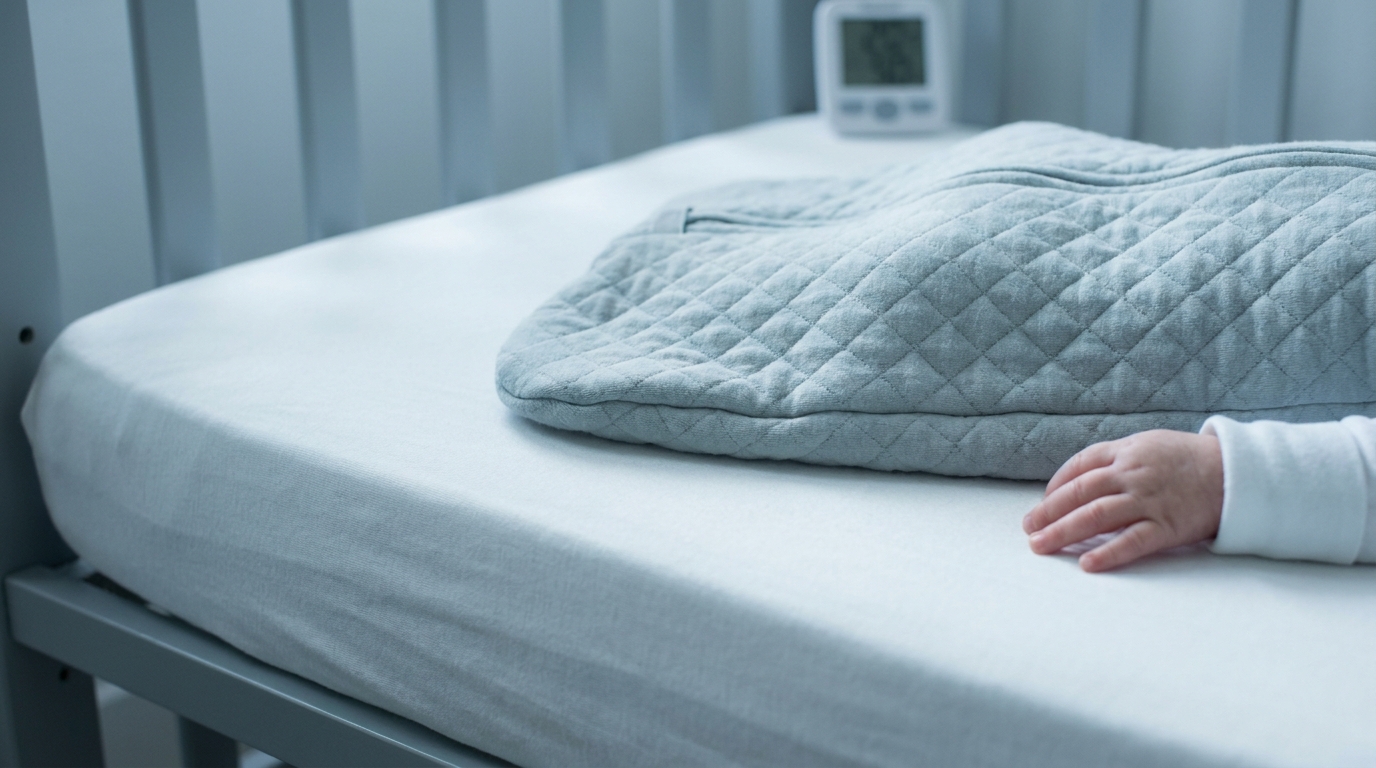
Sudden infant death – known in medical terminology as SIDS (Sudden Infant Death Syndrome) – is every parent's worst nightmare. The good news: over the past few decades, the number of cases has dropped dramatically. The most important reason for this are simple yet effective measures related to the sleep environment. Many of them you can implement right away – without expensive purchases, without complicated technology. In this article, you'll learn which recommendations are truly evidence-based, why back sleeping is so crucial, and how to make your baby's sleeping area as safe as possible.
What Is SIDS – and Why Is the Sleep Environment So Important?
SIDS refers to the sudden, unexpected death of an infant for which no cause can be found even after a thorough investigation. It primarily affects babies in their first year of life, with a peak incidence between the second and fourth months. The exact mechanisms are still not fully understood. Based on current knowledge, three factors interact:
- An underlying vulnerability of the baby (e.g., still-immature respiratory regulation in the brain)
- A critical developmental stage (the first months of life)
- External triggers – and this is exactly where the sleep environment comes into play
The sleep environment is the factor you as a parent can directly influence. Studies clearly show that consistently implementing the recommendations can reduce the risk of SIDS by up to 70%. This doesn't mean you can completely eliminate every danger – but you're giving your baby the best possible protection.
Back Sleeping – the Single Most Important Measure
If there's one single recommendation you should remember, it's this: Always place your baby on their back to sleep. This applies to nighttime sleep as well as every nap in between.
Why Back Sleeping Specifically?
In the prone (tummy-down) position, the risk of airway obstruction is significantly increased. The face can sink into the mattress, the airways can become blocked, and the baby may rebreathe stale, CO₂-rich air. Young infants often don't yet have the strength or reflexes to turn their head sufficiently to breathe freely.
Since consistent back sleeping was recommended as the standard in the 1990s, the SIDS rate has dropped by more than half in many countries. The American Heart Association (AHA) and all major pediatric professional societies clearly recommend back sleeping.
Common Concerns – and Why They Are Unfounded
- "My baby could choke on vomit." This fear is understandable but has been disproven by studies. In the back position, babies reflexively swallow vomit or turn their head to the side. The risk of aspiration (inhaling stomach contents) is actually lower in the back position than in the prone position.
- "My baby sleeps much more calmly on their tummy." This is sometimes actually true – but the deeper sleep in the prone position is part of the problem. Babies in the prone position are harder to arouse. The ability to wake up during breathing pauses can be life-saving.
- "What about flat head?" A slight flattening of the back of the head (plagiocephaly) can occur but almost always resolves on its own. You can prevent it by regularly changing your baby's head position while they're awake and placing your baby on their tummy during supervised awake time (so-called "tummy time"). This also strengthens the neck and core muscles.
What to Do When Your Baby Rolls Over on Their Own?
Once your baby can independently and reliably roll from back to tummy and back again, you don't need to keep turning them back. The important thing is that you continue to place them on their back. The ability to roll over independently shows that motor development and protective reflexes are sufficiently mature.
The Safe Sleeping Area: Mattress, Bedding, and More
Your baby's sleeping area should be as bare as possible. That may sound stark, but it's the best protection.
The Mattress
- Firm and flat. The mattress must be firm enough that your baby's head doesn't sink in. A simple test: press your hand onto the mattress. It should spring back to its original shape immediately.
- Properly fitted. There should be no gap between the mattress and the bed frame that the baby could slip into. As a rule of thumb: if you can fit more than two fingers between the mattress and the crib, the mattress is too small.
- No soft overlays. Avoid sheepskins, wool underlays, waterbeds, or memory foam mattresses. All of these materials promote sinking in and rebreathing of stale air.
What Does NOT Belong in the Baby's Bed?
The list is long – and important:
- No blankets. Blankets can slide over the face and block the airways.
- No pillows. Not even "very flat" pillows. Babies don't need a pillow.
- No stuffed animals, plush toys, or crib liners. As cute as they look – every soft object in the bed is a potential suffocation risk.
- No crib bumpers (bumper pads). They impede air circulation and pose a suffocation hazard.
- No loose strings, ribbons, or chains near the bed (including pacifier clips with long ribbons).
Sleep Sack Instead of Blanket
The safest alternative to a blanket is a well-fitting baby sleep sack. It keeps your baby warm but can't slide over the face. Pay attention to the following:
- Correct size: The neck opening must be snug enough that the baby can't slip inside. The sleep sack shouldn't be too long.
- No hood: A sleep sack for sleeping doesn't need a hood – it could cover the face.
- Appropriate warmth (TOG rating): The TOG rating indicates the thermal resistance. At a room temperature of 18–20 °C (64–68 °F), a sleep sack with a TOG rating of 2.5 is generally suitable. In summer, a thin sleep sack (TOG 0.5–1.0) is often sufficient. Underneath, a bodysuit or light pajamas are enough.
Room Temperature and Room Climate
Overheating is an independent risk factor for SIDS. Babies don't regulate their body temperature as effectively as adults and overheat faster than you might think.
- Ideal room temperature: 16–20 °C (61–68 °F). This often feels cool to adults but is optimal for sleeping babies.
- No hat indoors. The head is the most important area through which babies release heat. A hat in bed blocks this heat dissipation.
- Feel the neck. To check whether your baby is warm enough, feel the neck or the area between the shoulder blades. The skin should be warm and dry. Cold hands and feet are normal in babies and are not a sign that they're cold.
- Ventilate regularly, but avoid drafts. Fresh air in the sleeping room is good; direct drafts on the baby should be avoided.
Co-Sleeping, Room-Sharing, and Bed-Sharing – the Important Differences
When it comes to sleeping together, there's often confusion because different terms get mixed up. It's important to distinguish clearly:
Room-Sharing (Own Bed in the Parents' Bedroom) – RECOMMENDED
The current recommendations from the AHA and pediatric professional societies are clear: The baby should sleep in their own bed but in the same room as the parents for the first year of life – at least for the first six months. A bedside sleeper that attaches directly to the parents' bed is an ideal solution.
Why? Studies show that room-sharing reduces the risk of SIDS by up to 50%. The reasons are varied: you notice changes in your baby more quickly, nighttime breastfeeding is easier, and the parents' breathing sounds may have a regulating effect on the baby's breathing.
Bed-Sharing (Sharing a Bed with the Parents) – NOT RECOMMENDED
With bed-sharing, the baby sleeps on the same sleep surface as an adult. Professional societies explicitly advise against this, particularly in the following situations:
- Always during the first four months of life – the risk is especially high during this period
- If a parent smokes (even if not in the bedroom)
- After alcohol consumption, even in small amounts
- After taking medications that cause drowsiness (sleeping pills, certain painkillers, antihistamines)
- When severely overtired
- On a sofa, an armchair, or a waterbed – the risk here is dramatically increased
- With premature babies or babies with low birth weight
The risks of bed-sharing are concrete: the baby can slip into a gap between the mattress and the headboard/wall, become covered by bedding, or an adult can roll onto the baby during sleep without noticing.
What About Nighttime Breastfeeding?
Many mothers bring their baby into bed for breastfeeding – that's understandable and practical. Make sure to place the baby back in their own bed after breastfeeding. If you're worried about falling asleep while breastfeeding, it's better to breastfeed in bed than on the sofa or in an armchair. Sofas and armchairs are the most dangerous places where an adult can fall asleep with a baby.
Additional Protective Factors
Besides the sleep environment, there are other measures that have been proven to reduce the risk of SIDS:
Breastfeeding
Breastfeeding has a protective effect – even partial breastfeeding reduces the risk. The reasons are likely varied: breastfed babies wake more easily, have fewer infections, and better immune defenses. If breastfeeding isn't possible, there's no reason to worry – the other protective factors are just as important.
Pacifier
Using a pacifier at sleep onset is associated with a reduced risk of SIDS. You don't need to reinsert the pacifier if it falls out during sleep. Wait to introduce the pacifier until breastfeeding is well established (usually after the first few weeks of life).
Smoke-Free Environment
Smoking – during pregnancy and after birth – is one of the strongest risk factors for SIDS. This also applies to secondhand smoke. A completely smoke-free environment is one of the most effective protective measures you can take.
Vaccinations
There is no evidence that vaccinations increase the risk of SIDS – on the contrary: studies suggest that babies who are vaccinated on schedule have a lower risk of SIDS. Keep up with the recommended vaccination schedule.
What You Do NOT Need
In the uncertainty surrounding SIDS, many products are marketed that promise safety. Some of them are not only unnecessary but potentially dangerous:
- Home breathing monitors: There is no evidence that they prevent SIDS. They frequently cause false alarms and can create a false sense of security.
- Positioning pillows and sleep positioners: They are not recommended and can themselves become a suffocation risk.
- Special "anti-SIDS mattresses": There is no scientific evidence for any mattress product that it prevents SIDS. A firm, properly fitted mattress is completely sufficient.
Invest instead in a good sleep sack, a safe crib, and your own knowledge.
Checklist: The Safe Baby Sleep Area at a Glance
Here's everything summarized again – it's best to copy this list and go through it systematically:
- ✅ Baby sleeps on their back
- ✅ Firm, flat, properly fitted mattress
- ✅ Sleep sack instead of blanket
- ✅ No pillow, no stuffed animals, no crib bumpers
- ✅ Own bed in the parents' bedroom (at least 6 months)
- ✅ Room temperature 16–20 °C (61–68 °F)
- ✅ No hat indoors
- ✅ Smoke-free environment
- ✅ Pacifier at bedtime is an option
- ✅ No unnecessary products or monitors
What to Do in an Emergency?
Despite all precautions, situations can arise in which a baby stops breathing or becomes unresponsive. In such cases, it's critical that you know what to do. Infant resuscitation differs in key ways from adult resuscitation – for example, in the technique of chest compressions, rescue breaths, and compression points.
Knowledge alone is often not enough in such a stressful situation. The skills must be so internalized that they happen automatically. That's why experts recommend that all parents, grandparents, and caregivers practice infant resuscitation regularly.
Practical Training
Knowing the theory is an important first step. But you can only master the critical seconds in an emergency if you've also practiced the techniques hands-on – on realistic simulation manikins, under expert guidance. In the baby resuscitation course from Simulation Tirol, you'll learn in a compact, practice-oriented format how to respond correctly to breathing emergencies, choking, and cardiac arrest in infants and toddlers. The course is specifically designed for parents, grandparents, midwives, and anyone who cares for babies – no medical background is required. Because in an emergency, what matters is not what you've read, but what you can do.
Want to practice this hands-on?
In our Baby-Reanimationskurs you practice this topic hands-on with high-tech simulators and experienced instructors.
More Articles
Respiratory Distress Syndrome in Newborns: Causes and Initial Management
Transient tachypnea, meconium aspiration, and surfactant deficiency – how healthcare professionals and parents can distinguish the most common causes of neonatal respiratory distress and which immediate measures can be lifesaving.
Airway Obstruction in Infants: Back Blows and Chest Thrusts
Detailed lay-rescuer guide for choking emergencies in babies under 1 year: positioning, blow technique, alternating measures, and when to call emergency services.
Baby Not Breathing: Infant CPR for Laypeople
A clear, easy-to-understand guide to cardiopulmonary resuscitation (CPR) for babies under one year of age. This article explains how to check breathing, perform rescue breaths, and give chest compressions with the correct hand position – specifically designed for parents and grandparents with no medical background.