Baby Resuscitation: How to Correctly Use a Bag-Valve-Mask
Bag-valve-mask ventilation in newborns and infants is often prone to errors. This article explains the CE grip, mask sizing, ventilation rate, and common pitfalls – for parents and healthcare professionals.

Author: Dr. med. univ. Daniel Pehböck, DESA
Specialist in Anesthesiology and Intensive Care Medicine, AHA-certified ACLS/PALS Instructor, Course Director Simulation Tirol
Reading time approx. 10 min
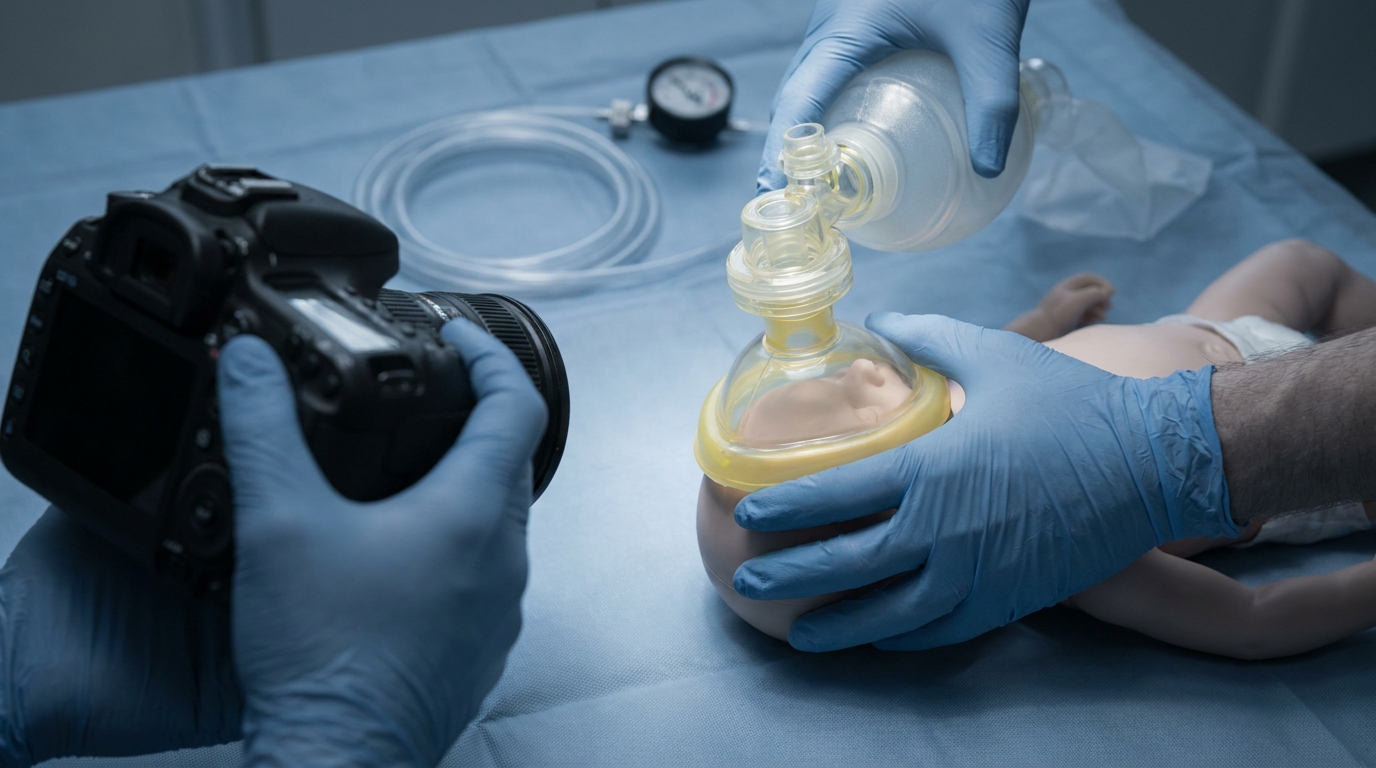
When a baby stops breathing, every second counts. Ventilation with a bag-valve-mask (BVM) – known in medical terminology as "bag-mask ventilation" – is one of the most effective measures to keep a newborn or infant alive. At the same time, it is one of the techniques where the most errors occur in practice. A bag squeezed too quickly. A mask that doesn't seal properly. A head position that blocks the tiny airway instead of opening it. All of this can result in hardly any air reaching the lungs despite ventilation attempts. This article explains step by step how to correctly use a bag-valve-mask on babies – clearly, practically, and in a way you can recall in an emergency.
Why Ventilation in Babies Is So Different
Babies are not small adults. Their airways differ fundamentally from those of older children or adults – and that's precisely what makes ventilation more challenging:
- Tiny airways: A newborn's trachea is roughly the diameter of a drinking straw. Even slight swelling or an unfavorable head position can completely obstruct the airway.
- Large tongue: Relative to the oral cavity, a baby's tongue is enormous. It can easily slide backward and block the airway.
- Soft larynx: The cartilaginous structures in the throat are still very soft. Too much external pressure – for example from incorrect gripping – can compress the airway.
- Delicate lungs: A baby's lungs are small and fragile. Too much air delivered with too much pressure can overinflate and injure them.
- Predominantly nasal breathers: Newborns breathe primarily through their nose. An obstructed nasal passage (e.g., from mucus) can significantly impair breathing.
These characteristics mean: you need the right equipment, the right grip, and the right measure. When it comes to baby ventilation, less is often more.
The Right Equipment: Bag and Mask in the Correct Size
Before you begin ventilation, the equipment must be right. A bag that's too large or an incorrectly sized mask will undermine even the best technique.
The Ventilation Bag
For newborns and infants, there are specially designed ventilation bags that are significantly smaller than those for adults:
- Infant bag: Capacity of approximately 220–320 ml. This bag is intended for newborns and infants up to about 10 kg.
- Pediatric bag: Capacity of approximately 450–500 ml. It is suitable for larger infants and toddlers.
Important: Never use an adult bag (approx. 1500 ml) on a baby. Even if you only squeeze it gently, the risk of lung overinflation is far too great. Most infant bags have a built-in pressure-relief valve (often set at 35–40 cmH₂O) that protects the lungs from excessive pressure.
The Ventilation Mask
The mask must fit the baby's face perfectly. It should:
- Cover the nose and mouth, but not cover the eyes and not extend beyond the chin.
- Be round-shaped for newborns – anatomically shaped (pear-shaped) masks are more suitable for older infants and toddlers.
- Have a soft, inflatable, or cushioned rim that conforms to the face and allows a good seal.
A simple test: Place the mask on the baby's face. It should sit like a picture frame around the nose and mouth. If the eyes are covered, it's too large. If the nose or mouth aren't completely enclosed, it's too small.
The CE Grip: How to Hold the Mask Correctly
The so-called CE grip (also called C-E grip or EC grip) is the standard technique for holding the mask sealed against the face with one hand while the other hand squeezes the bag. The name comes from the shape your fingers form:
How to Perform the CE Grip – Step by Step
Form the "C": Place your thumb and index finger like a "C" on the mask – thumb on one side, index finger on the other. This allows you to press the mask evenly and gently onto the baby's face.
Form the "E": Place the remaining three fingers (middle finger, ring finger, little finger) side by side under the baby's lower jaw – along the jawbone, not on the soft tissue beneath the chin. These three fingers form an "E" and gently lift the lower jaw upward toward the mask.
Lift the jaw, don't push: Your "E" fingers pull the jawbone toward the mask. This opens the airway by moving the tongue slightly forward. Never press on the soft tissue beneath the chin – this would push the tongue backward and block the airway.
Common Mistakes with the CE Grip
- Fingers on the soft tissue: If you press into the soft tissue beneath the chin instead of on the jawbone, you close the airway rather than opening it. This is the most common and most serious mistake.
- Too much pressure on the mask: If you press the mask too firmly onto the face, it can externally compress the soft larynx – again creating an airway problem.
- Holding with only thumb and index finger: Without the "E" (i.e., without jaw lift), the head often tilts unfavorably, and the airway is not kept open.
Memory aid: Imagine you're holding a delicate soap bubble: firm enough so it doesn't fly away, but gentle enough so it doesn't burst.
The Correct Head Position: Neutral to Slight Extension
Head positioning is crucial for whether air actually reaches the lungs:
- Newborns (up to approx. 4 weeks): The head is placed in a neutral position – straight ahead, neither flexed forward nor extended backward. In newborns, a neutral position is sufficient because the relatively large occiput already slightly flexes the head. You can place a small folded towel under the shoulders to support the neutral position.
- Older infants (approx. 1 month to 1 year): A slight extension of the head backward (the so-called "sniffing position") opens the airway optimally. Imagine the baby is smelling a flower – that's exactly the slight head tilt that's meant.
Caution: Excessive extension is counterproductive in babies. It can kink and close off the soft airway. Finding the middle ground is key.
Performing Ventilation: Rate, Volume, and Rhythm
Once the mask, grip, and head position are correct, it's time for the actual ventilation. The rule here is: gentle, even, and controlled.
Ventilation Parameters for Babies
| Parameter | Recommendation |
|---|---|
| Ventilation rate | Approximately 1 breath every 2–3 seconds (equivalent to approx. 20–30 breaths per minute) |
| Duration per breath | Approx. 1 second per breath |
| Volume | Only enough so the chest rises visibly but gently |
| During chest compressions (resuscitation) | At a ratio of 3 compressions to 1 breath for newborns; 15:2 for infants (with two rescuers) or 30:2 (with one rescuer) |
How to Ventilate Correctly
- Position the baby on a firm, flat surface (e.g., changing table, table, or floor).
- Position the head correctly (neutral or slight extension, depending on age).
- Place the mask on the face using the CE grip. Ensure a complete seal around the nose and mouth.
- Give two initial breaths. These first breaths may be delivered slightly slower and more gently – approximately 1–1.5 seconds per breath. Watch whether the chest rises.
- Squeeze the bag gently – using only your fingertips, not your entire hand. With an infant bag, two to three fingers are often sufficient to deliver enough air.
- Watch the chest: Does it rise visibly? Then air is getting through. If it doesn't rise, something is wrong with the technique (more on this shortly).
- Release the bag and wait until the chest falls again before giving the next breath. Exhalation occurs passively.
What to Do If the Chest Doesn't Rise
This is one of the most common and frustrating situations: you're ventilating, but nothing happens. The chest stays flat. Don't panic – proceed systematically:
Checklist for Unsuccessful Ventilation
Check the mask seal: Is the mask truly sealed? Is air escaping from the sides? Correct the CE grip and press the mask evenly but gently.
Correct the head position: Is the head over-extended or not extended enough? Adjust the head position. Sometimes a minimal change makes a huge difference.
Open the mouth: Open the baby's mouth slightly before reapplying the mask. Sometimes the lips are pressed together and blocking airflow.
Suction: Is there visible mucus, vomit, or amniotic fluid in the mouth or nose? If you have a suction device, use it carefully. Without suction: briefly turn the baby on their side and wipe the mouth out with a cloth.
Jaw thrust maneuver: If the airway remains blocked despite everything, push the lower jaw forward with both hands. For this, however, you need a second person to squeeze the bag.
Change the mask: Maybe the mask doesn't fit after all? Try a different size if available.
Important: If the chest doesn't rise after two corrected attempts, consider a possible airway obstruction from a foreign body. In this case, specific foreign body removal measures are needed (back blows and chest thrusts for infants).
Common Mistakes and How to Avoid Them
Bag-mask ventilation in babies is error-prone. Here are the most common pitfalls:
Too Much Air, Too Fast
Over-eagerness is understandable but dangerous. If you squeeze the bag too hard or too fast, the following happens:
- Air enters the stomach instead of the lungs (gastric distension). The inflated stomach then presses against the diaphragm and makes ventilation even more difficult. Additionally, the risk of the baby vomiting increases – and vomit in the lungs is a life-threatening complication.
- The lungs become overinflated (barotrauma). This can lead to air accumulation beside the lung (pneumothorax) – an absolute emergency.
Solution: Squeeze the bag only with your fingertips. Deliver just enough air so the chest rises visibly – no more. Think of the soap bubble.
Leaking Mask
If air escapes from the sides of the mask, only a fraction of the air reaches the lungs. You'll often hear a hissing sound.
Solution: Check the CE grip. Make sure the mask rim sits evenly all around. Sometimes it helps to slightly rotate the mask or try a different size.
Pressure on the Soft Tissue Beneath the Chin
This mistake happens intuitively: you want to lift the jaw and end up gripping into the soft tissue. This pushes the tongue backward and closes the airway.
Solution: Consciously feel the jawbone beneath your fingers. Only lift at the bone, never press into the soft tissue.
Wrong Bag Size
An adult bag used on a newborn delivers too much volume even with careful squeezing.
Solution: Always use the age-appropriate bag. In facilities where babies are cared for, an infant bag should always be readily available.
When Do You Actually Need a Ventilation Bag?
A bag-valve-mask is used when a baby:
- Is not breathing (respiratory arrest)
- Is breathing inadequately (gasping, extremely slow breathing, blue discoloration despite respiratory effort)
- Does not begin to breathe independently after birth (initial care in the delivery room)
For parents at home: a ventilation bag is not standard household equipment. In an emergency, you use mouth-to-mouth-and-nose ventilation – the principle is similar; instead of the bag, you use your own breath. The basic rules remain the same: ventilate gently, watch the chest, don't give too much air.
In medical facilities, doctor's offices, midwifery practices, ambulances, and delivery rooms, an infant ventilation bag should always be prepared and ready for use – including masks in various sizes.
Summary: The 7 Most Important Points
- Right equipment: Use an infant bag (220–320 ml) and a properly sized mask.
- Check mask size: Cover nose and mouth, keep eyes clear.
- Master the CE grip: "C" on the mask, "E" on the jawbone – never on the soft tissue.
- Mind the head position: Neutral position for newborns, slight extension for older infants.
- Ventilate gently: Squeeze only with fingertips; the chest should rise visibly but subtly.
- Maintain the correct rate: Approximately 1 breath every 2–3 seconds.
- If unsuccessful, proceed systematically: Mask seal, head position, open mouth, suction – in that order.
Practical Training
Bag-mask ventilation in babies is easy to understand in theory – but recalling the correct techniques under pressure in a stressful situation is something entirely different. The CE grip, the right feel for squeezing the bag, the correct head position – all of these are skills that must be internalized through hands-on practice with simulation manikins. In the Baby Resuscitation Course by Simulation Tirol, you train exactly these techniques under expert guidance until you master them confidently. Because in an emergency, the technique needs to come naturally, without having to think twice.
Want to practice this hands-on?
In our Baby-Reanimationskurs you practice this topic hands-on with high-tech simulators and experienced instructors.
More Articles
Respiratory Distress Syndrome in Newborns: Causes and Initial Management
Transient tachypnea, meconium aspiration, and surfactant deficiency – how healthcare professionals and parents can distinguish the most common causes of neonatal respiratory distress and which immediate measures can be lifesaving.
Airway Obstruction in Infants: Back Blows and Chest Thrusts
Detailed lay-rescuer guide for choking emergencies in babies under 1 year: positioning, blow technique, alternating measures, and when to call emergency services.
Baby Not Breathing: Infant CPR for Laypeople
A clear, easy-to-understand guide to cardiopulmonary resuscitation (CPR) for babies under one year of age. This article explains how to check breathing, perform rescue breaths, and give chest compressions with the correct hand position – specifically designed for parents and grandparents with no medical background.