Emergency Wound Management: Sutures, Tissue Adhesives, and Steri-Strips
Physicians in clinics and emergency departments manage traumatic wounds on a daily basis. This article compares closure techniques by location and contamination, describes suturing methods, and provides clear criteria for antibiotic prophylaxis.

Author: Dr. med. univ. Daniel Pehböck, DESA
Specialist in Anesthesiology and Intensive Care Medicine, AHA-certified ACLS/PALS Instructor, Course Director Simulation Tirol
Reading time approx. 8 min
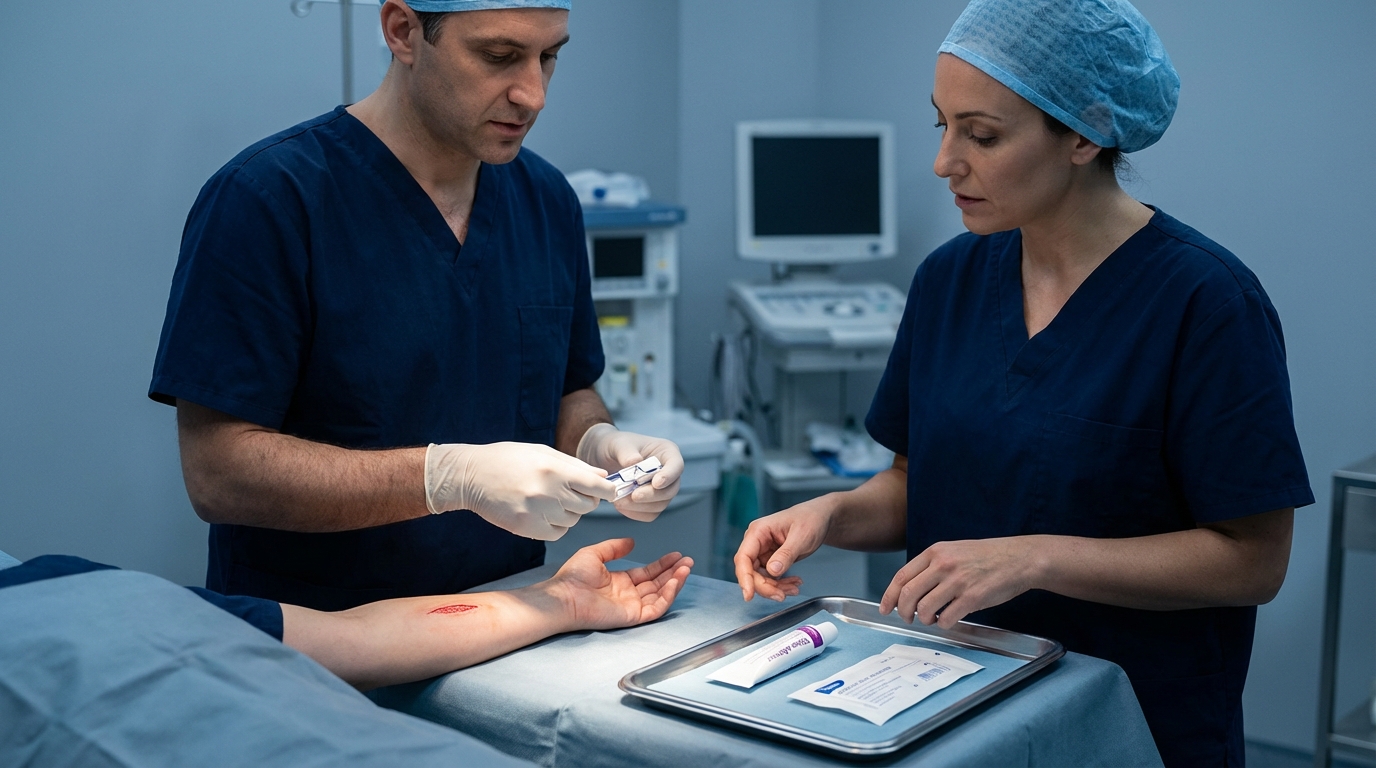
Traumatic wounds are part of the daily routine in emergency departments, outpatient clinics, and prehospital settings. From a kitchen knife laceration to a contaminated tear wound after a bicycle crash – the spectrum is enormous, and choosing the right closure technique significantly impacts the outcome. At the same time, clinical practice shows that many wounds are managed suboptimally: delayed exploration, incorrect suturing technique, unnecessary or omitted antibiotic therapy. This article gives you a systematic overview of the initial assessment of traumatic wounds, compares sutures, tissue adhesives, and Steri-Strips based on clinical criteria, and provides concrete decision-making guidance for antibiotic prophylaxis and tetanus protection.
Initial Assessment: Before You Close
Before you even think about closure techniques, a structured wound assessment is essential. A hasty suture over a foreign body, tendon injury, or open joint can have devastating consequences.
History
The following information is essential for decision-making:
- Mechanism of injury: Cut, tear, crush, bite, gunshot?
- Time of injury: How long has the wound been open? The classic "6-hour rule" for primary closure is a guideline, not an absolute limit – facial wounds can still be primarily closed after 12–24 hours, while heavily contaminated extremity wounds may already require delayed management even within 6 hours.
- Degree of contamination: Soil, animal feces, rust particles, saliva (bite wound)?
- Tetanus immunization status: Last booster? Primary immunization series complete?
- Comorbidities: Diabetes mellitus, peripheral arterial disease, immunosuppression, coagulation disorders, anticoagulation?
Clinical Examination
The examination is performed before local anesthesia, provided this is tolerable for the patient – in particular, the neurological assessment (sensation, motor function distal to the wound) must be documented before nerve blockade.
Assess systematically:
- Perfusion: Capillary refill time distally, pulses, active bleeding
- Sensation: Sharp-dull discrimination in the distribution of distal nerves
- Motor function: Active movement against resistance – tendon integrity
- Depth: Fascia, muscles, bone, joints involved?
- Foreign bodies: If in doubt, obtain imaging (X-ray for radiopaque foreign bodies, ultrasound for wood splinters or glass)
Wound Irrigation and Débridement
The most important measure for infection prevention is thorough wound irrigation. Evidence shows that irrigation with tap water of drinking quality is non-inferior to irrigation with sterile saline. What matters is the volume and moderate pressure:
- Irrigation volume: At least 100–200 ml per centimeter of wound length
- Pressure: Moderate pressure irrigation (e.g., a 20-ml syringe with an 18-G needle generates approximately 8–12 psi – an effective range that does not cause additional tissue damage)
- Débridement: Remove devitalized tissue, debris, and necrotic wound edges conservatively but thoroughly. Use particular care to preserve tissue on the face and hands.
Comparison of Closure Techniques
Surgical Sutures
Suturing remains the gold standard for the majority of traumatic wounds. It provides the best wound edge approximation, the highest tensile strength, and the most controllable tissue tension.
Indications:
- Deep wounds (subcutaneous tissue or deeper)
- Wounds under tension
- Wounds over joints or in highly mobile body regions
- Wounds where an optimal cosmetic result is important (face)
- Wounds requiring layered closure (muscle, fascia)
Basic Suturing Techniques:
- Simple interrupted suture: The standard technique. Each stitch is tied individually. Advantage: In case of infection, individual sutures can be selectively removed without compromising the entire closure. Entry point 3–5 mm from the wound edge, depth at least equal to wound depth, stitch spacing approximately 5–7 mm.
- Donati vertical mattress suture: Combines a deep approximating component with superficial skin adaptation. Ideal for wounds with a tendency toward wound edge inversion or more widely gaping wounds.
- Horizontal mattress suture: Distributes tension over a wider area. Suitable for wounds under traction, e.g., on extremities or the scalp.
- Continuous (running) suture: Faster, with even tension distribution. Disadvantage: If the suture breaks or infection occurs, the entire suture line must be removed. Suitable for linear, clean wounds with low infection risk.
- Subcutaneous (buried) suture: Using absorbable suture material (e.g., polyglactin 3-0 or 4-0), tension is relieved from the skin suture. Essential for deeper wounds to eliminate dead space and improve cosmetic scar outcome.
Suture Material – Orientation by Location:
| Location | Suture Material | Suture Removal |
|---|---|---|
| Face | Monofilament non-absorbable 5-0 or 6-0 | 5 days |
| Scalp | 3-0 or 4-0 (or staples) | 7–10 days |
| Trunk | 3-0 or 4-0 | 10–14 days |
| Extremities | 4-0 or 5-0 | 10–14 days |
| Over joints | 4-0 | 12–14 days |
| Hand/Fingers | 5-0 | 10–12 days |
| Sole of foot | 3-0 or 4-0 | 12–14 days |
Tissue Adhesives (Cyanoacrylate)
Tissue adhesives such as octyl-2-cyanoacrylate (Dermabond®) or n-butyl-2-cyanoacrylate (Histoacryl®) offer an elegant, painless alternative to sutures – but with a clearly defined indication spectrum.
Indications:
- Superficial, linear wounds with good wound edge approximation
- Short wounds (< 5 cm) without significant tension
- Wounds in well-perfused regions (face, scalp)
- Pediatric patients (avoidance of local anesthetic injection)
Contraindications:
- Wounds under tension
- Wounds over joints or highly mobile areas
- Deeper wounds requiring layered closure
- Wounds on mucous membranes or near the eyes (risk of adhesion)
- Contaminated wounds
- Hair-bearing regions (adhesive bonds to hair rather than skin)
- Bite wounds
Application:
The wound edges are precisely approximated using fingers or forceps, and the adhesive is applied in a thin layer over the closed wound – never into the wound itself. Apply three to four layers, allowing each layer to briefly dry. The adhesive forms a flexible splint that spontaneously falls off after 5–10 days.
Cosmetic outcomes for correctly selected wounds are comparable to sutures – this has been demonstrated in several randomized studies for facial wounds in both children and adults.
Steri-Strips (Adhesive Wound Closure Strips)
Steri-Strips are self-adhesive wound closure strips that enable atraumatic, painless wound approximation.
Indications:
- Superficial lacerations with minimal tension
- Supplementary support after suture removal (reinforcing the scar during the remodeling phase)
- Combined with subcutaneous sutures (skin approximation without transcutaneous sutures)
- Pediatric patients with minor injuries
- Regions with thin skin (e.g., forearm, dorsum of the hand in elderly patients)
Limitations:
- Low tensile strength – not suitable for gaping or tension-bearing wounds
- Poor adhesion on moist, hairy, or heavily perspiring skin
- May detach prematurely with poor patient compliance
- No deep wound approximation possible
Application technique: Dry and degrease the skin (benzoin tincture significantly improves adhesion). Apply strips perpendicular to the wound with approximately 3 mm spacing, alternating from both sides to achieve even approximation.
Decision Algorithm: Which Technique and When?
The choice of closure technique is not a matter of personal preference but follows clinical criteria:
- Deep wound (subcutis or deeper)? → Suture (layered closure if needed)
- Wound under tension? → Suture (consider mattress sutures or subcutaneous tension relief)
- Superficial, linear, tension-free wound < 5 cm? → Tissue adhesive or Steri-Strips
- Contaminated wound or bite wound? → Consider primary open wound management, with possible delayed primary closure after 3–5 days
- Pediatric patient, superficial wound? → Prefer tissue adhesive
- Scalp laceration? → Staples (fast, effective, good results in the hair-bearing scalp)
Special Cases: Bite Wounds and Heavily Contaminated Wounds
Bite wounds occupy a special position. Infection rates vary significantly by animal species and location:
- Cat bites: Puncture wounds with a high infection rate (30–50%). Deep inoculation of Pasteurella multocida. Do not close primarily (exception: face). Antibiotic prophylaxis is mandatory.
- Dog bites: Lower infection rate (5–15%). Tear wounds on the face can be primarily sutured after thorough irrigation. On the hand and foot: open management is preferred.
- Human bites: High infection rate due to polymicrobial flora. Always administer antibiotic prophylaxis. Knuckle wounds from punching teeth (so-called "fight bite") require surgical exploration to rule out joint penetration.
For heavily contaminated wounds (garden soil, animal feces, ground-in debris): Aggressive irrigation and débridement, open wound management, and delayed primary closure after 3–5 days, provided the wound appears clinically clean.
Antibiotic Prophylaxis: Clear Indications
Not every wound requires an antibiotic. Unjustified antibiotic therapy promotes resistance development without meaningfully reducing the infection risk of clean wounds. The indication should be targeted:
Antibiotic prophylaxis is indicated for:
- Bite wounds (cat, human; dog with risk factors)
- Contaminated wounds with delayed management (> 6–12 hours, depending on location)
- Wounds with exposed bone, tendon, or joint
- Wounds in immunosuppressed patients
- Open fractures
- Hand wounds with tendon or joint involvement
- Intraoral through-and-through injuries
Empiric First-Line Therapy:
- Bite wounds: Amoxicillin/clavulanate 875/125 mg PO twice daily for 5–7 days (alternative for penicillin allergy: moxifloxacin 400 mg once daily or clindamycin + ciprofloxacin)
- Contaminated soft tissue wounds: First-generation cephalosporin, e.g., cefazolin 2 g IV (or cefalexin 500 mg PO three times daily)
- Open fractures: Based on Gustilo classification – Grade I: cefazolin 2 g IV; Grade II/III: cefazolin + gentamicin; with fecal contamination: add metronidazole
Tetanus Prophylaxis
Tetanus prophylaxis is sometimes overlooked in the daily clinical hustle. A brief algorithm helps:
- Primary immunization complete, last booster < 5 years: No action required (even for contaminated wounds)
- Primary immunization complete, last booster 5–10 years: For clean wounds, no action; for contaminated/deep wounds → booster vaccination
- Primary immunization complete, last booster > 10 years: Booster vaccination for any wound
- Primary immunization incomplete or unknown: Simultaneous immunization (active + passive with tetanus immunoglobulin 250 IU IM)
Common Mistakes in Practice
- Inadequate exploration: A laceration on the hand is sutured without testing tendon function. Days later, a missed flexor tendon rupture becomes apparent.
- Adhesive inside the wound: Cyanoacrylate acts as a foreign body within tissue and delays healing. Always apply only to the closed wound surface.
- Primary closure despite high infection risk: A 12-hour-old, contaminated crush wound on the lower leg should not be primarily sutured.
- Sutures tied too tightly: Ischemia of wound edges from overtightened sutures leads to necrosis and wound dehiscence. Wound edges should be approximated, not strangulated.
- Forgetting tetanus prophylaxis: Especially in elderly patients, whose immunization status is often unclear.
Aftercare and Patient Education
Good wound management does not end with the last knot. The following points should be discussed with the patient and documented:
- Wound check: First follow-up after 48 hours if infection risk is elevated, otherwise after 5–7 days
- Signs of wound infection: Increasing redness, swelling, warmth, purulent discharge, fever → immediate return visit
- Suture removal: Timing according to location (see table above)
- Scar care: Sun protection for 6–12 months (UV radiation causes permanent hyperpigmentation of fresh scars)
- Immobilization: For wounds over joints or on the hand, consider splinting for 7–10 days
Practical Training
Proper wound management requires not only theoretical knowledge but above all manual dexterity and clinical decision-making competence – both are best trained under realistic conditions. In the emergency training courses by Simulation Tirol, you can practice suturing techniques, wound assessment, and clinical algorithms in simulation-based scenarios and reflect on your approach with experienced instructors.
Want to practice this hands-on?
In our Notfalltraining in deiner Arztpraxis oder Klinik you practice this topic hands-on with high-tech simulators and experienced instructors.
More Articles
Automated External Defibrillator: A Guide for First Responders
AEDs are widely available, but many laypeople hesitate to use them. This article explains how they work, correct pad placement, common mistakes, and provides practical tips for training first responders in the workplace.
First Aid for Seizures: Positioning, Protection, and Calling Emergency Services
Laypeople and first responders often look for concrete instructions on how to handle epileptic seizures. This article debunks common myths and provides a clear step-by-step guide.
Choking Emergency in Children: Foreign Body Airway Obstruction Algorithm
Foreign body aspiration is one of the most common preventable causes of death in childhood. This article describes age-dependent interventions (back blows, Heimlich maneuver), differentiation of mild vs. severe obstruction, and handover to the emergency team.