Automated External Defibrillator: A Guide for First Responders
AEDs are widely available, but many laypeople hesitate to use them. This article explains how they work, correct pad placement, common mistakes, and provides practical tips for training first responders in the workplace.

Author: Dr. med. univ. Daniel Pehböck, DESA
Specialist in Anesthesiology and Intensive Care Medicine, AHA-certified ACLS/PALS Instructor, Course Director Simulation Tirol
Reading time approx. 10 min
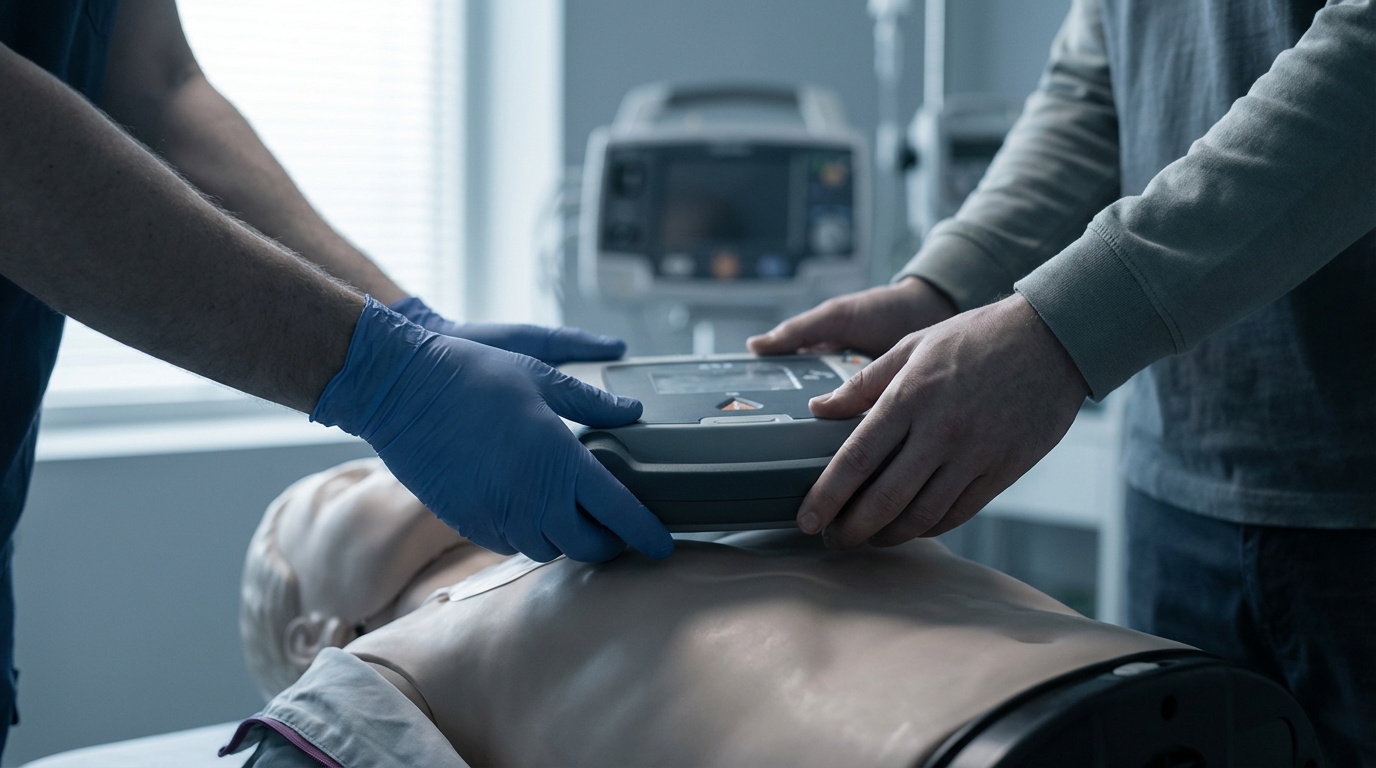
Sudden cardiac death is one of the most common causes of death in Austria. The survival rate in ventricular fibrillation drops by approximately 7–10% with every minute without defibrillation. An automated external defibrillator (AED) can break this deadly spiral – provided someone on scene reaches for the device. This is exactly where the problem lies: although AEDs are widely available in train stations, shopping centers, workplaces, and public buildings, many first responders hesitate to use them. As a healthcare professional, you are often the person who trains laypeople in first aid, serves as the point of contact in the workplace, or acts as the crucial bridge between bystander CPR and professional care in everyday situations. This article gives you the tools to explain AED use in a well-founded way, recognize typical sources of error, and provide practical guidance to first responders in the workplace.
Pathophysiology: Why the AED Saves Lives
To understand the importance of early defibrillation, it's worth taking a brief look at the electrophysiology of cardiac arrest. In a sudden cardiac arrest, approximately 60–80% of cases initially present with ventricular fibrillation (VF) or pulseless ventricular tachycardia (pVT). In both cases, the heart muscle contracts chaotically and in an uncoordinated manner – no effective cardiac output occurs.
Defibrillation delivers a defined electrical shock that simultaneously depolarizes the entire heart muscle. This interrupts the electrical chaos, giving the sinoatrial node the chance to resume organized electrical conduction. The time factor is critical:
- Within the first 3–5 minutes after the onset of ventricular fibrillation, the probability of survival with early defibrillation is 50–70%.
- After 10 minutes without defibrillation, it drops to below 5%.
- The average response time of emergency medical services in Austria is 8–15 minutes, depending on the region.
This time gap can only be closed by bystander CPR combined with AED use. Projections show that consistent use of AEDs by first responders can double or triple the survival rate in out-of-hospital cardiac arrest.
How the AED Works: What the Device Can Do – and What It Can't
Automatic Rhythm Analysis
AEDs are designed so that they can be safely operated even by people without medical training. After the electrode pads are applied, the device automatically analyzes the heart rhythm and distinguishes between:
- Shockable rhythms: Ventricular fibrillation (VF), pulseless ventricular tachycardia (pVT)
- Non-shockable rhythms: Asystole, pulseless electrical activity (PEA)
The sensitivity of modern AEDs for shockable rhythms exceeds 95%, and the specificity exceeds 98%. This means: the device will not deliver a shock when one is not indicated. This information is key when you're helping laypeople overcome their fear of making mistakes.
Fully Automatic vs. Semi-Automatic Devices
- Fully automatic AEDs deliver the shock independently after analysis, as soon as all safety conditions are met (pads correctly applied, no motion artifact). The user only needs to apply the pads.
- Semi-automatic AEDs prompt the user via voice instructions to press the shock button. This model is the most widely used in Austria.
Both types guide the first responder through the process step by step with clear voice prompts. Modern devices also provide feedback on compression depth and rate during chest compressions.
Energy Delivery
Most current AEDs use biphasic waveform technology and deliver energies between 120 and 360 joules. The exact energy level is automatically selected by the device or preset by the manufacturer. No settings need to be adjusted by the first responder.
Step-by-Step Guide: AED Use in Practice
The following guide outlines the procedure as you should teach it to first responders. It is based on current AHA guidelines and ERC recommendations for bystander resuscitation:
1. Safety and Emergency Call
- Check your own safety (no puddles of water, no power sources in the immediate vicinity).
- Check responsiveness: Speak to the person and shake their shoulders.
- Check breathing: Open the airway (head-tilt chin-lift), check for normal breathing for no more than 10 seconds. Agonal gasping counts as no breathing.
- Call 144 (or the internal emergency number in the workplace). Ideally delegate: "You call 144 now! You go get the AED!"
2. Start Chest Compressions
Begin high-quality chest compressions (CPR) immediately:
- Compression point: Center of the chest, lower half of the sternum
- Compression depth: 5–6 cm
- Rate: 100–120 per minute
- Full recoil between compressions
- Ratio: 30 compressions : 2 rescue breaths (for trained rescuers). Compression-only CPR is also acceptable and better than no CPR at all.
Important for training: Chest compressions must not be interrupted to fetch and set up the AED. If only one person is on scene, CPR takes priority – the AED is retrieved as soon as a second rescuer becomes available. If the first responder is alone and the AED is in the immediate vicinity (< 30 seconds walking distance), it can be briefly retrieved.
3. Turn On the AED and Apply the Pads
- Turn on the device (press the button or open the lid – depending on the model, the device starts automatically).
- Follow the voice prompts.
- Expose the chest: Open or cut away clothing. Many AED bags contain trauma shears.
- Dry the chest if wet or heavily sweating. Some kits include a towel.
- Excessive chest hair: If the pads won't adhere, shave the area (disposable razor in the kit) or use the first pair of pads to "rip off" the hair, then apply the second pair.
4. Correct Pad Placement
Pad placement is one of the most critical steps and a common source of error:
Standard position (anterior-lateral):
- Right electrode: Below the right clavicle, to the right of the sternum (parasternal)
- Left electrode: Left side of the chest, below the axilla, at the level of the nipple line (approximately V6 position)
The pads on most devices include illustrations showing correct placement. The current must flow through the heart between the two electrodes – therefore positioning is crucial for effectiveness.
Alternative positions (for the information of healthcare professionals):
- Anterior-posterior: One electrode on the sternum, one on the back between the shoulder blades. Particularly worth considering in obese patients or when the first shock is ineffective.
Special considerations for pad placement:
- Women: The electrode is placed under the left breast, not on it. Remove or move the bra aside.
- Implanted pacemaker/ICD: Maintain at least 8 cm distance from the device. Recognizable by a visible or palpable bulge below the clavicle, usually on the right side.
- Medication patches (e.g., nitroglycerin, fentanyl): Remove the patch, wipe the skin, then apply the pad. Otherwise, there is a risk of burns and reduced energy transmission.
5. Analysis and Shock Delivery
- "Everyone clear of the patient!": Before analysis and before the shock, no one may touch the patient or the surface they're lying on – motion artifacts distort the analysis, and current leakage endangers rescuers.
- The AED analyzes the rhythm (takes a few seconds).
- Shock advised: Safety check ("Everyone clear!"), then press the flashing shock button (semi-automatic) or wait for automatic delivery (fully automatic).
- No shock advised: Resume chest compressions immediately.
6. Continue CPR
After each shock – or when no shock is advised – resume chest compressions immediately for 2 minutes. The AED then re-analyzes. This cycle is repeated until emergency medical services arrive or return of spontaneous circulation (ROSC) occurs.
Common Mistakes and Myths
As a healthcare professional who trains first responders, you should be aware of the typical sources of error and barriers:
Mistake 1: Not Using the AED Out of Fear of Making Mistakes
By far the most common "mistake" is non-use. First responders fear harming the patient or doing something wrong. The clear message must be: The AED cannot cause harm when correctly applied. The device analyzes independently and only delivers a shock when a shockable rhythm is present. Doing nothing, on the other hand, is fatal.
Mistake 2: CPR Interruptions
Every interruption of chest compressions dramatically reduces coronary perfusion pressure. Common causes:
- AED pads are applied while nobody is performing compressions
- Long pauses during rhythm analysis
- Standing around and discussing instead of compressing
Solution: Have the pads applied during ongoing CPR (second rescuer). Resume CPR immediately after shock delivery – don't wait for a response from the patient.
Mistake 3: Pads Placed Incorrectly
- Too close together (current flows superficially, not through the heart)
- On the sternum instead of parasternal
- Over bone instead of on soft tissue
- Placed in reversed positions (with modern biphasic devices this is not a problem – the shock works in both directions. Nevertheless, aim for the standard position)
Mistake 4: Wet Environment
An AED can be used on a wet patient if the chest is dried. However, the patient should not be lying in a puddle of water, as current can be conducted through the water. If in doubt, move the patient to dry ground.
Mistake 5: Forgetting Pediatric Electrodes
For children between 1 and 8 years of age (or under 25 kg body weight), pediatric electrodes or a pediatric mode should be used to reduce energy delivery. If pediatric pads are not available, adult pads are used – defibrillation with higher energy is better than no defibrillation. For children under 1 year of age, AED use is only recommended with pediatric mode; if this is not available, manual defibrillation by the emergency medical services is preferable.
AED in the Workplace: Organizational Aspects
Many physicians and nurses are involved in workplace first aid organization as occupational health physicians or safety officers. The following points are relevant for AED implementation in the workplace:
Location Selection and Accessibility
- The AED should be at the patient's side within 3 minutes of recognizing cardiac arrest. This means: short distances, no locked doors, no hidden locations.
- Visible signage with the internationally standardized green heart-lightning symbol (as per ILCOR).
- No locking in cabinets or offices that are only accessible during business hours.
Maintenance and Inspection
- Battery life: Depending on the model, 2–5 years in standby mode. Most devices perform daily or weekly self-tests and display their status via an LED indicator.
- Electrode pads: Have an expiration date (typically 2–3 years). The gel dries out and loses conductivity.
- Checklist: Monthly visual inspection (LED status, pad expiration date, completeness of accessories). Designate a responsible person.
Training and Education
According to Austrian workplace regulations, workplace first responders must receive regular training. For AED use, the following applies:
- Initial training: All designated first responders should receive hands-on instruction on the specific AED in their workplace.
- Refresher training: At least every 2 years, ideally annually. Studies show that competency declines significantly as early as 3–6 months after training.
- Scenario-based training: Device operation alone is not sufficient. First responders must practice the entire sequence – from recognizing cardiac arrest through emergency call, starting CPR, and AED use, to handover to emergency medical services.
Legal Situation in Austria
First responders who use an AED are protected by the general provisions on the duty to render assistance (§ 95 StGB – failure to render assistance) and emergency provisions. Liability for correct, good-faith use is virtually excluded. On the contrary: failure to provide first aid can have criminal law implications. This information is important for removing first responders' fear of legal consequences.
Summary: Key Messages for First Responders
When you train first responders, reduce the information to the essentials:
- Check – Call – Compress – Shock: Check responsiveness and breathing, call 144, start chest compressions, use the AED as soon as possible.
- You can't do anything wrong – except doing nothing. The AED decides on its own whether a shock is needed.
- Push hard and fast: 5–6 cm deep, 100–120 times per minute, don't interrupt.
- Apply pads correctly: Right below the clavicle, left below the axilla. The pictures on the pads show you how.
- Everyone clear before the shock: Safety first.
Practical Training
AED use can be explained well in theory – but it is only through practical training that the confidence to act develops, which makes the difference in a real emergency. Applying the pads under stress, coordinating CPR and defibrillation as a team, giving the clear command "Everyone clear!" – all of this needs to be practiced. In the first aid courses offered by Simulation Tirol, you train these sequences in scenario-based settings with modern simulation equipment. Whether you want to refresh your own skills or train workplace first responders as a multiplier – structured, hands-on training is the best investment in the chain of survival.
Want to practice this hands-on?
In our Erste Hilfe Kurs für Firmen you practice this topic hands-on with high-tech simulators and experienced instructors.
More Articles
First Aid for Seizures: Positioning, Protection, and Calling Emergency Services
Laypeople and first responders often look for concrete instructions on how to handle epileptic seizures. This article debunks common myths and provides a clear step-by-step guide.
Choking Emergency in Children: Foreign Body Airway Obstruction Algorithm
Foreign body aspiration is one of the most common preventable causes of death in childhood. This article describes age-dependent interventions (back blows, Heimlich maneuver), differentiation of mild vs. severe obstruction, and handover to the emergency team.
Common Errors in Chest Compressions: Evidence and Practice
Compression depth, rate, recoil, and interruptions – the quality of chest compressions is a major determinant of outcome. This article analyzes the most common errors, feedback devices, and training concepts for improvement.