Common Errors in Chest Compressions: Evidence and Practice
Compression depth, rate, recoil, and interruptions – the quality of chest compressions is a major determinant of outcome. This article analyzes the most common errors, feedback devices, and training concepts for improvement.

Author: Dr. med. univ. Daniel Pehböck, DESA
Specialist in Anesthesiology and Intensive Care Medicine, AHA-certified ACLS/PALS Instructor, Course Director Simulation Tirol
Reading time approx. 8 min
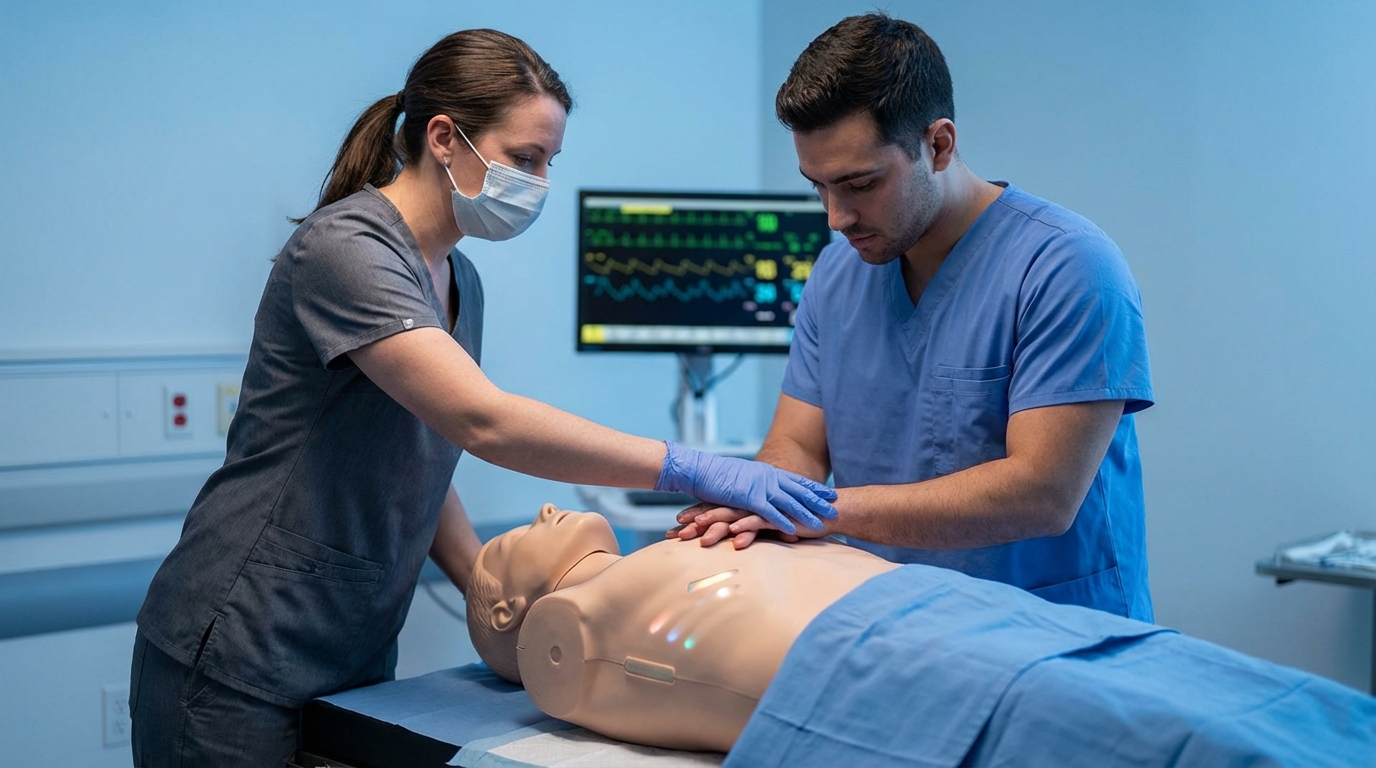
Chest compressions are the cornerstone of cardiopulmonary resuscitation – and at the same time the intervention where the most avoidable errors occur in practice. Studies consistently show that the quality of chest compressions is one of the strongest modifiable predictors of survival after cardiac arrest. Yet even professional rescuers in real resuscitation scenarios fail to meet the recommended quality parameters at an alarming rate. Too shallow, too slow, too many interruptions, incomplete recoil – each of these errors reduces coronary perfusion pressure and thus the chance of achieving return of spontaneous circulation (ROSC). This article analyzes the most common errors in chest compressions, examines the underlying evidence, and presents concrete strategies for sustainably improving compression quality in practice.
Why Compression Quality Is a Matter of Life and Death
Cardiac arrest leads to cessation of blood flow within seconds. Chest compressions are the only mechanism that maintains – albeit reduced – blood flow to the heart and brain during this phase. Under optimal conditions, chest compressions generate only 20–30% of normal cardiac output. Any deviation from the recommended quality parameters further reduces this already marginal output.
The current AHA guidelines define high-quality chest compressions based on five core parameters:
- Compression depth: at least 5 cm, maximum 6 cm in adults
- Rate: 100–120 compressions per minute
- Full recoil: complete chest wall recoil after each compression
- Minimal interruptions: Chest Compression Fraction (CCF) of at least 60%, ideally > 80%
- Avoidance of excessive ventilation: no hyperventilation
Evidence from large registry studies confirms that compression depth within the target range significantly improves ROSC rates and neurological outcome. Similarly, a linear relationship between chest compression fraction and survival has been demonstrated. Every minute without compressions reduces the probability of survival by approximately 7–10%.
The Five Most Common Errors in Detail
Error 1: Inadequate Compression Depth
By far the most common error – among both laypeople and professional rescuers – is insufficient compression depth. Observational studies from in-hospital and prehospital settings show that in up to 50% of resuscitations, the recommended minimum depth of 5 cm is not achieved. The causes are multifactorial:
- Fatigue: After just 1–2 minutes of continuous compressions, compression depth measurably decreases, often without the rescuer subjectively noticing. Studies with real-time feedback demonstrate that rescuers systematically overestimate their own compression depth.
- Fear of causing injuries: Particularly with elderly patients or those who appear frail, there is an often unconscious tendency to apply less force. While rib fractures occur in up to 30% of effective resuscitations, they are clinically irrelevant compared to the benefit of adequate compressions.
- Incorrect body position: Anyone who is not positioned directly above the compression point or does not keep their arms fully extended cannot generate sufficient force.
Clinical consequence: A compression depth of only 4 cm instead of 5 cm considerably reduces the generated coronary perfusion pressure. The difference between "almost adequate" and "adequate" can mean the difference between ROSC and unsuccessful resuscitation.
Error 2: Incorrect Compression Rate
The guidelines specify a narrow corridor of 100–120 compressions per minute. In practice, this range is frequently missed in both directions:
- Too slow (< 100/min): Directly proportionally reduces the generated cardiac output. Common in fatigued or uncertain rescuers.
- Too fast (> 120/min): Paradoxically, this is equally problematic. At excessive rates, the decompression phase shortens, compromising diastolic filling of the heart. Additionally, compression depth decreases significantly at higher rates – an inverse relationship that many are not aware of.
Registry data show that the highest survival rates are achieved at a rate of approximately 107–112/min. Above 120/min, mean compression depth falls below the target value, more than negating the theoretical advantage of the higher rate.
Practical tip: Musical pacing aids such as the Bee Gees song "Stayin' Alive" (approx. 104 bpm) are frequently recommended as a memory aid. Even more reliable are acoustic metronome functions, as integrated into modern defibrillators and CPR feedback devices.
Error 3: Incomplete Chest Recoil (Leaning)
This error is particularly insidious because it is barely visible from the outside and is almost never noticed by the rescuer themselves. "Leaning" describes the phenomenon where residual pressure remains on the chest between compressions because the hands are not fully released.
The pathophysiological consequences are significant:
- Increased intrathoracic pressure: Impedes venous return to the heart and thereby reduces cardiac preload.
- Reduced coronary perfusion pressure: Coronary blood flow occurs primarily during the decompression phase. If residual pressure remains, the pressure gradient decreases and thus myocardial perfusion is reduced.
- Impaired cerebral perfusion: The increased intrathoracic pressure raises intracranial pressure, additionally compromising cerebral perfusion.
Studies using force-measurement sensors show that leaning occurs in up to 50% of all resuscitations. Even a residual force of 2.5 kg (approx. 25 N) on the chest leads to a measurable reduction in hemodynamic parameters.
Common causes:
- Fatigue and the resulting tendency to "lean" on the patient for support
- Knee position too close to the patient, preventing full arm release after compression
- Lack of awareness of this error during training
Error 4: Excessively Long and Frequent Interruptions
Every interruption of chest compressions – whether for rhythm analysis, ventilation, intubation, intravenous access, or defibrillation – causes the painstakingly built-up coronary perfusion pressure to drop to zero within seconds. Rebuilding adequate pressure after an interruption requires several compression cycles.
The most common causes of avoidable interruptions:
- Peri-shock pauses: The time between the last compression and shock delivery, as well as between shock delivery and the first compression afterward. The guidelines recommend a peri-shock pause of under 10 seconds. In practice, 20–30 seconds are frequently measured.
- Excessively long rhythm checks: Rhythm analyses should take a maximum of 10 seconds.
- Airway management: Endotracheal intubation is a classic "compression killer." Without consistent coaching, teams often interrupt compressions for 30 seconds or longer.
- Poorly coordinated rescuer switches: The changeover of the compressing rescuer should ideally take less than 5 seconds.
Target value: The Chest Compression Fraction – the percentage of time with active compressions relative to total resuscitation time – should exceed 80%. Many teams achieve only 40–60% in practice.
Error 5: Incorrect Hand Position and Body Mechanics
The compression point is on the lower half of the sternum. Deviations in the cranial, caudal, or lateral direction significantly alter force transmission to the heart and can drastically reduce compression effectiveness.
Typical errors in body mechanics:
- Bent arms: Prevent efficient force transmission from the hips and lead to faster fatigue of the arm muscles.
- Too far or too close: If the rescuer is too far from the patient, a tangential force direction results. If too close, the force becomes more of a "pushing" motion rather than vertical.
- Compressing from the arms instead of the hips: Force should primarily be generated through controlled rocking of the upper body from the hip joint, not through arm muscle strength.
Feedback Devices: Technology for Quality Improvement
Real-time feedback during resuscitation has proven to be one of the most effective ways to improve compression quality. Various systems are available:
Audiovisual Feedback Devices
These devices are placed between the heel of the hand and the chest and measure compression depth, rate, recoil, and compression fraction in real time. Rescuers receive immediate feedback through visual displays (LEDs, screens) and acoustic signals.
The evidence shows:
- Significant improvement in all measurable quality parameters when using feedback devices
- Reduction of "no-flow time" (periods without compressions)
- Improvement in compression depth by an average of 5–8 mm compared to resuscitation without feedback
- Improved recoil through visual display of residual pressure
Defibrillator-Integrated Feedback
Modern defibrillators – both AEDs and manual devices – increasingly feature integrated CPR feedback functions. Compression parameters are captured via special electrodes or separate sensors and displayed on the screen. This has the advantage of not requiring any additional hardware.
Limitations
Feedback devices may overestimate compression depth on soft surfaces (hospital beds, soft mattresses), as they do not account for the depression of the underlying surface. A CPR backboard under the patient is essential in these cases. Newer systems with accelerometer sensors and compensation algorithms are increasingly addressing this problem.
Training Concepts for Sustained Improvement
Research clearly shows: one-time training is not enough. Compression quality deteriorates significantly within just a few months after a course. The following concepts have proven effective:
Deliberate Practice with Real-Time Feedback
The concept of "deliberate practice" – targeted, repeated practice with immediate feedback and specific improvement guidance – is clearly superior to the traditional "demonstration-then-practice" approach. Studies demonstrate that even short but regular training sessions of 5–10 minutes with feedback manikins maintain skills more sustainably than multi-hour courses without feedback.
High-Frequency, Low-Dose Training
Rather than attending a refresher course once a year, current evidence recommends short training sessions at high frequency – ideally every 3–6 months. This "booster" concept prevents the typical skill decay and keeps compression quality consistently within the target range.
Team-Based Training
Compression quality is not just an individual skill but also a team effort. Coordinated rescuer switches every 2 minutes, clear communication, and integration of compressions into the overall algorithm must be practiced as a team. Simulation-based training with subsequent structured debriefing is the gold standard here.
Summary of Key Points
| Parameter | Target Value | Most Common Error |
|---|---|---|
| Compression depth | 5–6 cm | Too shallow (< 5 cm) |
| Rate | 100–120/min | Too fast or too slow |
| Recoil | Complete (0 kg residual force) | Leaning (residual force > 2.5 kg) |
| CCF | > 80% | Excessively long/frequent interruptions |
| Hand position | Lower half of sternum | Too cranial or lateral |
Key Messages for Practice
- Push hard: At least 5 cm depth – better a rib fracture than a non-survived cardiac arrest.
- Push fast: 100–120/min, ideally with metronome support.
- Allow full recoil: Consciously release pressure after each compression. Hands may lightly touch the chest but must not exert pressure.
- Minimize interruptions: Every second without compressions counts. Keep peri-shock pauses under 10 seconds. Intubation attempts must not interrupt compressions.
- Rotate compressors: Switch every 2 minutes – even if you don't feel tired yet. Quality declines before subjective exhaustion sets in.
- Use feedback: Whenever available, use real-time feedback devices. Even experienced professionals benefit from them.
Hands-On Training
Chest compressions sound simple – but the evidence shows that even experienced professionals regularly deviate from target values. The critical difference comes from repeated, feedback-guided practice under realistic conditions. In the first aid courses offered by Simulation Tirol, you train chest compressions hands-on using modern training manikins with real-time feedback and learn to recognize and avoid common errors. More information and course dates can be found at simulation.tirol/erste-hilfe.
Want to practice this hands-on?
In our Erste Hilfe Kurs für Firmen you practice this topic hands-on with high-tech simulators and experienced instructors.
More Articles
Automated External Defibrillator: A Guide for First Responders
AEDs are widely available, but many laypeople hesitate to use them. This article explains how they work, correct pad placement, common mistakes, and provides practical tips for training first responders in the workplace.
First Aid for Seizures: Positioning, Protection, and Calling Emergency Services
Laypeople and first responders often look for concrete instructions on how to handle epileptic seizures. This article debunks common myths and provides a clear step-by-step guide.
Choking Emergency in Children: Foreign Body Airway Obstruction Algorithm
Foreign body aspiration is one of the most common preventable causes of death in childhood. This article describes age-dependent interventions (back blows, Heimlich maneuver), differentiation of mild vs. severe obstruction, and handover to the emergency team.