Triage Systems in Emergencies: START, mSTaRT, and JumpSTART
Structured triage in mass casualty incidents: This article compares common triage algorithms for adults and children, explains color categories, and their application under time pressure.

Author: Dr. med. univ. Daniel Pehböck, DESA
Specialist in Anesthesiology and Intensive Care Medicine, AHA-certified ACLS/PALS Instructor, Course Director Simulation Tirol
Reading time approx. 10 min
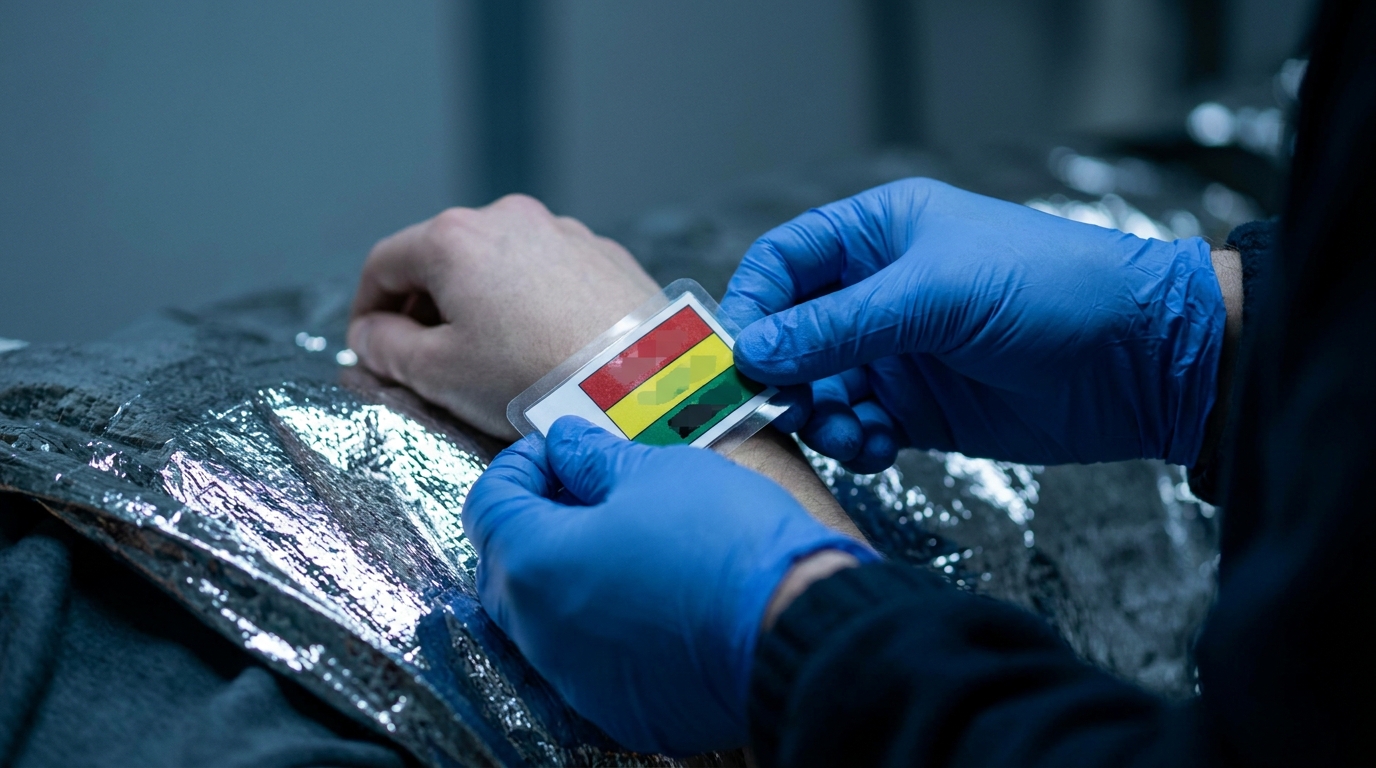
When a mass casualty incident (MCI) occurs, the first arriving rescue team faces one of the most difficult decisions in emergency medicine: Who gets treated first? Resources are not sufficient for everyone – at least not simultaneously. Triage systems transform this ethical dilemma into a structured, reproducible algorithm. They do not replace clinical judgment, but they create a common language and a transparent decision-making framework in a situation where every second counts. This article compares the three most common triage algorithms – START, mSTaRT, and JumpSTART –, explains their color categories, describes practical application under time pressure, and addresses typical pitfalls.
Fundamental Principles of Triage in Mass Casualty Events
In routine operations, the principle of "sickest patient first" applies. In an MCI, this logic is partially reversed: the goal is to ensure the survival of as many casualties as possible with the available resources. Triage therefore means not only prioritization but also the deliberate decision to withhold immediate interventions from patients whose chance of survival is minimal even with maximum effort.
The Four Triage Categories
Nearly all common triage systems use a four-tier color scheme that is largely standardized internationally in prehospital practice:
| Category | Color | Meaning | Consequence |
|---|---|---|---|
| T1 / SK 1 | 🔴 Red | Acute life-threatening condition, immediate treatment likely to result in survival | Immediate treatment, priority transport |
| T2 / SK 2 | 🟡 Yellow | Severe injury, delayed treatment tolerable | Timely treatment, transport after T1 |
| T3 / SK 3 | 🟢 Green | Minor injury, ambulatory | Self-care, later transport |
| T4 / SK 4 | ⚫ Black | No signs of life / futile prognosis despite therapy | No treatment in MCI context |
In German-speaking practice, a fifth category (Blue) is sometimes discussed for "expectant treatment with futile prognosis but still present signs of life." Its use varies by region and is not reflected in all algorithms.
Timeframe for Triage
A central quality criterion for any triage is speed. As a guideline: initial triage of an individual patient should take no longer than 30 to 60 seconds. The triaging provider performs only life-saving immediate measures – specifically, opening the airway and hemorrhage control for spurting bleeds. Everything else is delegated.
START – Simple Triage and Rapid Treatment
START is the most widely used triage algorithm internationally for adult patients. It was originally developed for fire departments and first responders in the USA and stands out for its simplicity: three physiological parameters are assessed in a fixed sequence without requiring any equipment.
The START Algorithm Step by Step
Step 1 – Assess ability to walk
At the beginning of triage, all casualties are asked to walk to a designated collection point. Anyone who can walk independently is categorized as T3 (green). These "walking wounded" are removed from the immediate triage area. This significantly reduces the number of patients who need to be individually assessed.
Step 2 – Assess breathing
For the remaining, non-ambulatory patients, breathing is assessed:
- No breathing present: Open the airway (head tilt, clear the mouth). If the patient then begins to breathe → T1 (red). If breathing does not resume → T4 (black).
- Respiratory rate > 30/min: → T1 (red).
- Respiratory rate ≤ 30/min: → proceed to Step 3.
Step 3 – Assess perfusion
Perfusion is assessed using the radial pulse or alternatively the capillary refill time (nail bed test):
- No radial pulse palpable or capillary refill time > 2 seconds: → T1 (red). Any spurting hemorrhage is compressed by a bystander or the patient themselves.
- Radial pulse palpable or capillary refill time ≤ 2 seconds: → proceed to Step 4.
Step 4 – Assess neurological status
Mental status is assessed with a simple command (e.g., "Squeeze my hand!"):
- Patient cannot follow simple commands: → T1 (red).
- Patient follows commands: → T2 (yellow).
Strengths and Weaknesses of START
START is robust, easy to learn, and requires no technical equipment. Its greatest strength is reproducibility: even under extreme stress, different providers produce similar results. Its weaknesses lie in its deliberate simplification: injury patterns, pain reports, and medical history are not factored in. Particularly with penetrating injuries and still-compensated shock, START can underestimate severity. Additionally, the algorithm is explicitly not validated for children under approximately eight years of age – this is where JumpSTART comes in.
mSTaRT – Modified START
The mSTaRT algorithm is a German-language further development of the START system. It was adapted for use in the German-speaking emergency medical services and takes into account the specific features of the local triage system, particularly the role of the medical incident commander (Leitender Notarzt / LNA) and integration into existing MCI concepts.
Key Differences from START
The basic structure of mSTaRT follows the START principle but expands it in several areas:
- Two-phase model: mSTaRT explicitly distinguishes between a preliminary triage (by paramedics) and a physician triage (by the emergency physician/medical incident commander). The preliminary triage follows the algorithmic scheme; the physician triage allows recategorization based on clinical experience.
- Extended assessment criteria in physician triage: The triaging physician may – and should – incorporate injury patterns, mechanism of injury, and overall clinical assessment into the categorization beyond the pure algorithm.
- Documentation: mSTaRT is more closely linked to standardized patient triage tags, as commonly used in Austria and Germany.
- Consideration of CBRN incidents: Some mSTaRT versions include guidance for triage in chemical, biological, radiological, or nuclear threat scenarios.
The mSTaRT Algorithm in Preliminary Triage
The preliminary triage algorithm essentially corresponds to the START scheme:
- Ambulatory? → Yes: T3 (green)
- Spontaneous breathing present? → No: Open airway → Breathing? → No: T4 (black) / Yes: T1 (red)
- Respiratory rate ≤ 30/min? → No (RR > 30): T1 (red)
- Radial pulse palpable? → No: T1 (red), hemorrhage control if needed
- Follows simple commands? → No: T1 (red) / Yes: T2 (yellow)
The critical addition is the subsequent physician triage, in which the emergency physician re-evaluates every T1 and T2 patient and either confirms or corrects the category.
Clinical Added Value of the Two-Phase Model
The two-phase model of mSTaRT addresses a well-known problem with purely algorithmic triage: overtriage. Studies show that algorithmic triage systems tend to categorize too many patients as T1. While this is safer for the individual patient, it ties up scarce resources. The physician's secondary triage can mitigate this effect by downgrading patients with stable compensation to category T2 – a decision that requires clinical experience and cannot be captured by the algorithm alone.
JumpSTART – Triage for Pediatric Patients
Children are not small adults – this principle also applies in triage. JumpSTART was developed specifically for children aged approximately one to eight years and addresses the physiological characteristics of pediatric patients.
Why a Separate Algorithm for Children?
Several factors necessitate adaptation:
- Children under eight years cannot be reliably assessed as "ambulatory." Young children may not walk on command due to fear, pain, or developmental stage, even if only mildly injured. Infants naturally cannot walk at all.
- Respiratory rate is age-dependent. A rate of 35/min is physiological in a two-year-old but an alarm sign in an adult.
- Children respond differently to hypovolemia. They compensate for volume loss through tachycardia for longer, then decompensate abruptly.
- The criterion "follows simple commands" is not applicable to infants and toddlers. Instead, an appropriate motor response is assessed (AVPU scale: at least Pain response).
The JumpSTART Algorithm Step by Step
Step 1 – Ability to walk / developmental stage
- Children who can walk and do so on command → T3 (green).
- Children who cannot walk due to developmental stage (infants, toddlers), or who will not/cannot walk → individual triage assessment.
Step 2 – Spontaneous breathing?
- Spontaneous breathing present: → proceed to Step 3.
- No spontaneous breathing:
- Peripheral pulse palpable? → No: T4 (black) (no resuscitation in MCI).
- Peripheral pulse palpable? → Yes: Give 5 rescue breaths (mouth-to-mouth or bag-valve-mask).
- If the child then begins to breathe → T1 (red).
- If breathing does not resume → T4 (black).
This step is the key difference from START: In children with a pulse but absent breathing, five rescue breaths are delivered before the decision of "black" is made. The rationale: children more frequently experience a primary respiratory arrest. Five rescue breaths can restore a spontaneous respiratory drive in these cases.
Step 3 – Respiratory rate
- Respiratory rate < 15/min or > 45/min: → T1 (red).
- Respiratory rate 15–45/min: → proceed to Step 4.
Note: The threshold values differ from START (where < 10 and > 30).
Step 4 – Perfusion
- No peripheral pulse palpable: → T1 (red).
- Peripheral pulse palpable: → proceed to Step 5.
Step 5 – Neurological status (AVPU)
- A (Alert) or V (Voice) – the child is awake or responds to voice: → T2 (yellow).
- P (Pain) – the child responds only to pain: → T1 (red).
- U (Unresponsive) – no response: → T1 (red).
Special Challenges in Pediatric Triage
Triaging children in an MCI is emotionally extremely burdensome. In addition, there are practical difficulties:
- Parent-child separation: Injured children scream, cry, and cling to caregivers. Triage must still proceed quickly. If possible, mildly injured caregivers (T3) should stay with the child at the collection point.
- Age estimation: In the chaos of an MCI, exact age is often unknown. As a rule of thumb: children who appear smaller than approximately 130 cm are triaged using JumpSTART.
- Medication dosing: Triage itself requires no medications. However, weight-based dosing is essential for subsequent treatment – have a Broselow tape or pediatric dosing chart ready.
Comparison of the Three Systems at a Glance
| Feature | START | mSTaRT | JumpSTART |
|---|---|---|---|
| Target population | Adults (> 8 years) | Adults (> 8 years) | Children (1–8 years) |
| Triage phases | One phase | Two phases (preliminary + physician triage) | One phase |
| RR threshold | > 30/min | > 30/min | < 15 or > 45/min |
| Ventilation attempt | No | No | Yes (5 rescue breaths if pulse present but apneic) |
| Neurology | Simple command | Simple command | AVPU scale |
| Special equipment | None | Triage tags recommended | Bag-valve-mask recommended |
| Time per patient | 30–60 seconds | 30–60 sec (preliminary triage) + physician triage | 30–60 seconds |
Typical Pitfalls in Triage Practice
Overtriage
Too many patients are categorized as T1. The consequence: the truly critically ill receive delayed treatment because resources are tied up with patients who would have survived as T2 with timely care. Common causes include lack of confidence in the algorithm, emotional overwhelm, and the – understandable – fear of missing a critical patient.
Undertriage
Less common but more dangerous: patients are categorized as T2 or T3 even though they require immediate intervention. A typical scenario: a compensated hemorrhagic shock with a still palpable radial pulse that decompensates minutes later. This is where the physician's secondary triage in the mSTaRT system can help identify such patients.
Time lost to therapeutic interventions
The triaging provider gets "stuck" with a patient and begins advanced interventions – IV access, procedural sedation, splinting. Every minute spent on a single patient is a minute lost for triaging the rest. The discipline to move on after algorithmic categorization and leave treatment to others must be actively trained.
Failure to re-triage
Initial triage is a snapshot. Patients can deteriorate (T2 → T1) or improve (T1 → T2). Regular re-triage – ideally at 15- to 30-minute intervals – is essential but is frequently forgotten under stress.
Integration into the MCI Workflow
Triage does not occur in isolation. It is embedded in an overall concept that typically includes the following elements:
- Reconnaissance and situation report by the first arriving team
- Preliminary triage (START/mSTaRT/JumpSTART) by EMS personnel
- Establishment of casualty collection points by triage categories (spatial separation)
- Physician triage and treatment – prioritized by categories
- Transport coordination by the EMS incident commander
- Re-triage at regular intervals
The triage systems provide the foundation for steps 2 and 3 of this workflow. Their effectiveness, however, depends on the subsequent steps – casualty collection, treatment, transport – also being conducted in a structured manner.
Ethical Dimension
Triage in an MCI means deliberately not treating patients who would receive maximum care under normal conditions. Category T4 (black) is not a medical decision about the individual patient but a resource allocation decision for the collective. This decision is burdensome and can lead to moral distress – particularly when children are involved. An open debriefing after every MCI deployment is not optional but an integral part of post-incident care.
Practical Training
Knowledge of a triage algorithm on paper is necessary but not sufficient. Under the stress, noise, and emotional burden of a real mass casualty event, routine makes the difference. Triage decisions must be simulated often enough that they run automatically even under maximum stress. In the Emergency Physician Refresher Course by Simulation Tirol, you train these scenarios in a realistic simulation environment – including structured preliminary triage, pediatric triage, and team communication under MCI conditions. This is the kind of training that makes the difference when it matters.
More Articles
Acute Dyspnea: Differential Diagnosis and Immediate Management
Dyspnea has numerous causes ranging from asthma to heart failure to pulmonary embolism. This article presents a systematic approach to differentiation based on history, clinical examination, auscultation, and point-of-care diagnostics.
Acute Hypoglycemia: Emergency Management in Adults and Children
Threshold values, symptom recognition, oral glucose vs. IV dextrose vs. glucagon – with separate dosing for adult and pediatric patients. A common emergency presentation systematically reviewed.
Acute Adrenal Insufficiency: Addisonian Crisis in the Emergency Setting
Adrenal crisis is frequently misdiagnosed and can be fatal. This article describes at-risk patients, clinical signs, immediate hydrocortisone administration, and the management of accompanying hypoglycemia and hyperkalemia.