How to Apply a Tourniquet Correctly: Indications and Technique
The tourniquet has evolved from a last-resort instrument to a first-line measure for life-threatening extremity hemorrhage. This article covers indications, correct application technique, time documentation, and common errors.

Author: Dr. med. univ. Daniel Pehböck, DESA
Specialist in Anesthesiology and Intensive Care Medicine, AHA-certified ACLS/PALS Instructor, Course Director Simulation Tirol
Reading time approx. 8 min
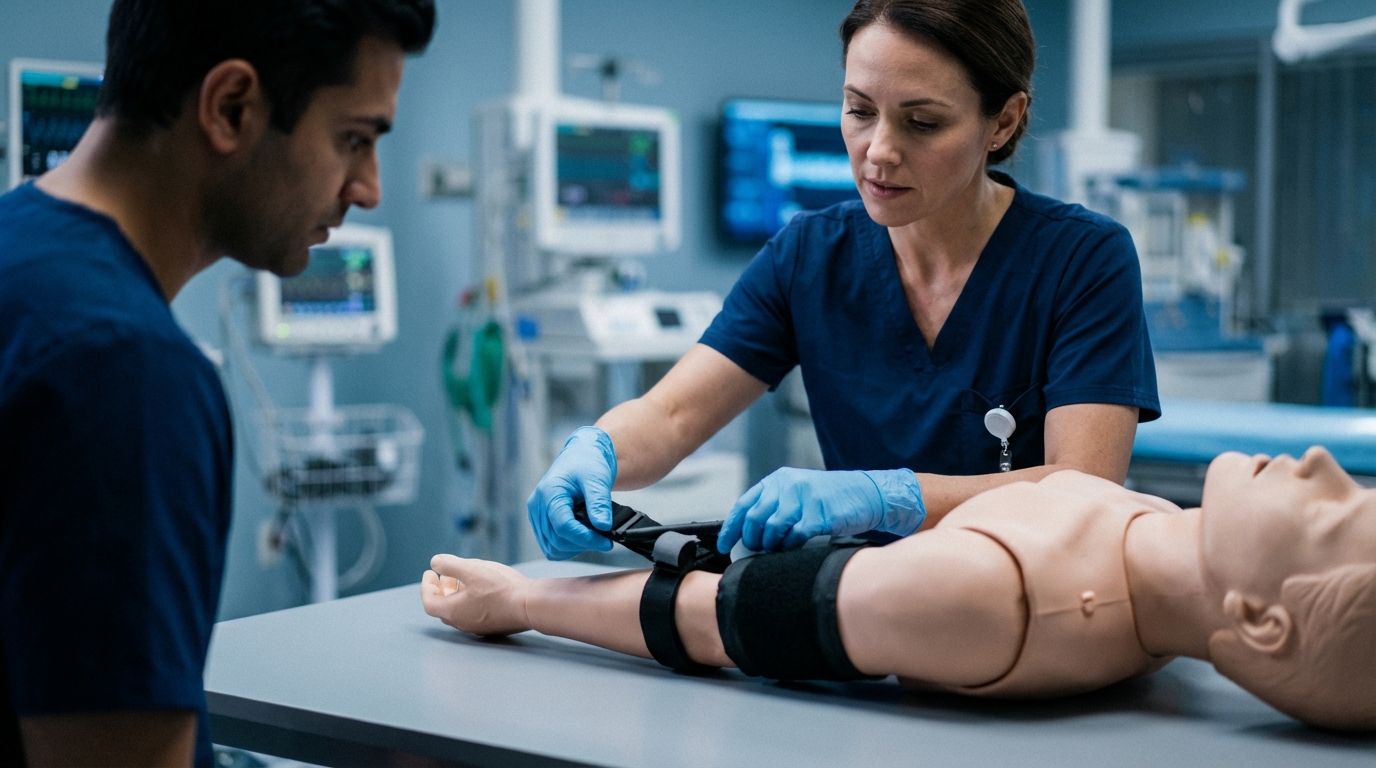
Life-threatening extremity hemorrhage is one of those emergency situations where minutes decide between life and death. What was long considered a surgical last resort has fundamentally changed through experience gained in military trauma care and the civilian evidence derived from it: the tourniquet is now a recognized first-line measure for uncontrollable, life-threatening bleeding from extremities. Nevertheless, tourniquets are applied incorrectly with surprising frequency in both clinical and prehospital settings – too loose, too distal, without time documentation. This article gives you a systematic overview of indications, correct application technique, common errors, and post-application management.
Paradigm Shift: From Stopgap to First-Line Measure
For decades, the tourniquet was viewed with skepticism in civilian emergency medical services. Concerns about ischemic damage, compartment syndrome, and amputation risk led to it being considered a "method of last resort" – to be used only when all other measures had failed. In reality, this attitude cost lives.
Systematic analysis of data from military conflicts has revised this doctrine. The results are clear:
- Early tourniquet application significantly reduces mortality in life-threatening extremity hemorrhage.
- The complication rate with application times under two hours is low.
- Most documented complications are attributable to incorrect application technique, not the principle itself.
Current guidelines – including the TCCC Guidelines (Tactical Combat Casualty Care), AHA recommendations, and European trauma guidelines – uniformly classify the tourniquet as a first-line measure for massive extremity hemorrhage. This applies not only to the military context but explicitly to the civilian setting as well: accident scenes, workplace injuries, penetrating injuries, amputation injuries.
Indications: When Is a Tourniquet Indicated?
The decision to apply a tourniquet follows a clear clinical logic. Not every bleed requires a tourniquet – but when the indication is right, application must not be delayed.
Clear Indications
- Massive, life-threatening extremity hemorrhage that cannot be controlled by direct pressure
- Traumatic amputation (complete or subtotal)
- Multiple casualties (mass casualty incident): Tourniquet as a rapid hemorrhage control measure, allowing you to attend to other patients
- Tactical situations: Bleeding under hazardous exposure (e.g., entrapped person, unsafe scene) where manual compression cannot be maintained
- Failure of other measures: Direct pressure and pressure dressings do not adequately control the bleeding
No Indication
- Bleeding that is controllable by direct pressure
- Bleeding from the trunk (neck, thorax, abdomen, pelvis) – other methods are required here (wound packing, pelvic binder, surgical management)
- Isolated venous oozing without hemodynamic significance
The Clinical Decision Point
In practice, the question arises: How do you recognize a "life-threatening" bleed? Use the following criteria as guidance:
- Pulsatile, spurting bleeding (arterial)
- Rapid soaking through of dressings
- Pool of blood on the ground that is rapidly expanding
- Signs of hemorrhagic shock: tachycardia, pallor, diaphoresis, altered level of consciousness
- Amputation injury with visibly active blood loss
When in doubt: It is better to apply one tourniquet too many than one too few. A correctly applied tourniquet can be removed at any time – lost blood cannot.
Choosing the Appropriate Tourniquet
Not every tourniquet is equally effective. Only commercial, tested systems with a windlass mechanism are recommended. The best-studied models recommended in the guidelines are:
- CAT (Combat Application Tourniquet): The most widely used and best-studied tourniquet worldwide. One-handed application is possible.
- SOFTT-W (Special Operations Forces Tactical Tourniquet – Wide): Wider band, robust metal windlass mechanism.
- SAM XT (SAM Extremity Tourniquet): Auto-stop buckle mechanism that prevents over-tightening of the windlass.
- TMT (Tactical Mechanical Tourniquet): Ratchet mechanism instead of a windlass.
Important: Improvised tourniquets (belts, triangular bandages, cords) are better than nothing in an emergency but are significantly less effective and carry a higher risk of complications. Narrow materials (e.g., cable ties, wire) cause focal pressure injuries and are contraindicated. The minimum width of a tourniquet should be approximately 4 cm.
Application Technique Step by Step
Correct technique determines whether the tourniquet fulfills its purpose. A tourniquet applied too loosely is more dangerous than none at all – it compresses only the venous vessels, worsens the bleeding, and creates venous congestion.
Step 1: Positioning
- Apply the tourniquet proximal to the bleeding source – that is, between the wound and the trunk.
- Recommended position: "High and tight" – as high and as close to the trunk as possible on the affected extremity. On the thigh, this means: as close to the inguinal region as possible. On the upper arm: as close to the axilla as possible.
- Do not apply over joints (knee, elbow) – effective compression is not possible there.
- Do not apply over foreign bodies or obvious fracture fragments.
- Apply directly on the skin or over a thin layer of clothing. Remove or open thick clothing (winter jackets, multiple layers) beforehand – it prevents effective compression.
Step 2: Apply and Tighten the Band
- Wrap the band around the extremity and pull it as tight as possible through the buckle before using the windlass.
- With the CAT: Pull the Velcro strap through the buckle and secure it tightly. The most common error occurs here – insufficient band tension before windlass application.
Step 3: Turn the Windlass
- Turn the windlass in one direction until the bleeding has completely stopped.
- Reference points: Distal bleeding has ceased, the distal pulse is no longer palpable.
- Typically three to four full turns are needed – often more on the thigh due to the greater soft tissue mass.
- The windlass must be tightened enough to completely occlude arterial blood flow. Venous congestion only (bleeding continues, extremity becomes livid) is the most common sign of insufficient compression.
Step 4: Secure the Windlass
- Lock the windlass in its retaining clip (clip, loop – depending on the model).
- With the CAT: Place the windlass in the windlass clip and additionally secure it with the securing strap.
- Recheck: No distal bleeding? No distal pulse? If the bleeding has not completely stopped, continue tightening.
Step 5: Time Documentation
- Record the time of application visibly on the tourniquet itself (most commercial models have a writable field), on the patient's forehead, or on an adhesive tape strip.
- Time documentation is essential for ongoing clinical care: It determines the urgency of surgical management and the decision regarding possible removal.
Step 6: Reevaluation
- Check effectiveness after application and after every transport or repositioning.
- If bleeding persists despite a correctly applied tourniquet, apply a second tourniquet directly proximal to the first. Never remove an ineffective tourniquet; instead, supplement it.
Common Errors
Knowing the most frequent mistakes is just as important as knowing the correct technique:
| Error | Consequence | Prevention |
|---|---|---|
| Application too loose | Venous congestion, increased bleeding | Pull the band maximally tight before using the windlass |
| Application too distal | Ineffective compression (two bones in the forearm/lower leg) | "High and tight" – apply on the upper arm/thigh |
| Application over thick clothing | Insufficient compression | Remove or at least open clothing |
| Application over a joint | No effective vascular compression | Always apply proximal to the joint |
| No time documentation | Unclear ischemia time, complicated clinical management | Record time immediately after application |
| Windlass not secured | Spontaneous loosening, recurrent bleeding | Always lock the windlass in its retaining clip and close the securing strap |
| Premature removal in the field | Rebleeding with renewed volume loss | Remove the tourniquet only under controlled conditions (OR, trauma bay) |
| Hesitant indication | Preventable blood loss | When in doubt, apply – removal is always possible |
Ischemia Tolerance and Time Management
The question of how long a tourniquet can safely remain in place is highly clinically relevant:
- Up to two hours is considered safe with a low complication rate. Significant ischemic damage is rare within this time window.
- Two to six hours: Increasing risk of nerve injury, muscle necrosis, and reperfusion injury. Surgical management should be pursued urgently.
- Beyond six hours: High risk of irreversible damage including compartment syndrome, rhabdomyolysis, hyperkalemia upon reperfusion, and need for amputation.
Clinical principle: A tourniquet applied in a life-saving context is not removed in the field. The decision to remove or convert (e.g., to a pressure dressing or surgical hemostasis) is made by an experienced clinician under controlled conditions – ideally in the trauma bay or operating room.
Conversion in the Clinical Setting
Tourniquet conversion may be considered under the following conditions:
- Application time is less than two hours.
- The patient is hemodynamically stable.
- The bleeding source has been identified and can be controlled by alternative means (e.g., pressure dressing, wound suture, vascular clamp).
- Conversion is performed under continuous monitoring.
When loosening: release slowly, observe distal perfusion, monitor for bleeding activity. If bleeding recurs, retighten immediately.
Special Situations
Junctional Bleeding (Extremity-Trunk Transition Zone)
Bleeding at the groin or axilla cannot be controlled with a conventional tourniquet. Specialized junctional tourniquets (e.g., SAM Junctional Tourniquet, JETT) or hemostatic wound packing (e.g., with kaolin- or chitosan-coated gauze) are used in these cases.
Children
The application technique does not fundamentally differ. Commercial tourniquets are suitable for most children from school age onward. For infants and toddlers, manual compression or a blood pressure cuff as a tourniquet substitute is more practical.
Bilateral Bleeding
In injuries to both extremities (e.g., blast trauma), each extremity is treated separately. Be aware of the increased risk of systemic hyperkalemia upon reperfusion.
Tourniquet in the First Aid Context
Integrating the tourniquet into first aid training is an important step. For first aid providers, simplified principles apply:
- Recognize: Massive bleeding from an arm or leg that does not stop with pressure.
- Apply: "High and tight" – as high as possible on the affected extremity.
- Tighten: Turn the windlass until the bleeding stops. Do not be half-hearted.
- Secure: Lock the windlass, record the time.
- Call for help: Call 144 (in Austria) or 112.
- Do not remove: The tourniquet stays in place until clinical care is available.
Even without medical training, a correctly applied tourniquet can be life-saving. The psychological reluctance to cause pain is the greatest barrier – it must be actively addressed in training.
Practical Training
Correct tourniquet application sounds simple in theory – but in a stress situation, practice and routine make the difference. The most common errors (too loose, too distal, not secured) result almost exclusively from a lack of practical experience. In the first aid courses offered by Simulation Tirol, you train tourniquet application under realistic conditions, including correct indication assessment, time documentation, and reevaluation. If you want to transform your theoretical knowledge into reliable hands-on skills, you can find all information about our course offerings at simulation.tirol/erste-hilfe.
Want to practice this hands-on?
In our Erste Hilfe Kurs für Firmen you practice this topic hands-on with high-tech simulators and experienced instructors.
More Articles
Automated External Defibrillator: A Guide for First Responders
AEDs are widely available, but many laypeople hesitate to use them. This article explains how they work, correct pad placement, common mistakes, and provides practical tips for training first responders in the workplace.
First Aid for Seizures: Positioning, Protection, and Calling Emergency Services
Laypeople and first responders often look for concrete instructions on how to handle epileptic seizures. This article debunks common myths and provides a clear step-by-step guide.
Choking Emergency in Children: Foreign Body Airway Obstruction Algorithm
Foreign body aspiration is one of the most common preventable causes of death in childhood. This article describes age-dependent interventions (back blows, Heimlich maneuver), differentiation of mild vs. severe obstruction, and handover to the emergency team.