Supraglottic Airways in Children: Selection and Sizes
Selecting the correct supraglottic airway in pediatric patients is error-prone. This article compares i-gel, laryngeal mask airway, and laryngeal tube with size charts, insertion techniques, and contraindications.

Author: Dr. med. univ. Daniel Pehböck, DESA
Specialist in Anesthesiology and Intensive Care Medicine, AHA-certified ACLS/PALS Instructor, Course Director Simulation Tirol
Reading time approx. 9 min
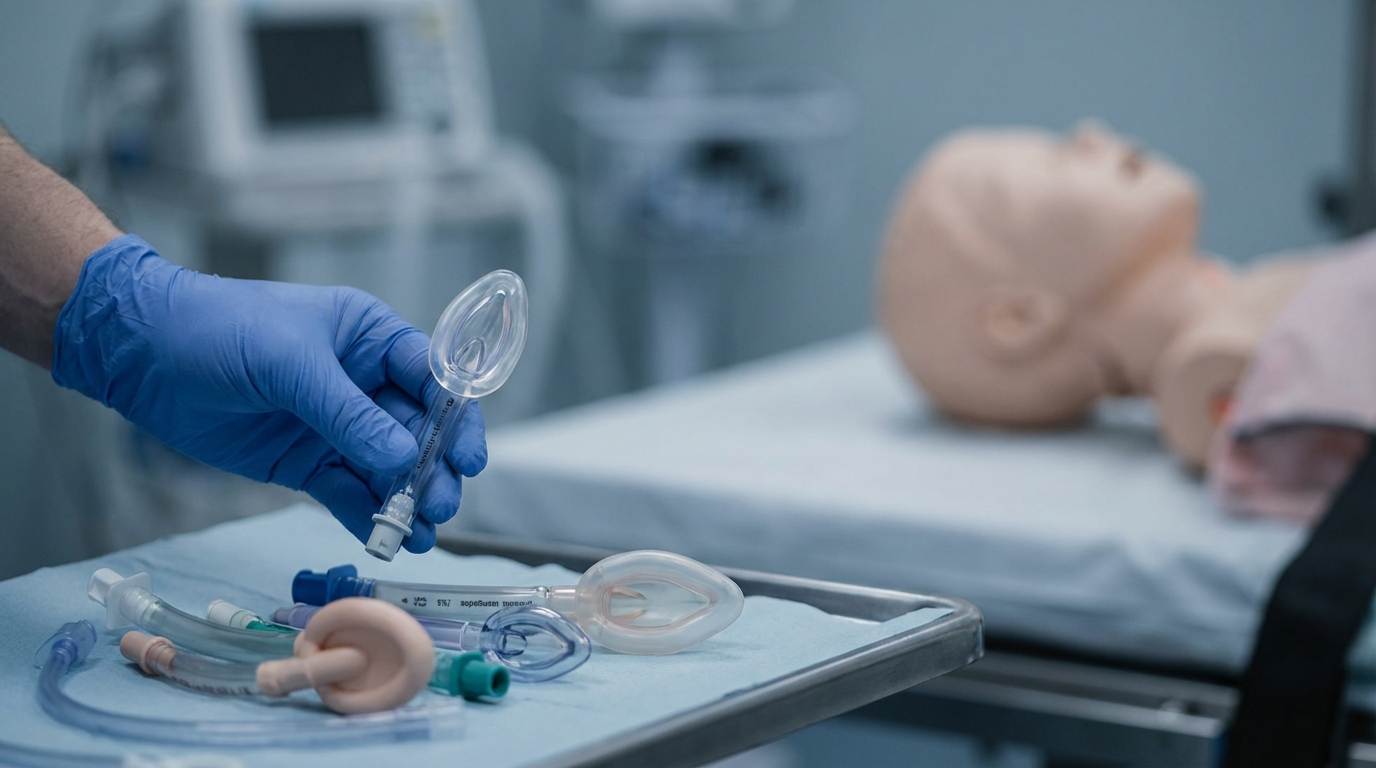
Securing the airway in children is one of the most stressful situations in emergency medicine. Anatomical differences, limited oxygen reserves, and the emotional burden on the team make every step error-prone. Supraglottic airways (SGAs) have established themselves as a key fallback option – both in in-hospital emergencies and in the prehospital setting. The current AHA guidelines on pediatric resuscitation explicitly recommend supraglottic airways as an alternative to endotracheal intubation, especially when intubation cannot be achieved promptly or safely. However, selecting the right device in the right size for a child is anything but trivial. This article gives you a practical overview of the three most common supraglottic airways in the pediatric setting: laryngeal mask airway (LMA), i-gel, and laryngeal tube (LT). You will find size charts, insertion techniques, and clear decision-making aids.
Why Supraglottic Airways Are Particularly Relevant in Children
Children are not small adults – this truism proves especially true when it comes to airway management. The relevant anatomical differences include:
- Large tongue relative to the oral cavity
- High-positioned, anteriorly tilted larynx (at the level of C3–C4 in infants vs. C5–C6 in adults)
- U-shaped, floppy epiglottis that easily obscures the view of the glottis
- Narrowest point is subglottic (at the level of the cricoid cartilage) rather than at the vocal cord level
- Short trachea with increased risk of endobronchial misplacement
- Lower functional residual capacity with simultaneously higher oxygen consumption per kilogram of body weight
These factors cause children to desaturate within seconds, and a failed intubation can rapidly become catastrophic. A supraglottic airway that can be placed quickly and with a high first-attempt success rate is therefore invaluable.
Comparison of the Three Common Supraglottic Airways
Laryngeal Mask Airway (LMA Classic / LMA Supreme)
The laryngeal mask airway is the longest-established supraglottic airway and has the broadest evidence base. It consists of a shaft tube and an inflatable cuff that positions itself over the laryngeal inlet.
Advantages:
- Broadest experience in pediatric anesthesia
- Various generations available (Classic, ProSeal, Supreme, Flexible)
- LMA Supreme offers a separate gastric drainage channel
- Good seal pressures with correct placement (typically 15–25 cmH₂O)
Disadvantages:
- Cuff must be inflated – overinflation leads to poorer seal and increased mucosal damage
- Without a gastric channel (LMA Classic), no gastric tube access
- Multiple subtypes create confusion in emergency situations
i-gel
The i-gel is a supraglottic airway with a non-inflatable gel cuff made of thermoplastic elastomer. It was specifically designed to conform to the perilaryngeal anatomy without the need to regulate cuff pressure.
Advantages:
- No cuff – no risk of incorrect inflation, faster insertion
- Integrated gastric channel from size 1
- Soft, anatomically shaped gel body reduces mucosal trauma
- High first-attempt success rate, even with less experienced providers
- Color-coding of sizes facilitates rapid selection
Disadvantages:
- Single-use device (higher unit cost)
- Lower seal pressures than inflatable systems in some studies
- Size 1 (neonates) – limited data in the resuscitation setting
Laryngeal Tube (LT / LTS-D)
The laryngeal tube is a single-lumen tube with two cuffs (proximal pharyngeal, distal esophageal) that is blindly advanced into the esophagus. Ventilation occurs through lateral openings between the two cuffs at the level of the larynx. The LTS-D variant additionally offers a gastric drainage channel.
Advantages:
- High seal pressures (often >25 cmH₂O)
- Simple, straight insertion movement
- Widely used in German-speaking countries (EMS)
- Gastric channel available with the LTS-D
Disadvantages:
- Two cuffs must be correctly inflated – overinflation leads to tongue edema and nerve damage
- With too-deep insertion, the pharyngeal cuff can press on the epiglottis
- Less evidence in the pediatric age group than LMA and i-gel
- Size selection is critical: an oversized tube quickly leads to complications
Size Charts for Clinical Practice
Correct size selection is the decisive success factor. Below you will find the weight-based recommendations from the respective manufacturers, which are widely accepted as the standard in clinical practice.
i-gel – Size Chart
| Size | Color | Body Weight | Typical Age Group |
|---|---|---|---|
| 1 | Pink | 2–5 kg | Neonates |
| 1.5 | Blue | 5–12 kg | Infants |
| 2 | Green | 10–25 kg | Toddlers |
| 2.5 | Orange | 25–35 kg | School-age children |
| 3 | Yellow | 30–60 kg | Adolescents / small adults |
Laryngeal Mask Airway (LMA) – Size Chart
| Size | Body Weight | Max. Cuff Volume | Typical Age Group |
|---|---|---|---|
| 1 | <5 kg | 4 ml | Neonates |
| 1.5 | 5–10 kg | 7 ml | Infants |
| 2 | 10–20 kg | 10 ml | Toddlers |
| 2.5 | 20–30 kg | 14 ml | School-age children |
| 3 | 30–50 kg | 20 ml | Adolescents |
Important: The stated cuff volumes are maximum values. In practice, the cuff is inflated with the minimum amount needed to achieve an adequate seal. A cuff pressure manometer (target pressure ≤60 cmH₂O) is recommended.
Laryngeal Tube – Size Chart
| Size | Color | Body Weight / Body Height | Cuff Volume (combined) |
|---|---|---|---|
| 0 | Transparent | Neonates <5 kg | approx. 10 ml |
| 1 | White | 5–12 kg / 12–25 cm dental row distance | approx. 20 ml |
| 2 | Green | 12–25 kg | approx. 35 ml |
| 2.5 | Orange | 25–50 kg | approx. 50 ml |
| 3 | Yellow | >50 kg / Adolescents | approx. 60 ml |
Caution: Cuff volumes vary depending on the manufacturer and model generation. Always verify the specific manufacturer's instructions for the product you have on hand. Overinflation of the cuffs, especially the pharyngeal cuff, can rapidly lead to severe complications (tongue edema, nerve injuries) in children.
Insertion Techniques
Laryngeal Mask Airway – Standard Technique
- Preparation: Fully deflate the cuff so that it forms a smooth, dorsally directed bowl. Lubricate the posterior surface.
- Head position: Neutral position in infants, slight sniffing position in older children. Hyperextension worsens positioning.
- Open the mouth: Chin lift or crossed-finger technique.
- Insertion: Guide the LMA with the opening facing caudally along the hard palate. The tip slides along the palate posteriorly until a springy resistance is felt (hypopharynx reached).
- Inflate the cuff: Fill with the minimum amount of air. The LMA moves slightly cranially during inflation – a sign of correct positioning.
- Verify placement: Capnography, symmetrical chest rise, no audible leak.
i-gel – Standard Technique
- Preparation: The gel cuff does not need to be inflated. Lubricate the dorsal surface. Do not use silicone-based lubricants – they can damage the gel body.
- Head position: Same as for the LMA.
- Insertion: Guide the i-gel along the hard palate until a definite resistance indicates correct positioning. The device has anatomical guidance from the gel body – less force is needed compared to the LMA.
- Fixation: The integrated bite block facilitates fixation. Secure with tape or a holding strap.
- Gastric tube: Insert through the gastric channel if indicated.
- Verify placement: Capnography is mandatory.
Laryngeal Tube – Standard Technique
- Preparation: Check both cuffs and fully deflate them. Lubricate the tube.
- Head position: Neutral or slight sniffing position.
- Insertion: Advance the tube in the midline along the hard palate into the hypopharynx. The black marking line faces cranially (toward the nose). Advance until the teeth marking is at the level of the dental ridge.
- Inflate the cuffs: Inflate both cuffs simultaneously via the common inflation line. Follow the recommended cuff volumes and ideally measure cuff pressure (≤60 cmH₂O).
- Verify placement: Capnography. If no CO₂ signal is detected: make minor position adjustments (withdraw 1–2 cm) or adjust cuff volume.
Contraindications and Limitations
Supraglottic airways are not a universal solution. You need to be aware of the following contraindications and limitations:
Absolute contraindications (all SGAs):
- Complete upper airway obstruction (e.g., foreign body at the glottic level) – direct laryngoscopy/bronchoscopy or a surgical airway is indicated here
- Known pathologies in the pharyngeal/laryngeal area that make placement impossible (e.g., large tumors, severe caustic injuries)
Relative contraindications:
- Non-fasted patients with intact protective reflexes – aspiration risk, although in the resuscitation setting the risk-benefit assessment clearly favors the SGA
- Significant limitation of mouth opening – all three devices require adequate mouth opening; the i-gel tends to require slightly less than the LMA
- Long-term ventilation: SGAs are primarily designed as short-term solutions. In the resuscitation setting, they are considered an appropriate definitive airway; for prolonged ventilation >2 hours, conversion to endotracheal intubation should be planned
Specific to the laryngeal tube:
- Ingestion of caustic substances (esophageal placement!)
- Known esophageal pathology
Decision-Making Aid: Which Device When?
The choice of SGA depends on several factors: availability, team experience, clinical situation, and patient characteristics.
i-gel as first-line in emergencies: The i-gel offers the advantage of the fastest insertion (no cuff management), the highest first-attempt success rate in studies involving less experienced providers, and color-coding that facilitates size selection in stressful situations. For the pediatric resuscitation algorithm, it is often the device of choice from a pragmatic standpoint.
LMA Supreme for planned anesthesia: In pediatric anesthesia, the LMA is the gold standard with the broadest experience. The LMA Supreme with its gastric channel offers a good safety profile for elective procedures.
Laryngeal tube as a prehospital option: In the EMS systems of German-speaking countries, the laryngeal tube is widely available and stocked across the board. The high seal pressures are an advantage during resuscitation. However, correct cuff inflation in children requires particular care.
Key Principle: Use the Device You Are Most Proficient With
The best supraglottic airway device is the one you train with regularly. A team that works exclusively with the laryngeal tube and can safely insert it in pediatric sizes will achieve better results than with an i-gel they are using for the first time. The AHA explicitly emphasizes this principle in their recommendations.
Practical Tips
- Size by weight, not by age: Body weight is the most reliable parameter. Use a Broselow tape or a weight-based emergency bag with SGAs pre-sorted by weight class.
- Always have one size smaller and one size larger ready: Especially in children, anatomy varies considerably.
- Capnography is mandatory: Without capnography, verification of SGA placement is unreliable. Auscultation alone is error-prone in children with a small thorax.
- Do not force it: If an SGA does not seat adequately after two attempts, change your strategy (different device, different size, endotracheal intubation, or bag-mask ventilation).
- Bag-mask ventilation as the baseline strategy: An SGA does not replace the ability to perform effective BMV. The AHA guidelines make clear that well-performed bag-mask ventilation in the pediatric resuscitation setting performs no worse than an advanced airway.
- Team communication: Announce the chosen size and device out loud during insertion. Document the insertion depth and any position adjustment maneuvers.
Hands-On Training
The theory of size selection and insertion technique is one thing – safe application under stress is another. Particularly in pediatric emergencies, regular hands-on training with realistic simulation scenarios makes a critical difference. In the PALS Refresher Course by Simulation Tirol, you can practice selecting and inserting supraglottic airways in children of various age groups under expert guidance on simulators – embedded in realistic resuscitation scenarios based on AHA standards. More information is available at Simulation Tirol – PALS Refresher.
Want to practice this hands-on?
In our PALS-Refresher you practice this topic hands-on with high-tech simulators and experienced instructors.
More Articles
Airway Management in Neonates: Suctioning and Stimulation
When and how suctioning is indicated in neonates, tactile stimulation as the first step, and common errors in initial respiratory support. A practical guide for healthcare professionals in the delivery room and prehospital setting.
Broselow Tape and Weight Estimation in Pediatric Emergencies
In pediatric emergencies, medications must be dosed based on weight. This article explains the use of the Broselow Tape, alternative estimation formulas, and dosing aids for the most common emergency medications in pediatrics.
Dehydration in Children: Severity Grading and Rehydration
Assessing the degree of dehydration in infants and young children is an essential pediatric emergency skill. This article covers clinical signs, oral vs. intravenous rehydration, bolus administration, and electrolyte monitoring.