Electrical Injury and Lightning Strike: Emergency Management and ECG Monitoring
Electrical injuries cause cardiac arrhythmias, burns, and occult organ damage. This article covers initial management, risk stratification, ECG monitoring duration, and differences between low-voltage, high-voltage, and lightning injuries.

Author: Dr. med. univ. Daniel Pehböck, DESA
Specialist in Anesthesiology and Intensive Care Medicine, AHA-certified ACLS/PALS Instructor, Course Director Simulation Tirol
Reading time approx. 9 min
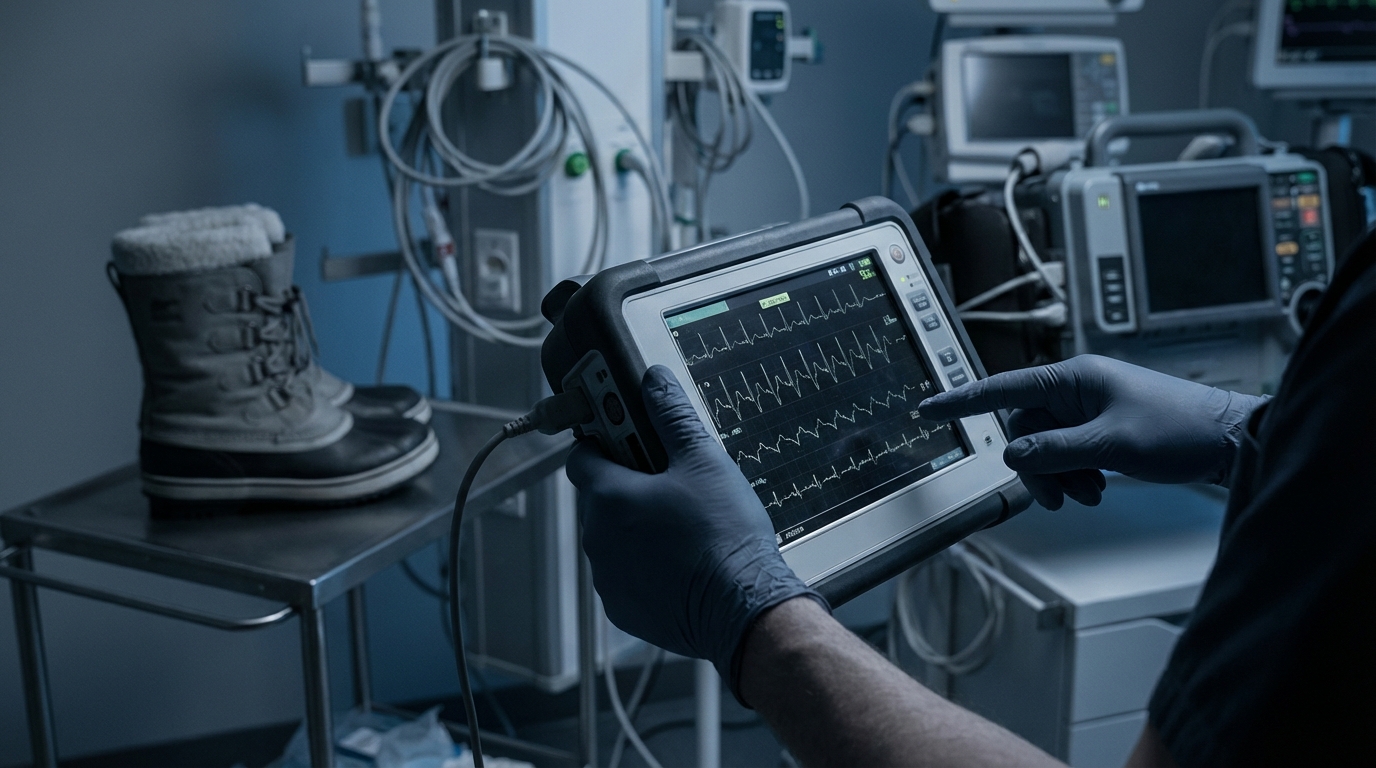
Electrical injuries are among those emergency situations whose severity is notoriously underestimated. The externally visible injuries – often only small electrical marks at entry and exit points – regularly belie the extent of internal damage. Myocardial arrhythmias, rhabdomyolysis, occult organ damage, and delayed cardiac arrest make electrical injuries a diagnostic and therapeutic challenge. At the same time, lightning strike represents a special entity that differs significantly from technical electrical injuries in terms of pathophysiology and prognosis. This article provides you with a systematic overview of initial management, risk stratification, ECG monitoring duration, and the critical differences between low-voltage, high-voltage, and lightning injuries.
Physical Fundamentals and Pathophysiology
Understanding tissue damage in electrical injuries requires some basic physics. The key determinants of injury severity are:
- Current (Amperes) – the actual tissue-damaging factor
- Voltage (Volts) – determines whether the current can overcome body resistance
- Resistance (Ohms) – varies considerably by tissue type (bone > fat > tendons > skin > muscle > blood vessels > nerves)
- Contact duration – longer contact means greater energy transfer
- Type of current – alternating current (AC) vs. direct current (DC)
- Current pathway through the body – transcardiac pathway is the most dangerous
Alternating current is more dangerous than direct current at equivalent voltage because tetanic muscle contraction "locks" the victim to the electrical source, prolonging contact duration. Furthermore, the vulnerable phase of the myocardium coincides more frequently with current flow at 50-Hz alternating current (European mains frequency), which promotes ventricular fibrillation.
Tissue Damage at the Cellular Level
Damage occurs via three mechanisms:
- Direct electroporation – irreversible destruction of cell membrane integrity by the electrical field
- Thermal damage – Joule heating along the current pathway, particularly at sites of high resistance (joints, bones)
- Mechanical trauma – from tetanic muscle contractions, falls, or being thrown
A critical point: thermal damage follows the path of least resistance. Current preferentially flows along neurovascular bundles. This explains why deep tissue necrosis frequently occurs along neurovascular structures – with externally intact-appearing skin.
Classification of Electrical Injuries
Low-Voltage Injuries (< 1000 Volts)
This category includes the most common electrical injuries in the domestic setting (230 V household current in Austria). The primary danger with low voltage is the induction of ventricular fibrillation, especially with transcardiac current passage (hand-to-hand or hand-to-foot). Burns are usually superficial and limited to contact sites.
High-Voltage Injuries (≥ 1000 Volts)
High-voltage injuries typically occur in the workplace (railway installations at 15,000 V, high-voltage power lines up to 380,000 V). They cause:
- Massive deep tissue burns along the current pathway
- Rhabdomyolysis with consequent acute kidney injury
- Compartment syndromes
- Vascular thrombosis and delayed vascular rupture
- Asystole as the primary cardiac rhythm (in contrast to ventricular fibrillation in low-voltage injuries)
With high voltage, a so-called arc flash injury can occur even without direct contact. Arc flashes can reach temperatures exceeding 20,000 °C and cause severe thermal burns without current flowing through the body.
Lightning Injury
Lightning strike is a special case with unique pathophysiology:
- Extremely high voltage (up to 300 million volts) with very short duration (milliseconds)
- Current flows predominantly over the body surface (flashover phenomenon) – therefore deep burns are rare
- Pathognomonic are Lichtenberg figures (fern-like skin redness), which do not represent true burns
- The primary cardiac rhythm is frequently asystole due to massive depolarization of the entire myocardium
- Simultaneously, respiratory arrest from brainstem respiratory center paralysis often occurs, which persists longer than cardiac automaticity recovery
This last point is precisely what justifies reverse triage in mass casualty lightning events: those who appear dead are treated first – that is, the patients without signs of life. In a lightning strike, cardiac automaticity can often recover spontaneously, while respiratory paralysis persists. Without ventilation, hypoxia then leads to secondary (and definitive) cardiac arrest.
Prehospital Initial Management
Safety and Hazard Zone
Before approaching an electrical injury victim, strict safety rules apply:
- Low voltage: Switch off the power source, remove the fuse, unplug. Only then make patient contact.
- High voltage: Minimum distance of 10 meters (for >110 kV: an additional 1 meter per 10 kV). Only the power utility can safely disconnect. Never attempt to separate the patient from the power source yourself. Be aware of step voltage!
- Lightning strike: There is no residual danger from the patient themselves. However, during ongoing thunderstorms, the risk of further lightning strikes persists – seek a safe environment.
Algorithm for Initial Management
Management follows the standard ABCDE approach with specific additions:
A – Airway: Cervical spine immobilization in every high-voltage injury and lightning strike (fall risk, tetanic contractions can cause vertebral fractures). Consider airway burns in arc flash injuries.
B – Breathing: Respiratory arrest in lightning strike can occur in isolation – initiate immediate ventilation. Rule out thoracic trauma from muscle contractions or falls.
C – Circulation: In ventricular fibrillation or pulseless ventricular tachycardia, immediate defibrillation per AHA algorithm. In asystole (common with high voltage/lightning), CPR with epinephrine 1 mg IV every 3–5 minutes. Initiate resuscitation efforts liberally and continue for a prolonged period – the prognosis after lightning strike is better than with other causes of cardiac arrest.
D – Disability: Basic neurological examination. Rule out spinal trauma. Document pupillary response – fixed mydriasis after lightning strike is not a reliable sign of irreversible brain damage and must not lead to termination of resuscitation.
E – Exposure/Environment: Complete undressing and search for entry and exit wounds. Estimate burn extent using the rule of nines. Keep in mind: the visible skin lesions in high-voltage injuries represent only the "tip of the iceberg."
Volume Management
In high-voltage injuries with suspected rhabdomyolysis, aggressive fluid therapy is essential:
- Target urine output: 1–2 ml/kg/h (significantly more than in thermal burns without electrical cause)
- Crystalloids as first-line therapy
- The Parkland formula systematically underestimates volume requirements in electrical injuries, as it only accounts for the visible burn surface area
In-Hospital Management and Diagnostics
Laboratory Diagnostics
The following laboratory parameters are mandatory in every significant electrical injury:
- Troponin (initial and at 6–12 hours) – myocardial damage
- CK, CK-MB, myoglobin – rhabdomyolysis screening
- Creatinine, BUN, electrolytes – renal function and hyperkalemia from cell lysis
- Lactate – tissue perfusion
- Blood gas analysis – metabolic acidosis indicating significant tissue damage
- Urinalysis – myoglobinuria (dark/cola-colored urine)
- Coagulation parameters – DIC screening
Imaging
- Chest X-ray: Pneumothorax, rib fractures, pulmonary edema
- CT as clinically indicated: Head CT for loss of consciousness, spinal CT for suspected fracture
- Abdominal ultrasound: Free fluid, organ rupture from falls or being thrown
ECG and Rhythm Monitoring
The 12-lead ECG is the central investigation in electrical injuries. The following changes may occur:
- Sinus tachycardia (most common finding, usually benign)
- Atrial fibrillation/flutter
- Premature ventricular complexes, ventricular tachycardia
- ST elevation or depression (direct myocardial damage or coronary vasospasm)
- QT prolongation
- Bundle branch blocks
- Bradycardia up to AV block
Risk Stratification and ECG Monitoring Duration
The question of which patients require continuous ECG monitoring and for how long is one of the most common clinical decisions in electrical injuries. Risk stratification is based on the following criteria:
High-Risk Criteria (Hospital Admission with Monitoring)
- High-voltage injury (≥ 1000 V)
- Lightning strike
- Loss of consciousness or amnesia
- Abnormal ECG on admission
- Transcardiac current pathway (hand-to-hand, hand-to-foot)
- Relevant comorbidities (pre-existing cardiac disease, pacemaker, ICD)
- Elevated cardiac biomarkers
- Chest pain or palpitations
- Pregnancy
Monitoring Recommendations
| Scenario | Monitoring Duration |
|---|---|
| High-voltage injury, abnormal ECG | At least 24–48 hours, until ECG normalization |
| High-voltage injury, normal ECG | At least 24 hours |
| Lightning strike | At least 24 hours |
| Low voltage + loss of consciousness or abnormal ECG | At least 12–24 hours |
| Low voltage + normal ECG + no high-risk factors | Monitoring for 4–6 hours, discharge if uneventful |
| Low voltage + normal ECG + no symptoms + no transcardiac pathway | Discharge after ECG and brief observation is justifiable |
Important: Delayed arrhythmias after an initial normal rhythm in low-voltage injuries are extremely rare according to current evidence. A normal 12-lead ECG in an asymptomatic patient after a low-voltage injury has a very high negative predictive value for significant arrhythmias.
In high-voltage injuries, however, arrhythmias can occur with a delay – due to progressive tissue necrosis, electrolyte shifts (hyperkalemia from rhabdomyolysis), and autonomic dysfunction.
Special Aspects of Resuscitation After Electrical Injury
Resuscitation after electrical injury follows the standard AHA algorithms with the following special considerations:
- Prolonged resuscitation: Especially after lightning strike, the prognosis is better than with other etiologies of cardiac arrest. Young patients without significant comorbidities have a realistic chance of survival.
- Fixed dilated pupils are not a criterion for termination: After lightning strike, transient sympathetic activation or direct nerve damage can cause bilateral mydriasis that resolves.
- Reverse triage in mass casualty events: Patients without signs of life are treated with priority (reversal of the usual triage principle).
- Early airway management: In suspected airway burns (arc flash, flame exposure), intubate early before airway edema makes intubation impossible.
Specific Complications and Their Management
Rhabdomyolysis and Acute Kidney Injury
Rhabdomyolysis is the most feared complication of high-voltage injury. Myoglobin obstructs the renal tubules and leads to acute kidney injury. Management:
- Aggressive fluid administration (target urine output 1–2 ml/kg/h)
- Urine alkalinization with sodium bicarbonate (target urine pH > 6.5) – evidence is debated, but still common in practice
- Frequent potassium monitoring – hyperkalemia can itself cause lethal arrhythmias
- Dialysis readiness for refractory hyperkalemia or anuria
Compartment Syndrome
Edematous swelling of damaged musculature can lead to compartment syndrome. Monitor clinical signs closely (pain on passive stretch, tense swelling, sensory disturbance). Perform compartment pressure measurement when in doubt. Do not delay fasciotomy when compartment syndrome is confirmed.
Vascular Damage
High-voltage injuries can cause delayed vascular rupture – days to weeks after the event. Patients must be informed about this risk.
Neurological Late Sequelae
Peripheral neuropathies, spinal cord lesions (especially ascending myelopathy), and cognitive deficits can appear weeks to months after the injury. Neurological follow-up is essential.
Pregnancy
Pregnant patients after electrical injury require fetal monitoring (CTG) regardless of voltage level, as amniotic fluid acts as a good electrical conductor and the fetus is at risk.
Summary of Key Clinical Points
- Visible injury correlates poorly with actual tissue damage in high-voltage injuries.
- The 12-lead ECG is the key investigation for risk stratification.
- Low voltage + normal ECG + asymptomatic = low risk for delayed arrhythmias.
- High voltage and lightning strike always require hospital admission with monitoring.
- Resuscitation after lightning strike has a comparatively good prognosis – perform prolonged resuscitation.
- Treat rhabdomyolysis aggressively with fluids in high-voltage injuries before kidney failure develops.
- In lightning mass casualty events: reverse triage – treat the apparently lifeless first.
Practical Training
Managing electrical injuries requires not only theoretical knowledge but also confident mastery of resuscitation algorithms, arrhythmia recognition, and structured management of critically ill patients. In the ACLS course by Simulation Tirol, you train exactly these skills hands-on with realistic scenarios – including rhythm-specific treatment decisions that can be life-saving in electrical injury victims. The AHA-certified courses give you the opportunity to internalize algorithms so they are readily available in real emergencies.
Want to practice this hands-on?
In our ACLS-Kurs (Advanced Cardiac Life Support) you practice this topic hands-on with high-tech simulators and experienced instructors.
More Articles
Acute Dyspnea: Differential Diagnosis and Immediate Management
Dyspnea has numerous causes ranging from asthma to heart failure to pulmonary embolism. This article presents a systematic approach to differentiation based on history, clinical examination, auscultation, and point-of-care diagnostics.
Acute Hypoglycemia: Emergency Management in Adults and Children
Threshold values, symptom recognition, oral glucose vs. IV dextrose vs. glucagon – with separate dosing for adult and pediatric patients. A common emergency presentation systematically reviewed.
Acute Adrenal Insufficiency: Addisonian Crisis in the Emergency Setting
Adrenal crisis is frequently misdiagnosed and can be fatal. This article describes at-risk patients, clinical signs, immediate hydrocortisone administration, and the management of accompanying hypoglycemia and hyperkalemia.