Emergency Vascular Access in Children: Peripheral IV vs. Intraosseous
When is an IO access indicated in a pediatric emergency, which puncture sites are appropriate depending on age, and what are common pitfalls? A practical guide for emergency teams.

Author: Dr. med. univ. Daniel Pehböck, DESA
Specialist in Anesthesiology and Intensive Care Medicine, AHA-certified ACLS/PALS Instructor, Course Director Simulation Tirol
Reading time approx. 9 min
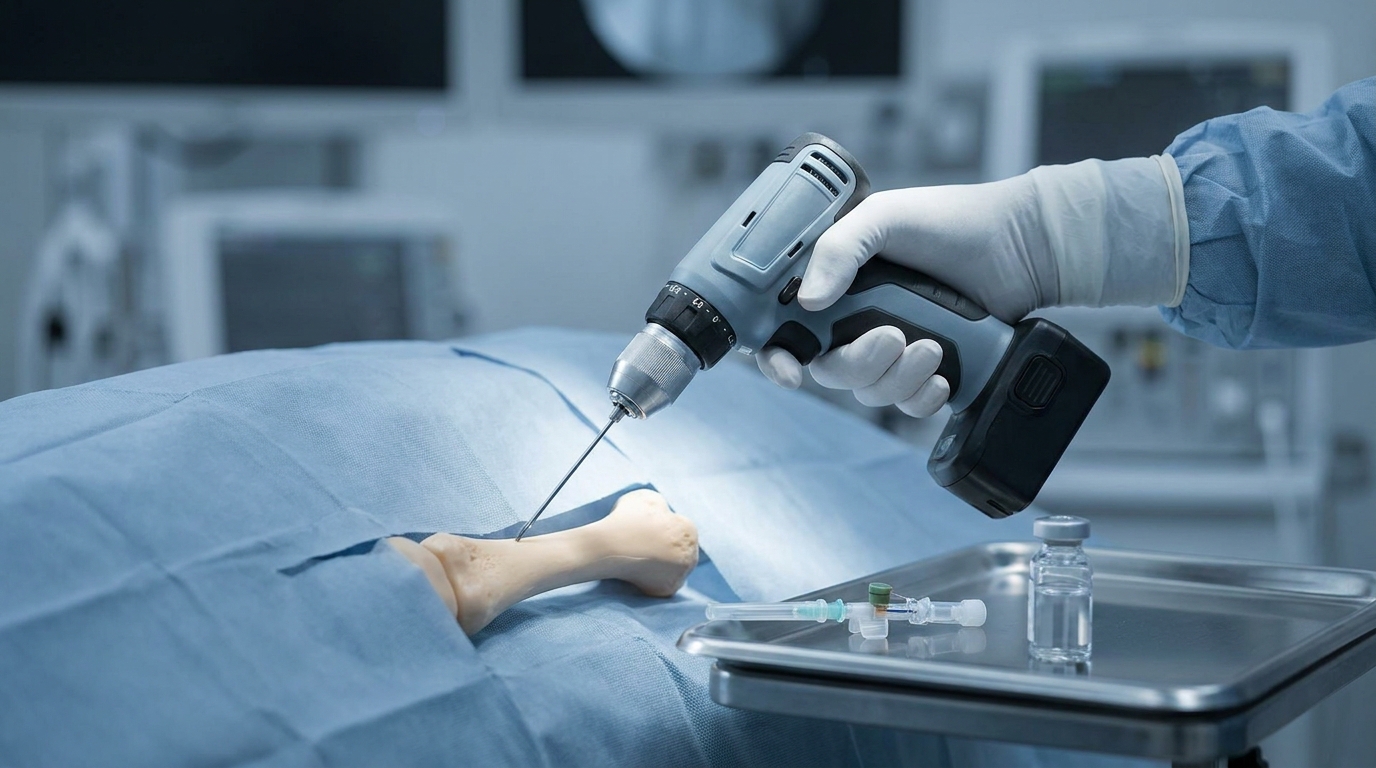
In a pediatric emergency, vascular access determines the ability to administer life-saving medications and fluids. At the same time, establishing peripheral intravenous access in children – especially in infants and toddlers – is one of the most technically demanding procedures in the emergency setting. Small veins, subcutaneous fat, movement, centralization in shock, and lack of routine frequently make IV access a time-consuming bottleneck. The intraosseous (IO) needle has therefore become firmly established in the AHA guidelines and PALS algorithms as an equivalent, fast, and safe alternative access route. This article examines clinical decision criteria, age-dependent puncture sites, practical implementation, and the most common pitfalls – as a practical guide for emergency teams.
Fundamental Principle: "Access Before Medication"
No PALS algorithm works without a functioning vascular access. Epinephrine, amiodarone, fluid bolus, glucose – all of these require a reliable administration route. The AHA guideline states clearly:
- Peripheral intravenous (IV) access remains the first choice, provided it can be established quickly and reliably.
- Intraosseous (IO) access is equivalent and should be established without delay when IV access cannot be achieved within a short time.
- During resuscitation: No IV access within 60 seconds → immediate IO.
The time limit is intentionally short. Every additional attempt at the peripheral venous system costs valuable seconds during which neither epinephrine nor fluids reach the patient. IO access is not a failure – it is an evidence-based escalation strategy.
Peripheral Intravenous Access in Children
Preferred Puncture Sites
The choice of vein depends on the age and clinical situation:
- Dorsum of the hand (dorsal hand veins): Often clearly visible, even in infants. Disadvantage: difficult to secure, high risk of dislodgement.
- Antecubital fossa (median cubital vein, basilic vein, cephalic vein): Larger veins, good fixation options. Often the first choice from toddler age onward.
- Forearm (cephalic vein of the forearm): Alternative access, easy to secure.
- Dorsum of the foot (dorsal pedal veins): Particularly useful in infants when the upper extremity is not accessible.
- Great saphenous vein at the medial malleolus: Classic "emergency vein" in infants – runs in an anatomically constant position anterior to the medial malleolus. Often palpable even with poor venous conditions.
- Scalp veins (superficial temporal vein, frontal vein): Only in infants under 12 months. Advantage: often clearly visible. Disadvantage: limited fixation, emotional distress for parents.
Tips for Optimization
- Tourniquet: Apply an age-appropriate tourniquet; in infants, a rubber glove finger can serve as a tourniquet.
- Warmth: Warm towels or briefly immersing the extremity in warm water improve venous filling.
- Transillumination: A cold red light held beneath the skin (vein finder, smartphone flashlight with a red filter) can make superficial veins visible in infants and toddlers.
- Ultrasound-guided puncture: Increasingly available in hospital settings, rarely practical in the prehospital setting.
- Cannula size: 24 G for neonates and small infants, 22 G for infants and toddlers, 20 G from school age onward. It is better to place a smaller cannula securely than to fail with one that is too large.
When Is Enough Enough?
The question of how many IV attempts are justified depends on the clinical urgency:
| Situation | Max. IV attempts | Time limit |
|---|---|---|
| Resuscitation (cardiac arrest) | 1 (prepare IO in parallel) | 60 seconds |
| Decompensated shock | 1–2 | 90 seconds |
| Stable but treatment-requiring situation | 2–3 | No strict limit, but have an escalation plan |
The recommendation is clear: in time-critical situations, IV placement must not become the bottleneck of the algorithm.
Intraosseous Access: Indication and Principle
Why Does IO Access Work?
Bone marrow is a non-collapsible venous network. Even in severe shock, hypothermia, or cardiac arrest, intraosseous drainage via the central vein is maintained. Medications and fluids administered intraosseously reach the central circulation within seconds – comparable to a central venous access. The AHA guideline classifies IO access as equivalent to IV access. Identical dosages apply.
Indications
- Cardiac arrest (primary alternative to IV access)
- Failure of peripheral venous puncture in a time-critical situation
- Severe dehydration with collapsed veins
- Burns with destroyed puncture sites
- Status epilepticus without venous access
- Any life-threatening situation where rapid access is needed
Contraindications
Absolute contraindications are few:
- Fracture of the target bone (leakage into soft tissue)
- Previous IO puncture of the same bone within 48 hours
- Osteogenesis imperfecta or severe osteoporosis (relative contraindication)
- Local infection/burn at the puncture site
- Previous orthopedic procedures with prostheses or plates on the target bone
Important: A relative contraindication becomes a non-contraindication when the alternative is the death of the child. When in doubt, puncture.
Puncture Sites: Age-Dependent Selection
Proximal Tibia (Standard Puncture Site, All Age Groups)
This is the AHA-recommended first-line puncture site in children:
- Landmark: Palpate the tibial tuberosity → 1–2 cm medial and 1–2 cm distal (in infants: 1 finger-breadth). The puncture site is on the flat, anteromedial tibial surface.
- Advantages: Large, flat bone; minimal soft tissue coverage; reliable landmarks; low risk of vascular/nerve injury.
- Needle direction: Slightly caudal (away from the epiphyseal plate), approximately 90° to the bone surface or with a 10–15° distal angulation.
- Age group: Neonates to adolescents. In adolescents, the cortex may be thicker – a powered system (e.g., EZ-IO) is helpful here.
Distal Tibia (Alternative)
- Landmark: Medial malleolus → 1–2 cm proximal on the flat medial tibial surface.
- Advantages: Minimal soft tissue, good fixation options.
- Special note: Particularly a good alternative in infants and toddlers when the proximal tibia is not accessible (e.g., fracture, burn).
Distal Femur (Infants and Toddlers)
- Landmark: 1–2 cm proximal to the patella on the anterolateral femoral surface.
- Needle direction: From lateral or anterior, angled slightly cranially (away from the growth plate).
- Advantage: Large bone with thin cortex in infants.
- Disadvantage: Difficult in older children due to thicker muscle layer.
Proximal Humerus (Older Children and Adolescents)
- Landmark: Greater tubercle of the humerus – arm in internal rotation, hand on the umbilicus.
- Advantage: Very good flow rates, rapid central distribution due to proximity to the heart.
- Disadvantage: Requires practice in landmark identification; anatomically more difficult in toddlers.
- Age group: Recommended from school age and in adolescents.
Overview by Age Group
| Age | 1st choice | 2nd choice |
|---|---|---|
| Neonates | Proximal tibia | Distal tibia |
| Infants (1–12 months) | Proximal tibia | Distal femur, distal tibia |
| Toddlers (1–5 years) | Proximal tibia | Distal tibia |
| School-age children (6–12 years) | Proximal tibia | Proximal humerus |
| Adolescents (>12 years) | Proximal tibia | Proximal humerus |
Practical Procedure for IO Puncture
Equipment and Systems
Widely used systems:
- EZ-IO (powered): Most widely used. Three needle sizes (pink 15 mm for 3–39 kg, blue 25 mm for ≥40 kg, yellow 45 mm for excessive soft tissue). Rapid insertion, minimal force required.
- Cook needle / Jamshidi needle (manual): Advanced with rotating movements. Requires more practice but is a proven alternative.
- BIG (Bone Injection Gun): Spring-loaded system, rarely used in pediatrics.
Step-by-Step Procedure
- Confirm indication, rule out contraindications.
- Identify puncture site (palpate landmarks).
- Disinfect the puncture site.
- Stabilize the skin, secure the bone with the non-dominant hand (do not place fingers behind the bone – risk of injury if the needle penetrates through!).
- Position the needle perpendicular to the bone surface (slightly angled distally if applicable).
- Insertion: For EZ-IO, activate the drill and advance with gentle pressure until a loss of resistance is felt (cortex penetrated). For manual needles, use rotating back-and-forth movements.
- Remove the stylet.
- Verify placement:
- Needle is stable in the bone (no wobbling)
- Aspiration of bone marrow (not always possible – this is not a mandatory criterion!)
- Flush with 2–5 ml of 0.9% NaCl – flows freely without swelling of surrounding soft tissue
- Secure the needle.
- Begin medication and fluid administration.
Important Note on Pain Management
In conscious children, IO infusion is painful, particularly during flushing and fluid administration. The AHA guideline recommends the slow administration of preservative-free lidocaine 2% (0.5 mg/kg, max. 20 mg) via the IO needle before infusion in conscious patients. During resuscitation, this is naturally not relevant.
Common Errors and Pitfalls
Errors with IV Access
- Too many attempts in a time-critical situation: The most common and most consequential error. "One more try" can cost minutes during resuscitation.
- Cannula too large: It is better to place a 24 G securely than to fail repeatedly with a 20 G.
- Tourniquet left on too long: Hematomas and edema worsen conditions for subsequent attempts.
- Inadequate fixation: In children, careful fixation with adhesive dressings is essential – a dislodged cannula means a lost access.
Errors with IO Access
- Hesitating too long: IO access is considered too late. Mentally, IO equipment should be within reach for every pediatric emergency.
- Wrong landmark: Puncture too close to the epiphyseal plate → growth plate injury. Puncture too far medial or posterior → proximity to vessels/nerves.
- Advancing too deep: The drill penetrates the opposite cortex → extravasation into soft tissue, compartment syndrome. In children, the cortex is thin – less force and depth are required.
- Unrecognized through-and-through puncture: Particularly with manual needles in neonates (extremely thin cortex).
- Aspiration as the sole placement criterion: Bone marrow cannot always be aspirated. A firm needle seat and a flush without soft tissue swelling are the decisive criteria.
- Missed placement check after transport: Dislodgement after repositioning is common. Verify function before every medication administration.
- Forgotten pain management: In conscious children, IO infusion without lidocaine is unnecessarily painful.
- IO access left in too long: IO access is an emergency access. Once the situation is stabilized, a peripheral or central venous access should be established and the IO needle removed. A maximum dwell time of 24 hours is recommended.
Complications of IO Puncture
- Extravasation (most common complication, usually due to incorrect placement)
- Compartment syndrome (rare but severe complication with unrecognized malpositioning)
- Osteomyelitis (very rare, <1%, with correct technique and limited dwell time)
- Growth plate injury (extremely rare with correct landmarks)
- Fat embolism (isolated case reports, clinically barely relevant)
The overall complication rate is low and in no proportion to the risk of lacking vascular access in a life-threatening situation.
Medication Administration via IO Access
The general rule is: All medications that can be given IV may also be administered IO – at identical dosages. This includes:
- Epinephrine
- Amiodarone
- Atropine
- Adenosine
- Glucose
- Antibiotics
- Sedatives and analgesics
- Crystalloids and colloids
- Blood products
Every medication administration should be followed by a flush with 0.9% NaCl (5–10 ml) to propel the medication from the marrow cavity into the central circulation.
Special note: Laboratory samples can also be obtained via IO access (blood gas analysis, blood glucose, blood type, crossmatch). The values are comparable to venous values, although potassium and alkaline phosphatase may be elevated.
Team Communication and Algorithm Integration
In the PALS algorithm, vascular access is an early but often underestimated step. Best practices include:
- Clarify role assignments in advance: Who establishes access? Who prepares IO equipment in parallel?
- Closed-loop communication: "I am now attempting IV access on the right dorsum of the hand. Please prepare the IO needle for the proximal tibia."
- Time callouts: "60 seconds, IV unsuccessful – switching to IO."
- No blame: The decision to use IO access is not an admission of incompetence – it is a guideline-compliant escalation.
Summary: Decision Algorithm
- Attempt peripheral intravenous access (most experienced team member)
- Have IO equipment prepared in parallel
- Adhere to time limits (60 s during resuscitation, 90 s in decompensated shock)
- If unsuccessful: immediately establish IO access (proximal tibia as standard puncture site)
- Verify placement: firm seat, flush without swelling
- Administer medications and fluids at identical dosages as IV
- As soon as possible: establish definitive venous access, remove IO needle
Practical Training
Placing an intraosseous access in a child cannot be learned from text alone – palpating landmarks, handling the drill system, and verifying placement require hands-on practice on simulation models. In the PALS course (Pediatric Advanced Life Support) by Simulation Tirol, you train exactly these skills in realistic scenarios: from the failed IV attempt to the decision to escalate to successful IO puncture with medication administration – under expert guidance and with structured debriefing. Because in a real emergency, what matters is what you can do with your hands.
Want to practice this hands-on?
In our PALS-Kurs (Pediatric Advanced Life Support) you practice this topic hands-on with high-tech simulators and experienced instructors.
More Articles
Airway Management in Neonates: Suctioning and Stimulation
When and how suctioning is indicated in neonates, tactile stimulation as the first step, and common errors in initial respiratory support. A practical guide for healthcare professionals in the delivery room and prehospital setting.
Broselow Tape and Weight Estimation in Pediatric Emergencies
In pediatric emergencies, medications must be dosed based on weight. This article explains the use of the Broselow Tape, alternative estimation formulas, and dosing aids for the most common emergency medications in pediatrics.
Dehydration in Children: Severity Grading and Rehydration
Assessing the degree of dehydration in infants and young children is an essential pediatric emergency skill. This article covers clinical signs, oral vs. intravenous rehydration, bolus administration, and electrolyte monitoring.