Team-Based Emergency Training: How to Design Effective Simulation Scenarios
How do you plan a hands-on emergency training for the hospital or outpatient clinic? This article covers scenario design, moulage tips, learning objective definition, and the role of the facilitator.

Author: Dr. med. univ. Daniel Pehböck, DESA
Specialist in Anesthesiology and Intensive Care Medicine, AHA-certified ACLS/PALS Instructor, Course Director Simulation Tirol
Reading time approx. 9 min
Simulation-based emergency training has established itself as one of the most effective methods for preparing clinical teams for critical situations. Studies consistently show that regular team training reduces error rates, improves communication, and ultimately has a positive impact on patient outcomes. But a simulation scenario is only as good as its planning. There is a world of difference between a half-heartedly improvised case example and a systematically designed scenario with clear learning objectives, realistic moulage, and professional debriefing — not only in terms of learning outcomes but also in participant acceptance. This article gives you, as a trainer, facilitator, or person responsible for in-hospital continuing education, a practical guide to systematically developing and effectively conducting simulation scenarios.
Why Simulation? The Evidence Behind the Training
The rationale for simulation training is straightforward: emergencies are rare, but when they occur, teams must function within seconds. In many hospitals and outpatient clinics, months pass between actual resuscitation situations. The consequence is a gradual loss of competence — both in technical skills and in non-technical skills such as team communication, task allocation, and decision-making under pressure.
Simulation training bridges this gap. It enables:
- Repeated practice of rare but critical situations
- Errors in a safe environment that would have catastrophic consequences in real-life settings
- Targeted training of non-technical competencies (Crew Resource Management, CRM)
- Team building across professional groups and hierarchies
- Identification of systemic weaknesses in workflows, equipment, or infrastructure
The crucial point is: simulation is not an end in itself. Without a clear didactic structure, it remains a nice exercise with no lasting learning effect. The following sections describe the key building blocks of effective training.
Defining Learning Objectives: Goal First, Then Scenario
The most common mistake in scenario design is starting with the clinical case. Instead, you should always begin with the question: What should participants be able to do better after the training?
Technical vs. Non-Technical Learning Objectives
Learning objectives can be divided into two categories:
Technical learning objectives relate to clinical skills and algorithms:
- Correct performance of an ABCDE assessment
- Rhythm recognition and defibrillation according to the AHA algorithm
- Airway management including a Plan B strategy
- Drug dosages and routes of administration
Non-technical learning objectives relate to team dynamics and communication:
- Clear role assignment upon arrival at the emergency scene
- Closed-loop communication during medication administration
- Situation awareness under stress
- Structured handover (e.g., using the ISBAR framework)
- Decision-making under ambiguity
SMART Criteria for Simulation Learning Objectives
Formulate learning objectives as concretely as possible:
- Specific: "Participants perform a structured handover using ISBAR" rather than "Communication should improve"
- Measurable: The behavior must be observable
- Attractive: Relevant to participants' clinical practice
- Realistic: Achievable within the given timeframe
- Time-bound: Verifiable within the scenario
As a rule of thumb: no more than three to four learning objectives per scenario. If you try to train everything at once, nothing gets trained effectively.
Scenario Design: From Learning Objective to Clinical Case
Only once the learning objectives are in place do you choose the appropriate clinical case. In doing so, you should follow these principles:
Realism vs. Didactics
A scenario must be realistic enough for participants to become immersed (the so-called suspension of disbelief), but at the same time didactically designed so that the learning objectives are reliably addressed. A case that is too complex overwhelms. A case that is too simple bores and fails to provoke relevant team interactions.
The Scenario Blueprint
A well-structured scenario contains the following elements:
Initial situation (Setting): Where does the emergency take place? Who is present? What resources are available? What time of day? This contextual information significantly influences behavior. An emergency during a night shift with reduced staffing poses different demands than one during the day with full staffing.
Patient profile: Age, sex, comorbidities, current medications, allergies. The profile must be consistent — experienced participants will immediately notice inconsistencies, which destroys immersion.
Initial state: Vital signs, level of consciousness, clinical findings upon arrival. What do participants see, hear, and feel?
Expected progression (Branching): How does the patient respond to correct interventions? And to missing or incorrect ones? Here you need a decision tree with at least two pathways: one for adequate and one for inadequate management.
Trigger points: Define in advance which interventions lead to a change in condition. Example: "After administration of 1 mg epinephrine IV and two minutes of CPR → rhythm change to VF → defibrillation possible."
Endpoint: When is the scenario over? Define clear termination criteria, e.g., successful ROSC, handover to the resuscitation team, or after a defined maximum time.
Example Structure: Anaphylaxis in an Outpatient Clinic
| Element | Description |
|---|---|
| Learning objectives | 1) Recognition of anaphylaxis, 2) Correct IM epinephrine dosing, 3) Closed-loop communication, 4) Calling for backup |
| Setting | General practice outpatient clinic, afternoon, 2 staff members present |
| Patient | 38-year-old female patient, known allergy to wasp stings, sting 10 minutes ago |
| Initial state | GCS 14, stridor, generalized urticaria, BP 80/50, HR 130, SpO₂ 89% |
| Correct treatment | Epinephrine 0.5 mg IM → improvement within 3 minutes |
| Missing treatment | Deterioration: GCS decline, respiratory arrest after 5 minutes |
Moulage and Environmental Design: The Art of Immersion
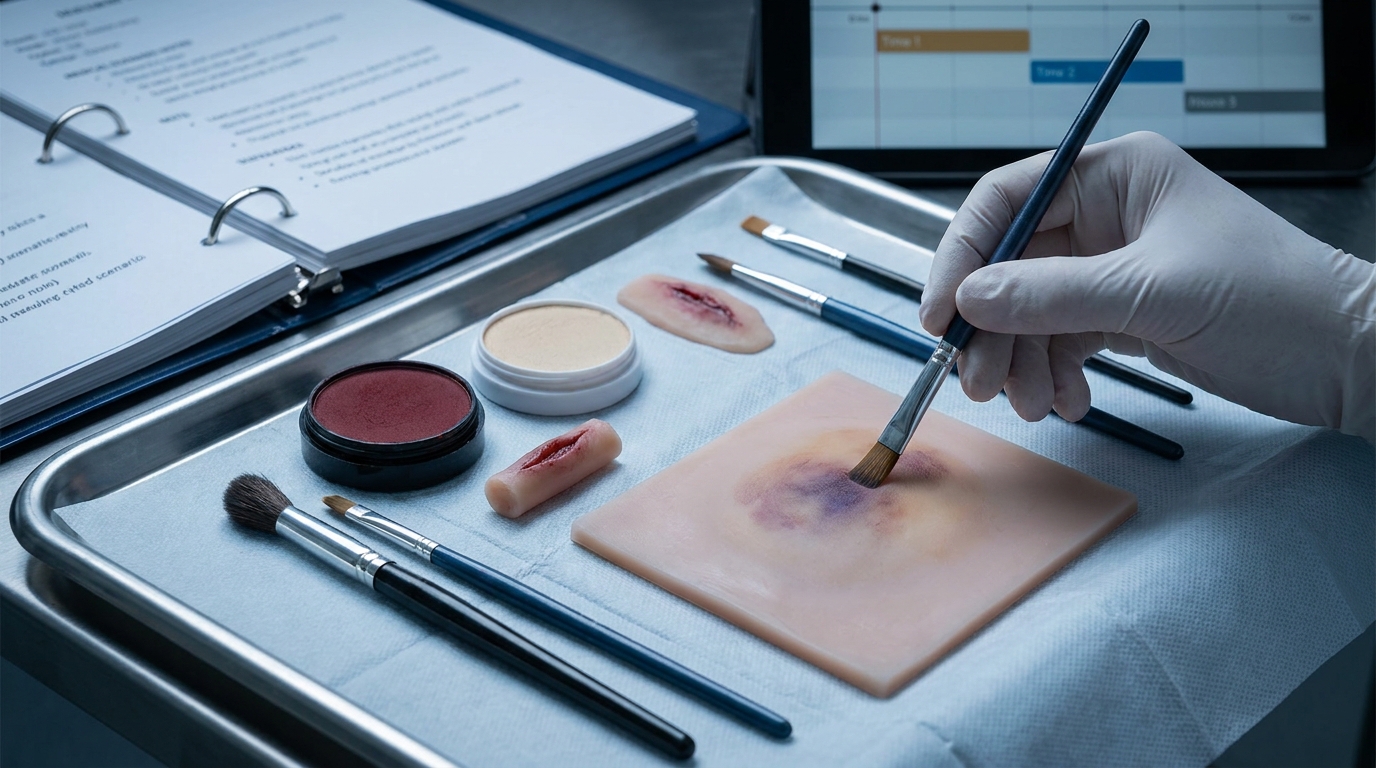
Moulage refers to the realistic design of the simulation environment and the simulated patient. You don't need to achieve Hollywood-level effects, but a few basic principles significantly enhance learning outcomes.
Low-Fidelity vs. High-Fidelity
- Low-fidelity: Manikins without electronic controls, standardized patients (role players), tabletop scenarios. Inexpensive, flexible, ideal for CRM training.
- High-fidelity: Computer-controlled simulators with adjustable vital parameters, breath sounds, and palpable pulses. Ideal for technically demanding scenarios.
The evidence shows: for training non-technical skills, the degree of fidelity is less important than the quality of the debriefing. Excellent training is possible even with the simplest means.
Practical Moulage Tips
- Environment: Use real equipment (emergency kit, defibrillator, monitoring). Nothing destroys immersion faster than missing basic equipment.
- Soundscape: Alarms, phones, background conversations. Stress arises not only from the case itself but from the environment.
- Distractors: A worried family member (played by a confederate), a ringing phone, a second request for assistance. These elements provoke the learning objectives of prioritization and team coordination.
- Confederates: Trained role players who take on a defined role in the scenario as a nurse, family member, or referring physician. They can deliberately provide information, generate stress, or influence team dynamics.
- Props: Even simple items are effective — an IV bag filled with water, an empty medication ampoule, a taped-on wound dressing. The principle of the "fiction contract" states: if you explain to participants what should be accepted as real, they will generally do so willingly.
The Role of the Facilitator: More Than Just a Course Instructor
The facilitator is the heart of every simulation training. The role goes far beyond simply starting and stopping scenarios.
Before the Scenario: Creating Psychological Safety
Simulation training can trigger anxiety — nobody wants to fail in front of colleagues. The facilitator must actively create a learning environment where mistakes are welcome:
- Prebriefing: Explain the procedure, the rules, and the underlying philosophy. A tried-and-tested phrase is: "We assume that everyone is doing their best. We are here to learn together, not to test."
- Basic Assumption: The assumption that all participants are competent, engaged, and willing to learn. This principle must be explicitly stated.
- Confidentiality: What happens in the simulation room stays in the simulation room.
During the Scenario: Guide, Don't Intervene
The facilitator observes, controls the simulation (vital parameters, confederate behavior), and documents key moments for the debriefing. Important:
- Don't intervene too early. Let the team make mistakes — that's where the greatest learning occurs.
- But don't intervene too late either. If the scenario reaches a dead end or participants are visibly overwhelmed, a targeted hint (e.g., through a confederate) can save the situation.
- Documentation: Note specific observations with timestamps. "Minute 3: Team leader gives epinephrine order, no read-back from the nurse" is more valuable than "Communication was suboptimal."
After the Scenario: The Debriefing
The debriefing is the most important part of simulation training. The research is clear on this: without a structured debriefing, the learning effect is minimal, regardless of scenario quality.
Established Debriefing Models
- PEARLS (Promoting Excellence and Reflective Learning in Simulation): Combines different debriefing strategies depending on the learning objective. Particularly suited for experienced facilitators.
- Plus-Delta: Simple format — what went well (Plus), what would you do differently (Delta)? Good for beginners.
- Advocacy-Inquiry: The facilitator states an observation (Advocacy) and asks for the participants' perspective (Inquiry). Example: "I noticed that after intubation, nobody continued chest compressions for about 30 seconds. What was your thought process there?"
Ground Rules for Effective Debriefing
- Timeframe: At least as long as the scenario itself, ideally longer
- Focus on the predefined learning objectives — don't address everything you noticed
- Let participants speak first (emotions, perceptions)
- Discuss specific behaviors, not blanket judgments
- Always close with a positive, constructive take-home message
Integration into Clinical Practice
Even the best simulation is of little use if it remains a one-time event. Lasting impact comes from regular integration into the daily work routine:
In-Situ Simulation
Training directly in the workplace — on the ward, in the emergency department, in the outpatient clinic — offers the advantage of uncovering real systemic weaknesses: Where is the emergency kit? Does the defibrillator work? Does everyone know the alert pathway? These insights are often more valuable than the clinical training itself.
Frequency and Dose
Shorter, more frequent training sessions are more effective than infrequent full-day events. Even a 20-minute scenario with debriefing once a month can measurably improve team performance. The key is continuity.
Follow-Up and System Improvement
After each training session, document not only individual learning outcomes but also identified system problems. Defective equipment, unclear responsibilities, missing medications — these findings must lead to concrete improvement measures. Simulation thus becomes a quality management tool.
Common Mistakes in Scenario Design
To conclude, here is a checklist of common pitfalls:
- Too many learning objectives: Focus on three to four per scenario
- Cases that are too complex: If diagnostics dominate the entire scenario, there is no room for team training
- No prebriefing: Participants feel exposed and shut down
- Debriefing as a review rather than reflection: "That was wrong" is not debriefing
- Lack of flexibility: If the team takes an unexpected but valid approach, the facilitator must be able to go with it
- No repetition: One-time training has no lasting effect
- Neglecting non-technical skills: A team that knows the algorithm but doesn't communicate will fail in a real emergency
Practical Training
The theoretical foundations of scenario design are important, but competence as a facilitator grows primarily through hands-on experience — both as a participant and as a trainer. In the emergency training by Simulation Tirol, you experience how professionally designed scenarios are structured, how effective debriefing works, and how team dynamics develop under stress. The insights from the course can be directly applied to designing your own training sessions at your workplace — whether in the hospital, on the ward, or in the outpatient clinic.
Want to practice this hands-on?
In our Notfalltraining in deiner Arztpraxis oder Klinik you practice this topic hands-on with high-tech simulators and experienced instructors.
More Articles
Acute Dyspnea: Differential Diagnosis and Immediate Management
Dyspnea has numerous causes ranging from asthma to heart failure to pulmonary embolism. This article presents a systematic approach to differentiation based on history, clinical examination, auscultation, and point-of-care diagnostics.
Acute Hypoglycemia: Emergency Management in Adults and Children
Threshold values, symptom recognition, oral glucose vs. IV dextrose vs. glucagon – with separate dosing for adult and pediatric patients. A common emergency presentation systematically reviewed.
Acute Adrenal Insufficiency: Addisonian Crisis in the Emergency Setting
Adrenal crisis is frequently misdiagnosed and can be fatal. This article describes at-risk patients, clinical signs, immediate hydrocortisone administration, and the management of accompanying hypoglycemia and hyperkalemia.