Emergencies in the Medical Practice: Preparation and Initial Management
Whether anaphylaxis, cardiac arrest, or seizures – emergencies in the medical practice are rare but time-critical. This article describes minimum equipment, emergency medications, team roles, and regular training concepts.

Author: Dr. med. univ. Daniel Pehböck, DESA
Specialist in Anesthesiology and Intensive Care Medicine, AHA-certified ACLS/PALS Instructor, Course Director Simulation Tirol
Reading time approx. 9 min
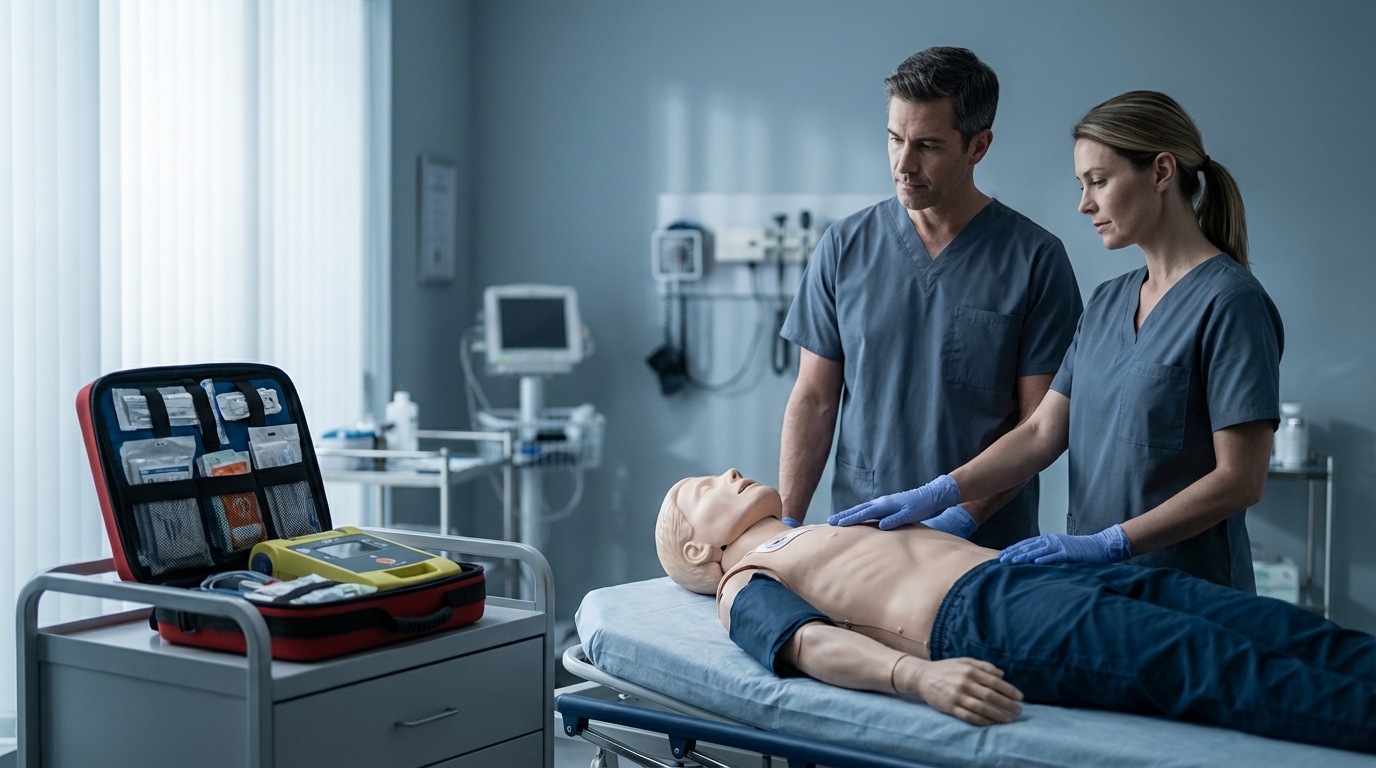
Emergencies in the medical practice are statistically rare – and that's exactly what makes them so dangerous. Those confronted with critical situations daily in a hospital setting develop routine. In a private practice, however, months or years often pass between two real emergencies. When a patient then collapses in the waiting room with anaphylactic shock, or an elderly gentleman suffers a cardiac arrest during a blood draw, preparation, equipment, and a well-coordinated team response determine life or death. This article provides you with a structured guide for emergency preparedness in the medical practice – from minimum equipment and concrete algorithms to team roles and training concepts.
Why the Medical Practice Is a Unique Emergency Setting
The medical practice differs fundamentally from a hospital: there is no resuscitation team that appears at the push of a button, no monitoring, no resuscitation bay. At the same time, patients rightly expect that competent help will be provided, especially in a physician's practice. The paradox: expectations are high, but resources are limited.
The most common emergencies in the medical practice include:
- Vasovagal syncope (the most common "emergency," usually harmless but relevant for differential diagnosis)
- Anaphylaxis (following medication administration, allergen exposure, immunotherapy)
- Acute coronary syndrome (ACS)
- Hypoglycemia
- Seizures
- Asthma attack / acute bronchospasm
- Cardiac arrest (rare, but with the highest consequences)
- Hypertensive crisis
The key insight: you don't need a resuscitation bay to professionally bridge the first few minutes. But you do need a plan, the right equipment, and a team that knows what to do.
Minimum Equipment for Practice Emergencies
Emergency Kit or Emergency Cart
Whether it's a kit, backpack, or cart – what matters is that the emergency equipment is kept in a fixed location known to everyone, is regularly checked, and is systematically organized. A chaotically stocked kit that hasn't been inspected in years is worthless in an actual emergency.
Basic airway management equipment:
- Bag-valve-mask ventilation system (adult, pediatric if applicable)
- Oropharyngeal airways (Guedel; sizes 2, 3, 4)
- Nasopharyngeal airways (sizes 6, 7, 8)
- Oxygen with flowmeter and non-rebreather mask (at least one full cylinder with documented fill level)
- Suction device (manual or electric) with appropriate catheters
- Laryngeal mask airway or laryngeal tube as a supraglottic alternative (especially if regular intubation practice is lacking)
Basic circulatory equipment:
- Peripheral IV catheters (various sizes, at least 18G and 20G)
- IV tubing and three-way stopcocks
- Normal saline 0.9% (500 ml or 1000 ml)
- Syringes (2 ml, 5 ml, 10 ml, 20 ml)
- Tourniquet
- Needles and drawing-up needles
Diagnostics:
- Blood pressure cuff (manual as backup)
- Pulse oximeter
- Blood glucose meter with test strips
- Stethoscope
- Thermometer
Automated External Defibrillator (AED):
An AED is by far the most important single investment for emergency equipment. In ventricular fibrillation – the most common initially shockable rhythm in sudden cardiac death – the probability of survival decreases by approximately 7–10% with every minute without defibrillation. An AED must be available, accessible, charged, and known to the entire team. Modern AEDs provide voice-guided instructions and are intentionally designed for use by non-physicians as well.
Emergency Medications
The following list represents a practical minimum set of medications. All medications must be regularly checked for expiration dates and restocked accordingly.
| Medication | Indication | Dosage (Adults) |
|---|---|---|
| Epinephrine (Adrenaline) | Anaphylaxis, resuscitation | Anaphylaxis: 0.3–0.5 mg IM (anterolateral thigh); Resuscitation: 1 mg IV every 3–5 min |
| Epinephrine auto-injector | Anaphylaxis (alternative/supplement) | 0.3 mg IM |
| Atropine | Symptomatic bradycardia | 0.5 mg IV, repeatable up to max. 3 mg |
| Amiodarone | Refractory ventricular fibrillation/pulseless VT | 300 mg IV (after the 3rd shock), then 150 mg IV (after the 5th shock) if needed |
| Midazolam | Status epilepticus | 10 mg buccal or intranasal (adults >40 kg) |
| Salbutamol (metered-dose inhaler) | Bronchospasm, asthma attack | 4–8 puffs via spacer, repeatable |
| Nitroglycerin (spray/capsule) | ACS, angina pectoris, hypertensive crisis | 0.4–0.8 mg sublingual (contraindicated if SBP <90 mmHg and PDE-5 inhibitor use) |
| Prednisolone | Anaphylaxis (second-line therapy), asthma attack | 250 mg IV (anaphylaxis); 50–100 mg IV (asthma) |
| Dimetindene (Fenistil) | Anaphylaxis (adjunctive) | 4 mg IV slowly |
| Glucose 40% | Hypoglycemia | 10–20 ml IV (= 4–8 g glucose), titrated |
| Acetylsalicylic acid (ASA) | ACS | 150–300 mg IV or PO |
| Normal saline 0.9% | Volume therapy | 500–1000 ml IV, as needed |
Important notes:
- Epinephrine is the number one medication for anaphylaxis. It is administered intramuscularly – not subcutaneously, not intravenously (except during resuscitation or under monitoring in treatment-refractory anaphylaxis by experienced practitioners).
- Prednisolone and antihistamines do not work immediately in anaphylaxis and are in no way a substitute for epinephrine. They are second-line therapy.
- Glucagon (1 mg IM or SC) can be considered in severe hypoglycemia without IV access and is a useful addition.
The Most Common Emergency Scenarios – In Brief
Anaphylaxis
Anaphylaxis is the most time-critical emergency in the practice because it is potentially lethal and – unlike cardiac arrest – can be immediately influenced by pharmacological intervention.
Immediate actions:
- Stop the trigger (discontinue infusion, stop allergen exposure)
- Call for help (call emergency services 144, alert the team)
- Epinephrine 0.5 mg IM into the anterolateral thigh – don't hesitate!
- Positioning: shock position (legs elevated) for circulatory insufficiency, sitting upright for dyspnea, recovery position if unconscious
- High-flow oxygen (15 L/min via non-rebreather mask)
- IV access, volume resuscitation with normal saline 0.9% (rapidly 500–1000 ml for hypotension)
- If symptoms persist: repeat epinephrine IM every 5–15 minutes
- Adjunctive: prednisolone 250 mg IV, dimetindene 4 mg IV, ranitidine 50 mg IV
- For bronchospasm: inhaled salbutamol
Cardiac Arrest
Even though it rarely occurs: a cardiac arrest in the practice must be immediately recognized and treated. The algorithm follows the universal BLS/ALS algorithm of the AHA.
Algorithm:
- No response, no breathing or no normal breathing → assume cardiac arrest
- Have someone call emergency services (144), send someone to get the AED
- Start CPR immediately – 30:2 (compressions:ventilations), compression depth 5–6 cm, rate 100–120/min
- Attach the AED, follow rhythm analysis
- If shockable rhythm: deliver shock, immediately resume CPR
- Epinephrine 1 mg IV/IO: for non-shockable rhythms immediately, for shockable rhythms after the 3rd shock
- Amiodarone 300 mg IV after the 3rd unsuccessful shock
- CPR for 2 minutes, then rhythm check – repeat the cycle
- Consider reversible causes (4 H's and 4 T's): Hypoxia, Hypovolemia, Hypo-/Hyperkalemia, Hypothermia – Thrombosis (coronary/pulmonary), Tamponade, Toxins, Tension pneumothorax
Hypoglycemia
- Symptoms: sweating, tremor, confusion, agitation, loss of consciousness, seizures
- Blood glucose measurement: act if < 70 mg/dl with symptoms
- In conscious patients: oral glucose administration (glucose tablets, juice)
- In patients with altered consciousness: glucose 40% 10–20 ml IV
- Recheck blood glucose after 15 minutes, repeat if necessary
Seizures
- Protect from injury (remove sharp objects, do not restrain!)
- Recovery position if possible
- Oxygen
- If seizure duration >5 minutes (status epilepticus): midazolam 10 mg buccal or intranasal
- IV access, measure blood glucose (hypoglycemia as a cause?)
- Monitoring, call emergency services
Team Roles and Task Assignment
One of the most common mistakes during a practice emergency is not a lack of knowledge, but a lack of coordination. When everyone runs to the emergency kit at the same time, no one calls emergency services, and CPR is delayed, valuable time is lost.
Define clear roles – ideally in writing, laminated, and attached to the emergency kit:
- Team leader (usually the physician): takes charge, makes decisions, delegates, authorizes medications
- Airway/Ventilation: bag-valve-mask ventilation, oxygen, supraglottic airway if needed
- Compressions (during CPR): chest compressions, switches every 2 minutes
- IV access/Medications: establishes IV access, prepares medications, administers on order
- Emergency call/Documentation: calls emergency services (144), meets the EMS team, documents times and medication administration, has the patient record ready
In small practices with only two or three people, roles will need to be combined – but even this can be discussed and practiced in advance. The key is: everyone knows what they do first.
Communication During Emergencies
Use closed-loop communication:
- Clear instruction with name: "Maria, please draw up 0.5 mg epinephrine intramuscular."
- Read-back: "0.5 mg epinephrine intramuscular, drawing up now."
- Confirmation after completion: "Epinephrine intramuscular has been given."
This sounds trivial, but it demonstrably reduces errors. In a stressful situation, "Quick, give epinephrine!" is not an adequate order – the dose, route of administration, and the person receiving the instruction must be clear.
Regular Training: The Decisive Factor
Knowledge alone is not enough. The evidence consistently shows that CPR skills deteriorate significantly just a few months after a course if not practiced regularly. This applies to chest compressions as well as airway management and medication dosing.
Recommended Training Concept for the Practice
Quarterly (15–30 minutes):
- Brief practice on a manikin: check CPR quality (depth, rate, chest recoil)
- Run through AED application
- Jointly check the location and contents of the emergency kit
Biannually (60–90 minutes):
- Scenario-based training with the entire team: e.g., "Patient collapses after vaccination" or "Unconscious patient in the waiting room"
- Practice and rotate team roles
- Debriefing: What went well? Where is there room for improvement?
Annually:
- External emergency course (e.g., certified emergency training) with professional simulation
- Refresh algorithms according to current evidence
- Review emergency equipment for completeness and functionality
The Emergency Checklist
In addition to training sessions, a laminated emergency checklist at a central location in the practice (and a copy on the emergency kit) is recommended:
- Emergency services (144) called?
- Emergency kit/AED on scene?
- Team roles assigned?
- Oxygen connected?
- IV access established?
- Medications given according to indication?
- Vital signs documented?
- EMS team directed on arrival?
Such checklists are not a sign of insecurity – they are a sign of professionalism. In aviation and operating rooms alike, checklists are standard because they provide cognitive relief in stressful situations and prevent errors.
Legal Aspects and Documentation
In Austria, physicians have a legal duty to provide assistance. Failure to render aid is a criminal offense (§ 95 StGB – Austrian Criminal Code). Additionally, the treatment contract creates a duty of care toward patients in the practice. Adequate emergency equipment and regular training are therefore not only a medical but also a legal necessity.
Documentation during an emergency includes:
- Time of event onset and interventions
- Vital parameters over time
- Medications administered with dose, route, and time
- Airway management measures
- Time of the emergency call and arrival of EMS
- Handover information
During an acute emergency, treatment obviously takes priority over documentation. However, one team member should – as soon as possible – record times and interventions in writing. Retrospective documentation from memory is error-prone and forensically problematic.
Don't Forget the Debriefing
A frequently neglected aspect: after a real emergency in the practice, the team needs a structured debriefing. This has two levels:
Clinical: What followed the algorithm? Where were there deviations? Do workflows need to be adjusted? Are materials missing?
Emotional: Emergency situations – particularly resuscitations with unfavorable outcomes – can be psychologically burdensome for the team. In a small practice team that often knows patients personally, this weighs especially heavily. Actively offer the opportunity to talk and refer to professional support services when needed.
Hands-On Training
The best emergency equipment is of little use if the skills aren't solid and the team isn't well-coordinated. Scenario-based training under realistic conditions – with time pressure, role assignment, and structured debriefing – is the most effective way to act safely and effectively in a real emergency. In the emergency training courses offered by Simulation Tirol, you practice exactly these situations: from anaphylaxis to cardiac arrest to seizures, hands-on and following current AHA algorithms. The training is suitable for individual physicians and nurses as well as for entire practice teams looking to strengthen their emergency competence together.
Want to practice this hands-on?
In our Notfalltraining in deiner Arztpraxis oder Klinik you practice this topic hands-on with high-tech simulators and experienced instructors.
More Articles
Automated External Defibrillator: A Guide for First Responders
AEDs are widely available, but many laypeople hesitate to use them. This article explains how they work, correct pad placement, common mistakes, and provides practical tips for training first responders in the workplace.
First Aid for Seizures: Positioning, Protection, and Calling Emergency Services
Laypeople and first responders often look for concrete instructions on how to handle epileptic seizures. This article debunks common myths and provides a clear step-by-step guide.
Choking Emergency in Children: Foreign Body Airway Obstruction Algorithm
Foreign body aspiration is one of the most common preventable causes of death in childhood. This article describes age-dependent interventions (back blows, Heimlich maneuver), differentiation of mild vs. severe obstruction, and handover to the emergency team.