Emergency Echocardiography: Recognizing Cardiac Tamponade
Focused echocardiography for cardiac tamponade is a life-saving point-of-care diagnostic tool. This article explains the subxiphoid view, sonographic tamponade signs, and indications for pericardiocentesis.

Author: Dr. med. univ. Daniel Pehböck, DESA
Specialist in Anesthesiology and Intensive Care Medicine, AHA-certified ACLS/PALS Instructor, Course Director Simulation Tirol
Reading time approx. 9 min
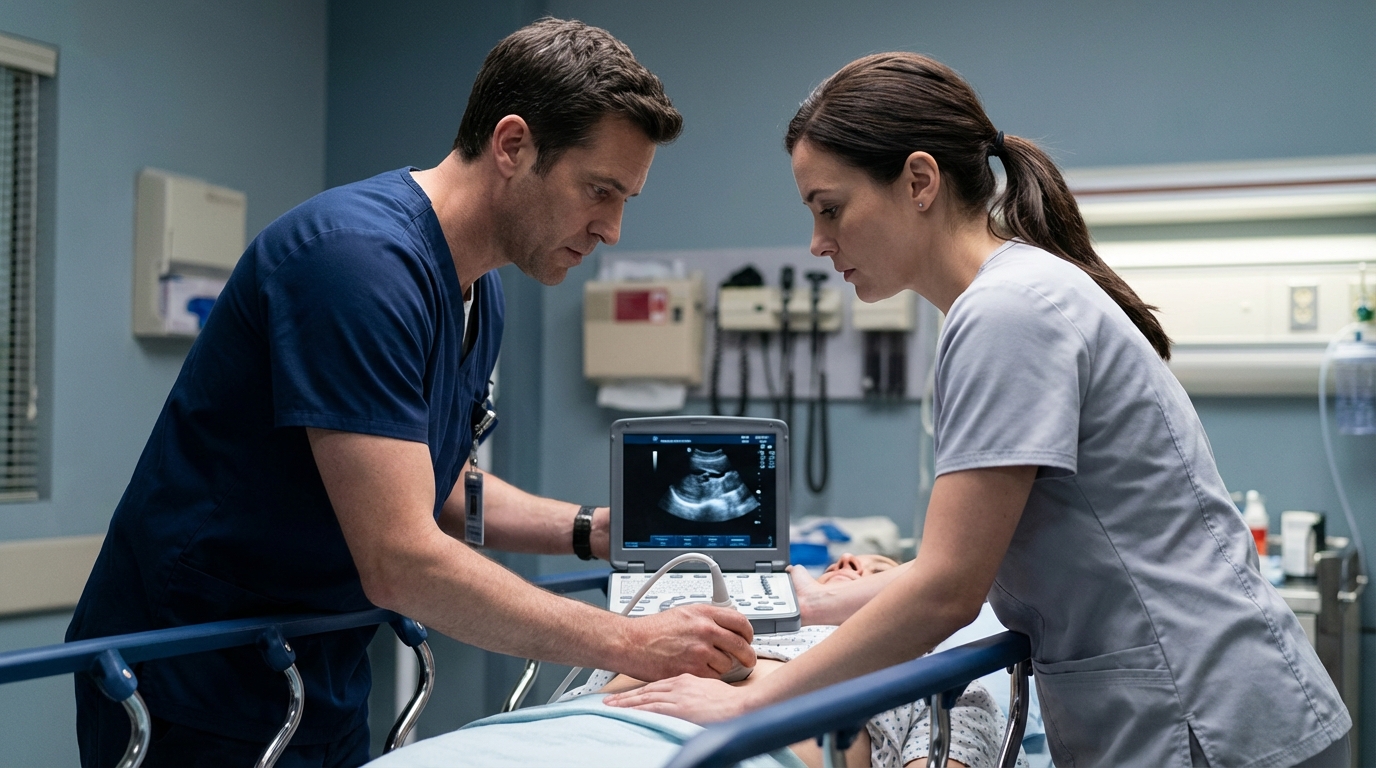
Cardiac tamponade is one of those emergencies where minutes decide between life and death. An obstructive form of shock that can easily be confused clinically with other causes of circulatory failure – and that is fatal without rapid diagnosis and intervention. Focused emergency echocardiography is the decisive tool here: it allows you to identify a significant pericardial effusion within seconds, assess hemodynamic compromise, and determine the indication for pericardiocentesis. This article systematically guides you through the sonographic diagnosis of cardiac tamponade – from probe positioning to recognition of classic tamponade signs to clinical decision-making.
Pathophysiology – Why Tamponade Is So Treacherous
The pericardium is a tough, fibrous sac surrounding the heart that normally contains approximately 15–50 ml of serous fluid. The key to understanding tamponade is not the absolute volume of the effusion, but the rate of fluid accumulation relative to the compliance of the pericardium.
- Slow accumulation (e.g., chronic effusions): The pericardium can adapt, so that even 1000–2000 ml may be tolerated before hemodynamic compromise occurs.
- Rapid accumulation (e.g., trauma, ventricular perforation, aortic dissection): As little as 100–200 ml can trigger a life-threatening tamponade.
The pathophysiological mechanism is clear: rising intrapericardial pressure first compresses the thin-walled, low-pressure cardiac chambers – namely the right atrium and right ventricle. Diastolic filling becomes progressively impaired, stroke volume drops, and obstructive shock ensues. Compensatory mechanisms include increased heart rate and rising peripheral vascular resistance – until compensation ultimately fails and cardiac arrest occurs (frequently presenting as PEA).
Common Causes in the Emergency Setting
- Penetrating or blunt thoracic trauma
- Iatrogenic: following cardiac catheterization, pacemaker implantation, central venous catheter placement
- Type A aortic dissection with rupture into the pericardial sac
- Myocardial infarction with free wall rupture
- Uremic pericarditis
- Malignant effusions (typically chronic, but may decompensate)
- Anticoagulation therapy with pre-existing effusion
Clinical Signs – And Why They Are Not Enough
The classic Beck's triad – muffled heart sounds, hypotension, distended neck veins – is often incomplete or difficult to assess in clinical reality. In the emergency setting, ambient noise, obesity, mechanical ventilation, or concurrent hypovolemia significantly impair clinical assessment.
- Distended neck veins: Absent in hypovolemia (e.g., polytrauma patient with concurrent blood loss).
- Muffled heart sounds: Virtually impossible to assess reliably in prehospital care or during trauma bay evaluation.
- Pulsus paradoxus (systolic blood pressure drop > 10 mmHg during inspiration): Sensitive, but nearly impossible to measure practically in an unstable patient.
This is precisely where focused echocardiography adds value: it provides real-time visual evidence that clinical signs alone cannot offer.
The Subxiphoid View – Step by Step
The subxiphoid (subcostal) view is the gold standard for emergency echocardiography when cardiac tamponade is suspected. It offers the advantage of directly visualizing the pericardium as a bright, echogenic line and immediately detecting fluid between the pericardium and myocardium.
Technique
- Probe: Phased array (sector) probe, alternatively a curvilinear probe.
- Position: Place the probe subxiphoidally, nearly flat on the abdomen (marker pointing to the patient's right, following cardiac convention).
- Orientation: Angle the probe toward the patient's left shoulder. The liver serves as the acoustic window.
- Optimization: Apply gentle pressure to slide the probe beneath the costal margin. In mechanically ventilated patients, a brief reduction in PEEP can improve the acoustic window.
- Target structure: Ideally, all four cardiac chambers should be visible. The pericardium appears as an echogenic line surrounding the heart.
When the Subxiphoid View Cannot Be Obtained
In up to 30% of emergency patients, the subxiphoid view is not usable – for example due to previous abdominal surgery, morbid obesity, bowel distension, or abdominal trauma. In these cases, alternative acoustic windows are essential:
- Parasternal long axis: Probe placed left parasternally at the 3rd–4th intercostal space, marker toward the right shoulder. An effusion appears here as an echo-free stripe posterior to the left ventricle (and anterior as well in larger effusions).
- Apical four-chamber view: Probe at the cardiac apex, marker pointing left. Effusion typically visible laterally and apically.
- Parasternal short axis: Supplementary view for assessing effusion distribution.
Within the FAST protocol (Focused Assessment with Sonography in Trauma), the subxiphoid view is already integrated and routinely performed during trauma bay evaluation.
Sonographic Tamponade Signs
The mere presence of a pericardial effusion does not automatically indicate tamponade. The critical question is: Is the effusion causing hemodynamic compromise? The following sonographic signs help you make this assessment – listed in order of increasing specificity and urgency.
1. Pericardial Effusion – Quantification
- Small effusion: Echo-free stripe < 10 mm, typically only posterior in the long axis view.
- Moderate effusion: 10–20 mm, visible circumferentially.
- Large effusion: > 20 mm, often with a "swinging heart" – the heart pendulates freely within the effusion.
Note: Effusion size alone does not reliably correlate with hemodynamic significance. A small, acutely developing effusion can cause tamponade, while a large, chronic effusion may be hemodynamically tolerated.
2. Right Atrial Collapse (RA Collapse)
- What you see: Indentation or inversion of the right atrial free wall during ventricular systole (i.e., during the phase when the atrium should be filling).
- Sensitivity: High (> 90%) – an early sign.
- Specificity: Moderate – brief RA collapse can also occur without tamponade in settings of low filling pressures. It becomes clinically significant when the collapse persists for more than one-third of the cardiac cycle.
3. Right Ventricular Collapse (RV Collapse)
- What you see: Indentation of the RV free wall during early diastole, when the ventricle should be relaxing and filling.
- Specificity: High – this sign is considerably more specific for hemodynamically significant tamponade than RA collapse.
- Clinical significance: Diastolic RV collapse in the presence of a pericardial effusion is a strong indicator of tamponade and should trigger immediate action.
4. Dilated Inferior Vena Cava Without Respiratory Variation
- What you see: A distended inferior vena cava (> 21 mm) without inspiratory collapse (< 50% diameter reduction during spontaneous breathing).
- Interpretation: Reflects elevated right atrial pressure. In the context of a pericardial effusion, this is a supportive sign of tamponade.
- Limitation: In mechanically ventilated patients, IVC respiratory variation is inherently reduced. Right heart failure from other causes also produces this finding.
5. "Swinging Heart"
In very large effusions, the heart may swing freely within the pericardial sac. On ECG, this phenomenon correlates with electrical alternans (alternating QRS amplitude). This sign is impressive but only seen with extensive effusions and is less relevant for acute decision-making than RA and RV collapse.
6. Doppler Signs (Advanced)
Pulsed-wave Doppler can demonstrate exaggerated respiratory variation in flow velocities across the mitral and tricuspid valves – the Doppler correlate of pulsus paradoxus. A reduction of the mitral E-wave peak by more than 25% during inspiration (or > 40% across the tricuspid valve) suggests tamponade. However, this measurement requires practice and is often difficult to perform in the acute setting.
Differential Diagnoses – What Else to Consider
Not every echo-free stripe around the heart is a pericardial effusion, and not every tamponade-like clinical picture has a cardiac cause. Important differential diagnoses include:
- Pericardial fat pad (epicardial fat): Hypoechoic but not completely echo-free. Typically more prominent anteriorly and moves with the myocardium.
- Left pleural effusion: Can mimic a posterior pericardial effusion. Key landmark: the descending aorta. A pericardial effusion lies anterior to the aorta; a pleural effusion lies posterior.
- Tension pneumothorax: Can also cause obstructive shock with distended neck veins and hypotension – but without pericardial effusion on echocardiography.
- Massive pulmonary embolism: Obstructive shock with RV dilation, but without pericardial effusion.
- Hemopericardium in trauma: Fresh blood may appear more echogenic than serous effusion, occasionally with visible clots. This is a common finding in penetrating thoracic trauma.
Clinical Decision-Making – From Diagnosis to Intervention
The diagnosis of "cardiac tamponade" is ultimately a combined clinical-sonographic assessment. You need two components:
- Sonographic: Pericardial effusion with signs of chamber compression (RA collapse, RV collapse, distended IVC).
- Clinical: Hemodynamic instability (hypotension, tachycardia, signs of shock) or cardiac arrest (particularly PEA).
Indication for Emergency Pericardiocentesis
Ultrasound-guided pericardiocentesis is indicated for:
- Hemodynamically unstable tamponade unresponsive to volume resuscitation
- PEA arrest with sonographically confirmed pericardial effusion as a suspected reversible cause
- Lack of immediate surgical intervention capability
Technique of Ultrasound-Guided Pericardiocentesis
- Approach: Subxiphoid, needle at a 30–45° angle directed toward the left shoulder, under continuous ultrasound guidance.
- Equipment: Long puncture needle (at least 12 cm, 18 G), three-way stopcock, syringe.
- Real-time guidance: The needle tip must be identifiable in the ultrasound image at all times. Agitated saline can confirm needle position.
- Target volume: Drainage of as little as 20–30 ml can produce dramatic hemodynamic improvement in acute tamponade, as the pressure-volume curve of the pericardium is exponential.
Surgical Options
In traumatic tamponade (particularly penetrating), pericardiocentesis is often only a temporizing measure – definitive management requires emergency thoracotomy. For recurrent effusions or coagulated blood within the pericardium, surgical pericardial window is also superior to needle drainage.
Pitfalls and Common Errors
- False reassurance with a small effusion: Even a small effusion can cause tamponade if it develops acutely. Always consider the clinical context.
- Missed effusion due to poor acoustic window: If the subxiphoid view cannot be obtained, always use alternative acoustic windows. Never interpret a poor image as "no effusion."
- Loculated effusion: Postoperatively or after trauma, the effusion may be loculated and only visible in certain views. Posteriorly located hematomas in particular are easily missed on the subxiphoid view.
- Confusion with pleural effusion: Use the descending aorta as your landmark.
- Overdiagnosis with chronic effusion: Not every effusion with RA collapse is a tamponade. Hemodynamics and clinical presentation must correlate.
- Forgetting reversible causes in PEA: Tamponade is one of the classic "4 T's" (Tamponade, Thrombosis, Toxins, Tension pneumothorax) – but the other causes must be evaluated simultaneously.
Integration into Resuscitation Algorithms
Current AHA guidelines recommend point-of-care ultrasound (POCUS) when searching for reversible causes of cardiac arrest. Cardiac tamponade is among those causes that can be rapidly identified and treated using focused echocardiography.
Important: Echocardiography must not significantly interrupt chest compressions. The recommendation is to perform the examination during planned rhythm analyses (so-called "pulse-check windows") and limit it to a maximum of 10 seconds. One approach is to pre-position the probe subxiphoidally so that an image can be obtained immediately at the next pulse check.
Summary – Key Points at a Glance
- Cardiac tamponade is a combined clinical-sonographic diagnosis: effusion + hemodynamic compromise.
- The subxiphoid view is the preferred approach – use alternative views when the acoustic window is inadequate.
- RA collapse (sensitive) and diastolic RV collapse (specific) are the key signs.
- A dilated IVC without respiratory variation supports the diagnosis.
- Drainage of as little as 20–30 ml can be life-saving in acute tamponade.
- In traumatic tamponade, pericardiocentesis is often only a bridge to surgical management.
- In the resuscitation setting: integrate POCUS into pulse-check windows; do not interrupt chest compressions.
Practical Training
Focused emergency echocardiography is a skill that requires regular hands-on practice – recognizing tamponade signs, correct probe positioning under stress, and the decision to perform pericardiocentesis cannot be learned from texts alone. In the Emergency Physician Refresher Course by Simulation Tirol, you have the opportunity to train these scenarios under realistic conditions, practice sonographic image interpretation on simulators, and strengthen your clinical competence for real-life emergencies.
More Articles
Acute Dyspnea: Differential Diagnosis and Immediate Management
Dyspnea has numerous causes ranging from asthma to heart failure to pulmonary embolism. This article presents a systematic approach to differentiation based on history, clinical examination, auscultation, and point-of-care diagnostics.
Acute Hypoglycemia: Emergency Management in Adults and Children
Threshold values, symptom recognition, oral glucose vs. IV dextrose vs. glucagon – with separate dosing for adult and pediatric patients. A common emergency presentation systematically reviewed.
Acute Adrenal Insufficiency: Addisonian Crisis in the Emergency Setting
Adrenal crisis is frequently misdiagnosed and can be fatal. This article describes at-risk patients, clinical signs, immediate hydrocortisone administration, and the management of accompanying hypoglycemia and hyperkalemia.