Laryngeal Mask vs. Endotracheal Tube in Emergencies
Supraglottic airway devices have gained importance in emergency medicine. This article compares the laryngeal mask and endotracheal tube regarding indications, success rates, complications, and guideline recommendations.

Author: Dr. med. univ. Daniel Pehböck, DESA
Specialist in Anesthesiology and Intensive Care Medicine, AHA-certified ACLS/PALS Instructor, Course Director Simulation Tirol
Reading time approx. 9 min
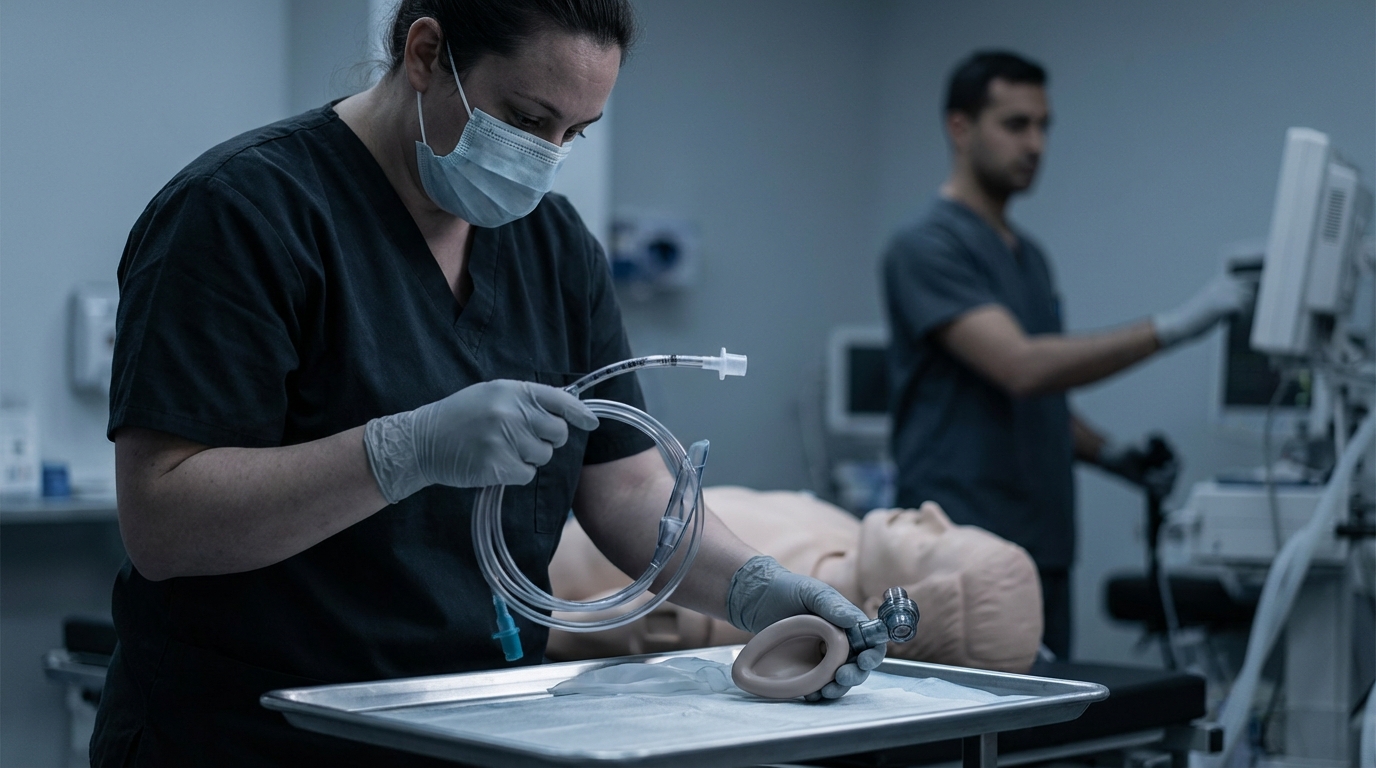
Securing the airway is one of the most time-critical interventions in emergency medicine. The team faces a central decision: endotracheal intubation or supraglottic airway? For a long time, the endotracheal tube (ETT) was considered the undisputed gold standard. However, supraglottic airway devices (SGA) – led by the laryngeal mask airway (LMA) and the laryngeal tube – have established themselves as equivalent or, in certain scenarios, even superior alternatives in recent years. The current evidence paints a nuanced picture that goes far beyond the simplified question of "which is better?" This article examines both techniques in the context of prehospital and in-hospital emergency care, compares success rates, complications, and guideline recommendations, and provides you with concrete decision-making tools for clinical practice.
Fundamentals: Two Concepts of Airway Management
The Endotracheal Tube (ETT)
With the ETT, a tube is advanced through the vocal cords into the trachea under direct or video laryngoscopic visualization. The cuffed tube sits below the glottic level and thus provides a definitive airway with maximum aspiration protection. Correct placement is verified by capnography, auscultation, and clinical signs.
Advantages:
- Highest aspiration protection through intratracheal cuff seal
- Enables high ventilation pressures (e.g., in severe oxygenation impairment)
- Direct tracheal suctioning possible
- Definitive airway management in the strict sense
Disadvantages:
- Requires extensive training and regular practice
- High failure rate among inexperienced providers (prehospitally up to 20–30%)
- Risk of unrecognized esophageal misintubation
- Hemodynamic response to laryngoscopy (sympathetic activation)
- Dental injuries, mucosal trauma, vocal cord lesions
The Laryngeal Mask Airway (LMA) and Other SGAs
Supraglottic airway devices are inserted blindly or with minimal visual guidance into the hypopharynx and seal above the glottic level. In addition to the classic laryngeal mask (LMA Classic™), numerous further developments exist: LMA Supreme™, i-gel®, laryngeal tube (LTS-D), and other devices.
Advantages:
- Significantly shorter learning curve
- High first-attempt success rate (> 90% even among less experienced providers)
- No laryngoscopy required
- Less hemodynamic response
- Rapid placement – often in under 30 seconds
Disadvantages:
- Not a definitive airway in the classic sense
- Lower aspiration protection (varies by device)
- Limited ventilation pressures (typically max. 20–30 cmH₂O leak pressure)
- Potentially inadequate ventilation with severely reduced compliance
- Not suitable for certain airway pathologies (e.g., supraglottic obstruction)
Evidence: What Do the Studies Show?
Prehospital Cardiac Arrest
The evidence for airway management during prehospital cardiac arrest has fundamentally changed. Several large, randomized trials have compared supraglottic airways with endotracheal intubation:
The AIRWAYS-2 trial compared the i-gel® with endotracheal intubation in over 9,000 patients with prehospital cardiac arrest. Functionally favorable neurological survival at 30 days (modified Rankin Scale 0–3) showed no significant difference between the two groups. The first-attempt success rate was significantly higher for the i-gel®.
The PART trial (Pragmatic Airway Resuscitation Trial) compared the laryngeal tube with endotracheal intubation in over 3,000 patients and even showed a survival benefit in favor of the supraglottic airway at 72 hours. However, the intubation success rate was notably low compared to other studies, which limits generalizability.
In summary, the current evidence shows:
- No survival benefit of endotracheal intubation over SGA in prehospital cardiac arrest
- Higher first-attempt success rates for SGA, particularly among EMS personnel without regular intubation practice
- Shorter interruptions of chest compressions with SGA placement
- Comparable or better ventilation quality with SGA during resuscitation
In-Hospital Setting
In the in-hospital setting – such as in the ICU or emergency department resuscitation bay – the assessment is different. Here, experienced providers (anesthesiologists, emergency physicians) are typically available, equipment is more comprehensive (video laryngoscopy, bougie, surgical airway), and patients frequently require prolonged mechanical ventilation. In this context, the ETT remains the procedure of choice for:
- Expected prolonged ventilation duration
- High aspiration risk (e.g., acute abdomen, esophageal variceal hemorrhage)
- Need for high ventilation pressures
- Situations requiring tracheal suctioning
Guideline Recommendations
AHA Guidelines (ACLS)
The current AHA guideline for Advanced Cardiovascular Life Support (ACLS) states the following key points regarding airway management during resuscitation:
- There is insufficient evidence to recommend any particular airway strategy as generally superior.
- Bag-mask ventilation, SGA, and ETT are all acceptable options during cardiac arrest.
- The choice should be based on provider experience, patient factors, and system resources.
- When an advanced airway is placed, continuous capnography should be used for placement confirmation.
- After placement of an advanced airway (SGA or ETT), asynchronous ventilations at a rate of 1 breath every 6 seconds (10/min) are recommended while chest compressions continue without interruption.
ERC Guidelines
The European Resuscitation Council (ERC) recommends in its current guideline:
- A stepwise approach to airway management
- Starting with bag-mask ventilation as the initial strategy
- SGA as the recommended first-line intervention for an advanced airway when bag-mask ventilation is insufficient
- Endotracheal intubation only by experienced providers with regular practice
- Endotracheal intubation should not interrupt chest compressions for more than 5 seconds
The Stepwise Approach: Algorithm for Clinical Practice
Both major guideline organizations advocate an escalating approach. For your clinical practice, the following algorithm can be derived:
Step 1: Basic Measures
- Head tilt, chin lift (unless cervical spine pathology is suspected)
- Insert oropharyngeal airway (Guedel) or nasopharyngeal airway
- Bag-mask ventilation with two providers (C-E grip) and capnography
Step 2: Supraglottic Airway
- Indication: inadequate bag-mask ventilation or advanced airway desired
- Laryngeal mask, i-gel®, or laryngeal tube depending on availability and local expertise
- Placement confirmation: capnography, chest rise, ventilation pressures
- If ventilation is adequate: remain with the SGA – no switch to ETT required during resuscitation
Step 3: Endotracheal Intubation
- Indication: SGA failure, high aspiration risk, need for high ventilation pressures
- Ideally performed by an experienced provider
- Video laryngoscopy recommended as first-line technique (higher first-attempt success rate)
- Maximum 2 intubation attempts, then return to SGA or bag-mask ventilation
Step 4: Surgical Airway (Cannot Intubate, Cannot Oxygenate – CICO)
- Cricothyrotomy as the last resort
- Scalpel-bougie-tube technique as the recommended standard procedure
- Every emergency team must master this step – even though it is rarely necessary
Complications: A Direct Comparison
| Complication | ETT | SGA (LMA/i-gel/LT) |
|---|---|---|
| Esophageal misplacement | 2–10% (prehospital) | Rare (by design) |
| Aspiration | Rare when correctly placed | Slightly higher residual risk |
| Dental injuries | Relevant risk | No risk |
| Vocal cord injury | Possible | No risk |
| Pharyngeal mucosal trauma | Possible | Possible (usually less severe) |
| Interruption of chest compressions | Longer (> 10 s) | Shorter (< 5 s) |
| Gastric insufflation | Rare when correctly placed | Possible at high pressures |
| Unrecognized misplacement | Potentially lethal | Usually clinically obvious |
One of the most dangerous complications overall is unrecognized esophageal intubation. It is associated with extremely high mortality. Continuous capnography is therefore mandatory for every advanced airway – whether ETT or SGA. Waveform capnography detecting CO₂ is the most reliable method for confirming correct placement and detecting dislocation.
Special Patient Populations
Obese Patients
In morbidly obese patients, bag-mask ventilation is frequently difficult, and intubation can be significantly more challenging due to anatomical features (short neck, limited mouth opening, large tongue). Here, second-generation SGAs (e.g., LMA Supreme™, i-gel®) provide rapid airway access. For prolonged ventilation and high aspiration risk, endotracheal intubation under optimized conditions (head-up positioning, video laryngoscopy, experienced provider) remains the goal.
Children
In pediatric emergency medicine, the laryngeal mask airway holds a particularly important role. Selection of the correct tube size, anatomical differences (anterior laryngeal position, large epiglottis, short trachea), and rapid desaturation make pediatric intubation especially challenging. The AHA guideline for PALS recommends the SGA as an acceptable alternative to endotracheal intubation when the latter cannot be achieved in a timely manner.
Trauma Patients
In trauma patients – particularly those with facial fractures, massive oropharyngeal hemorrhage, or suspected airway burns – both SGA and ETT may reach their limits. In cases of massive oropharyngeal bleeding, endotracheal intubation with suctioning capability is preferred. When supraglottic obstruction due to swelling or foreign body is suspected, an SGA may be contraindicated, and early surgical airway management must be considered.
Decision Matrix: When to Use What?
As a pragmatic decision aid for acute situations:
Prefer SGA when:
- Cardiac arrest without obvious airway pathology
- Provider has limited intubation experience (< 50 intubations/year)
- Rapid airway management needed, minimal CPR interruption desired
- Difficult airway anticipated and intubation not immediately possible
- EMS without an emergency physician on scene
Prefer ETT when:
- High aspiration risk (non-fasting, active GI bleeding, ileus)
- High ventilation pressures required (severe ARDS, status asthmaticus)
- Prolonged ventilation anticipated
- Experienced provider with video laryngoscopy available
- Tracheal suctioning necessary
- Controlled setting (resuscitation bay, operating room)
SGA as an Intubation Aid
An often underestimated aspect: certain SGA models allow fiberoptic intubation through the device. The LMA Fastrach™ (intubating laryngeal mask airway) was specifically developed for this purpose. In practice, this means: an SGA can serve as a bridging measure to ensure initial oxygenation and ventilation while definitive intubation is being prepared in parallel. This concept of "Plan B as a bridge to Plan A" is a central component of modern airway algorithms.
Common Mistakes in Practice
- Fixation on intubation: Multiple intubation attempts without a fallback strategy prolong no-flow time and worsen outcomes. After two failed attempts: insert an SGA and stop trying to intubate.
- Missing capnography: Every advanced airway – whether ETT or SGA – must be monitored with waveform capnography. No exceptions.
- Incorrect size selection: An SGA that is too small won't seal properly; one that is too large causes trauma. Follow manufacturer recommendations and, when in doubt, choose the size recommended by the manufacturer for the respective body weight.
- Cuff pressure not checked: For both ETT and cuffed SGAs, cuff pressure should be measured (ETT: 20–30 cmH₂O, SGA: manufacturer-specific).
- Excessive ventilation volumes/rates: Hyperventilation is one of the most common and harmful errors in emergency ventilation. It increases intrathoracic pressure, reduces venous return, and worsens resuscitation outcomes. Target: 10 breaths/minute with normal tidal volume (approx. 6–7 ml/kg).
Summary: The Right Strategy Rather Than the Right Device
The question "Laryngeal mask or endotracheal tube?" is too narrow. The decisive question is: Which airway strategy maximizes the chances of survival for this specific patient, in this specific situation, with this specific team?
The current evidence clearly shows: in prehospital cardiac arrest, supraglottic airways are at least equivalent to endotracheal intubation – and in many systems, they are even superior due to higher success rates and shorter hands-off times. Endotracheal intubation remains the procedure of choice for specific indications and in the hands of experienced providers.
The key lies in team training, mastery of both techniques, and the consistent application of a stepwise algorithm – from bag-mask ventilation to SGA to ETT and, in extreme cases, to the surgical airway.
Practical Training
The decision between a supraglottic airway and endotracheal intubation cannot be derived from guidelines alone – it requires hands-on experience, team coordination, and the ability to execute the correct algorithm under stress. In the ACLS course by Simulation Tirol, you train exactly these scenarios: airway management during cardiac arrest, the stepwise approach, managing the difficult airway, and team-based decision-making – using realistic simulators and following the current AHA guidelines. Because the best device is of little use if the strategy behind it isn't solid.
Want to practice this hands-on?
In our ACLS-Kurs (Advanced Cardiac Life Support) you practice this topic hands-on with high-tech simulators and experienced instructors.
More Articles
Acute Dyspnea: Differential Diagnosis and Immediate Management
Dyspnea has numerous causes ranging from asthma to heart failure to pulmonary embolism. This article presents a systematic approach to differentiation based on history, clinical examination, auscultation, and point-of-care diagnostics.
Acute Hypoglycemia: Emergency Management in Adults and Children
Threshold values, symptom recognition, oral glucose vs. IV dextrose vs. glucagon – with separate dosing for adult and pediatric patients. A common emergency presentation systematically reviewed.
Acute Adrenal Insufficiency: Addisonian Crisis in the Emergency Setting
Adrenal crisis is frequently misdiagnosed and can be fatal. This article describes at-risk patients, clinical signs, immediate hydrocortisone administration, and the management of accompanying hypoglycemia and hyperkalemia.