Hypertensive Emergency: Recognizing and Treating End-Organ Damage
The distinction between hypertensive urgency and hypertensive emergency determines the therapeutic approach. This article describes end-organ damage (brain, heart, kidney, eye), blood pressure targets, and medication selection (urapidil, nitroglycerin, esmolol).

Author: Dr. med. univ. Daniel Pehböck, DESA
Specialist in Anesthesiology and Intensive Care Medicine, AHA-certified ACLS/PALS Instructor, Course Director Simulation Tirol
Reading time approx. 8 min
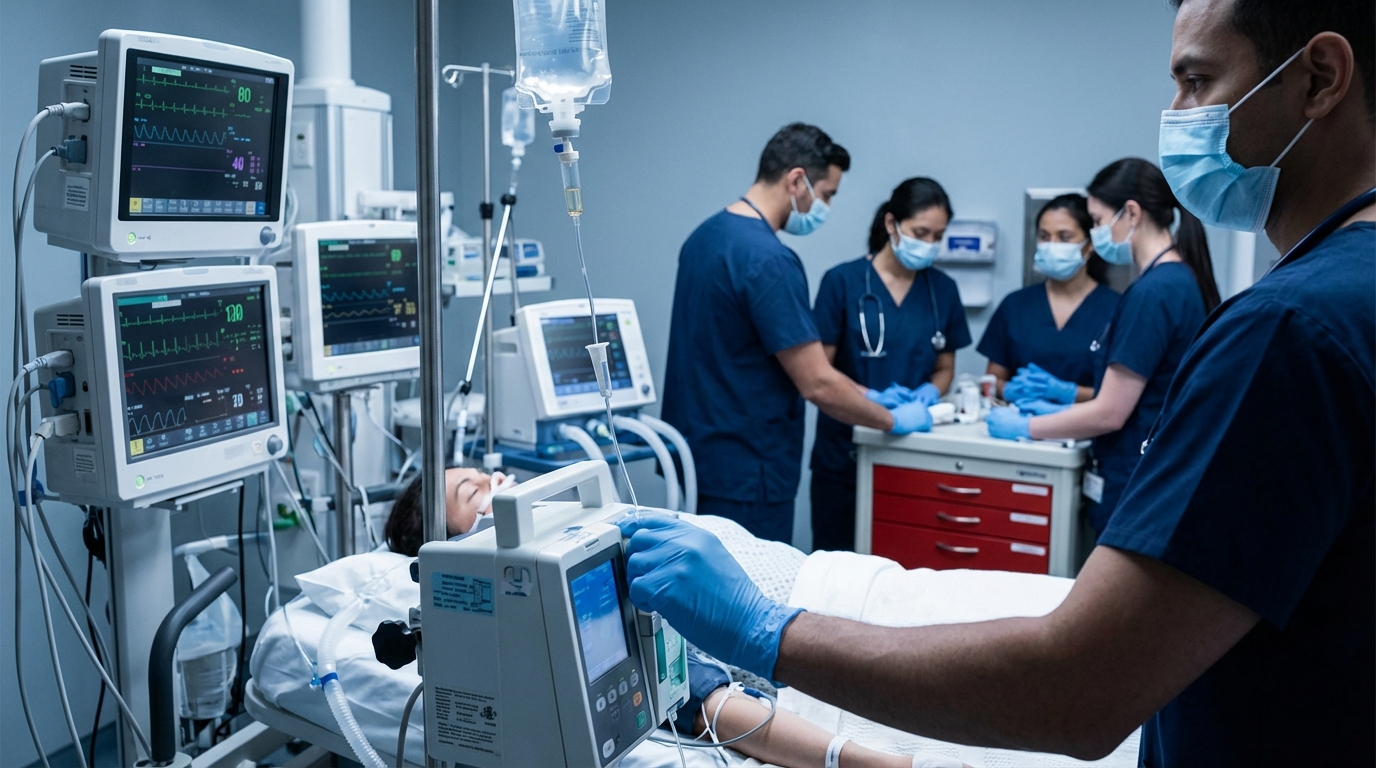
A massively elevated blood pressure reading alone does not constitute an emergency. What matters is not the absolute blood pressure value, but whether acute end-organ damage is already present. This distinction between hypertensive urgency and hypertensive emergency determines the entire therapeutic approach – from monitoring to medication selection to the timeframe for blood pressure reduction. In clinical practice, this differentiation is often insufficiently considered, which can lead either to dangerous undertreatment or – equally risky – to excessive blood pressure reduction. The following article is aimed at emergency physicians, anesthesiologists, and nurses and provides you with a structured overview of the pathophysiology, diagnostics, and pharmacological management of hypertensive emergencies.
Hypertensive Urgency vs. Hypertensive Emergency
These terms are often used interchangeably in clinical practice – incorrectly so. The distinction has immediate therapeutic consequences:
Hypertensive Urgency
- Severe blood pressure elevation (systolic often > 180 mmHg and/or diastolic > 120 mmHg)
- No signs of acute end-organ damage
- The patient is often asymptomatic or has nonspecific complaints (headache, dizziness, epistaxis)
- Treatment: oral blood pressure reduction over hours to days, outpatient follow-up
Hypertensive Emergency
- Severe blood pressure elevation with acute, demonstrable end-organ damage
- Affected organs: brain, heart, aorta, kidney, retina, placenta
- Treatment: intravenous, titratable blood pressure reduction under invasive or close monitoring
- Admission to a step-down or intensive care unit is mandatory
A common mistake in the emergency department: A blood pressure of 220/120 mmHg in an asymptomatic patient who has not taken her antihypertensives is an urgency – not an emergency. Conversely, a blood pressure of 190/100 mmHg in a patient with acute dyspnea and pulmonary edema can be a life-threatening emergency.
Systematically Identifying End-Organ Damage
The central task in any severe hypertension is the targeted search for end-organ damage. Only then can you initiate the correct therapy.
Brain – Hypertensive Encephalopathy and Stroke
Cerebral autoregulation maintains cerebral blood flow at a constant level over a wide blood pressure range. In chronic hypertension, this autoregulation curve shifts to the right. When the upper limit is exceeded, autoregulation fails, resulting in:
- Cerebral edema (hypertensive encephalopathy): headache, nausea, confusion, visual disturbances, seizures, decreased level of consciousness progressing to coma
- Ischemic stroke: focal neurological deficits
- Intracerebral hemorrhage: sudden neurological deficits, decreased level of consciousness
Important: If stroke is suspected, cerebral imaging (CT, ideally MRI) must be performed before any aggressive blood pressure reduction. In ischemic stroke, separate, more restrictive blood pressure targets apply – overly rapid reduction can jeopardize the penumbra.
Heart – Acute Coronary Syndrome and Pulmonary Edema
The heart is a frequent target organ of hypertensive emergencies. The following manifestations should be considered:
- Acute pulmonary edema: Dyspnea, orthopnea, fine crackles, frothy sputum. The acutely increased afterload leads to decompensation, even with preserved ejection fraction (HFpEF).
- Acute coronary syndrome (ACS): Angina pectoris, ECG changes (ST elevations/depressions, T-wave inversions), troponin elevation. Increased myocardial oxygen demand with simultaneously reduced coronary reserve can trigger myocardial ischemia.
- Acute aortic dissection: Sudden, tearing chest pain radiating to the back, blood pressure differential between arms, pulse discrepancies. The most aggressive blood pressure targets apply here.
Kidney – Acute Hypertensive Nephropathy
The kidneys are simultaneously perpetrators and victims of hypertension. Acute signs include:
- Acute deterioration of renal function: rise in creatinine and urea
- Microhematuria and proteinuria on urinalysis
- Oliguria to anuria in severe cases
- Thrombotic microangiopathy with schistocytes on peripheral blood smear
Eye – Hypertensive Retinopathy
Fundoscopy is a rapid, noninvasive method for assessing microvascular damage:
- Grade III: Flame hemorrhages, cotton-wool spots, hard exudates
- Grade IV: Papilledema – a sign of malignant hypertension
Fundoscopy is part of the baseline workup in every suspected hypertensive emergency and is unfortunately often forgotten in the emergency department.
Pregnancy – Eclampsia and HELLP Syndrome
Severe hypertension in pregnancy is always an emergency. Preeclampsia, eclampsia, and HELLP syndrome must be considered. Medication selection differs fundamentally here (preferred: oral nifedipine, IV urapidil, magnesium sulfate for seizure prophylaxis; contraindicated: ACE inhibitors, sodium nitroprusside).
Baseline Diagnostics in Hypertensive Emergency
Diagnostics must run in parallel with therapy and aim to identify end-organ damage:
- History: Known hypertension? Antihypertensive medication? Adherence? Substance use (cocaine, amphetamines)?
- Clinical examination: Neurological status, auscultation (heart and lungs), blood pressure measurement in both arms, pulse status
- 12-lead ECG: Signs of ischemia, left ventricular hypertrophy
- Laboratory: Complete blood count, reticulocytes, schistocytes, creatinine, urea, electrolytes, troponin, BNP/NT-proBNP, urinalysis, LDH, haptoglobin
- Imaging: Chest X-ray (pulmonary edema?), CT/MRI for neurological symptoms, CT angiography if aortic dissection is suspected, echocardiography
- Fundoscopy
Blood Pressure Targets: Not Too Much, Not Too Fast
The speed of blood pressure reduction is just as important as medication selection. Overly rapid reduction can cause iatrogenic ischemia in the brain, heart, and kidneys, especially in chronically hypertensive patients.
General Rule of Thumb
- First hour: Reduction by a maximum of 20–25% of the baseline value
- Next 2–6 hours: Target blood pressure 160/100–110 mmHg
- Next 24–48 hours: Gradual normalization to the individual target value
Exceptions with More Aggressive Targets
| Clinical Scenario | Blood Pressure Target | Timeframe |
|---|---|---|
| Aortic dissection | Systolic < 120 mmHg, HR < 60/min | Within 20 minutes |
| Acute pulmonary edema | Rapid afterload reduction, systolic < 140 mmHg | Within 1 hour |
| Intracerebral hemorrhage (systolic 150–220 mmHg) | Systolic 130–140 mmHg | Within 1 hour |
| Eclampsia | Systolic < 160 mmHg, diastolic < 105 mmHg | Immediately |
Ischemic Stroke – Special Consideration
In ischemic stroke without thrombolytic therapy, blood pressure is only cautiously lowered when values exceed > 220/120 mmHg (reduction by 15% within the first 24 hours). If thrombolysis is planned, blood pressure must be brought below 185/110 mmHg before initiating lysis.
Medication Selection: Urapidil, Nitroglycerin, Esmolol, and More
In hypertensive emergencies, only intravenous, easily titratable medications are used. The choice depends on the affected target organ.
Urapidil (Ebrantil®)
Urapidil is the most commonly used first-line medication for hypertensive emergencies in German-speaking countries – and rightly so.
- Mechanism of action: Peripheral alpha-1 blocker with a central serotonergic component (5-HT1A agonism), thereby avoiding reflex tachycardia
- Dosing: Initial bolus of 12.5–25 mg IV slowly over 20 seconds, may be repeated after 5 minutes. Maintenance: 5–40 mg/h as continuous infusion.
- Advantages: Good controllability, no reflex tachycardia, no increase in intracranial pressure, safe for use in pregnancy
- Preferred indications: Hypertensive encephalopathy, postoperative hypertension, broad spectrum of use as first-line therapy
Nitroglycerin (Glyceryl Trinitrate)
- Mechanism of action: Predominantly venous, and at higher doses also arterial vasodilator. Reduces preload and afterload.
- Dosing: 0.5–10 mg/h IV as continuous infusion, titrated to effect
- Preferred indications: Acute pulmonary edema, acute coronary syndrome with hypertension
- Caution: Contraindicated in right heart failure, aortic stenosis, concurrent PDE-5 inhibitor use (sildenafil). Tolerance develops with prolonged administration.
Esmolol (Brevibloc®)
- Mechanism of action: Ultra-short-acting, cardioselective beta-1 blocker
- Dosing: Loading dose 500 µg/kg over 1 minute, then maintenance 50–300 µg/kg/min
- Advantages: Extremely short half-life (approximately 9 minutes), excellent titratability
- Preferred indications: Aortic dissection (in combination with a vasodilator for BOTH heart rate AND blood pressure control), perioperative hypertension, tachycardia-associated hypertension
- Caution: Contraindicated in decompensated heart failure, bradycardia, AV block > first degree, bronchial asthma
Clevidipine (Cleviprex®)
- Mechanism of action: Ultra-short-acting dihydropyridine calcium channel blocker
- Dosing: Start at 1–2 mg/h IV, double every 90 seconds until target is reached, maintenance usually 4–6 mg/h (maximum 32 mg/h)
- Advantages: Very rapid onset of action, short half-life (approximately 1 minute)
- Caution: Lipid emulsion as carrier solution (allergy risk!), not to be used in severe aortic stenosis
Sodium Nitroprusside (Nipruss®)
- Mechanism of action: Direct arterial and venous vasodilator via NO release
- Dosing: 0.3–10 µg/kg/min IV
- Advantages: Extremely potent, rapid onset and short duration of action
- Disadvantages: Cyanide toxicity with prolonged or high-dose administration, possible increase in intracranial pressure, light-sensitive solution, invasive monitoring mandatory
- Use: Reserve medication when other agents fail. Avoid if possible in neurological emergencies.
Treatment Algorithm by Target Organ
The following overview summarizes the organ-specific medication selection:
- Hypertensive encephalopathy: Urapidil first line, alternatively clevidipine. No nitroprusside (ICP elevation).
- Intracerebral hemorrhage: Urapidil, clevidipine. Careful titration to systolic 130–140 mmHg.
- Ischemic stroke: Urapidil (when blood pressure reduction is indicated). Use restraint!
- Acute coronary syndrome: Nitroglycerin first line, esmolol for tachycardia. No pure vasodilators without a beta-blocker.
- Acute pulmonary edema: Nitroglycerin in combination with a loop diuretic (furosemide 40–80 mg IV). Initiate NIV early.
- Aortic dissection: Esmolol first line (rate AND blood pressure control), then add urapidil or clevidipine. Target: systolic < 120 mmHg and HR < 60/min. Nitroprusside only in combination with a beta-blocker (otherwise reflex tachycardia!).
- Eclampsia: Urapidil IV, magnesium sulfate 4–6 g IV as loading dose (seizure prophylaxis), oral nifedipine as alternative. NO nitroprusside (fetal cyanide toxicity), NO ACE inhibitors.
Common Mistakes in Practice
There are several recurring pitfalls that should be avoided when managing hypertensive emergencies:
Sublingual nifedipine: Uncontrolled blood pressure reduction using sublingual nifedipine capsules is obsolete. Absorption is unpredictable, and severe cerebral and cardiac ischemia have been reported. Do not use.
Overtreatment of asymptomatic hypertension: A patient with 210/110 mmHg without end-organ damage does not need an ICU admission or IV urapidil. Oral therapy and outpatient follow-up are sufficient.
Overly aggressive reduction: A blood pressure reduction of more than 25% in the first hour (except in aortic dissection) can cause watershed infarcts in the brain, acute renal failure, or myocardial ischemia.
Failure to investigate the underlying cause: A hypertensive emergency may be caused by secondary hypertension: pheochromocytoma, renal artery stenosis, Conn syndrome, cocaine abuse, thyroid storm. Consider these especially in young patients or treatment-refractory cases.
No arterial monitoring: In a true hypertensive emergency with IV therapy in the ICU, invasive arterial blood pressure monitoring is the standard of care. Non-invasive measurement is inadequate when titrating short-acting agents.
Transition to Oral Therapy
Once blood pressure is stabilized and the acute organ threat has been averted, early transition to oral antihypertensives should be initiated. The IV regimen is tapered in an overlapping fashion. Oral medication follows the standard recommendations for long-term therapy (ACE inhibitors/ARBs, calcium channel blockers, thiazides, beta-blockers) and must be individually tailored. It is essential to investigate the cause of the hypertensive crisis – in many cases, non-adherence to existing medication is the underlying issue.
Practical Training
The rapid differentiation between hypertensive urgency and true emergency, organ-specific medication selection, and controlled titration of intravenous antihypertensives require clinical routine and confident decision-making. In the ACLS Refresher Course by Simulation Tirol, you train exactly these acute medical scenarios in realistic simulation environments – including cardiovascular emergencies, algorithms, and team communication. If you want to refresh or deepen your skills, you can find all information at simulation.tirol.
Want to practice this hands-on?
In our ACLS-Refresher you practice this topic hands-on with high-tech simulators and experienced instructors.
More Articles
Acute Dyspnea: Differential Diagnosis and Immediate Management
Dyspnea has numerous causes ranging from asthma to heart failure to pulmonary embolism. This article presents a systematic approach to differentiation based on history, clinical examination, auscultation, and point-of-care diagnostics.
Acute Hypoglycemia: Emergency Management in Adults and Children
Threshold values, symptom recognition, oral glucose vs. IV dextrose vs. glucagon – with separate dosing for adult and pediatric patients. A common emergency presentation systematically reviewed.
Acute Adrenal Insufficiency: Addisonian Crisis in the Emergency Setting
Adrenal crisis is frequently misdiagnosed and can be fatal. This article describes at-risk patients, clinical signs, immediate hydrocortisone administration, and the management of accompanying hypoglycemia and hyperkalemia.