Drowning: Resuscitation and Therapy in Drowning Emergencies
Drowning emergencies require a modified resuscitation algorithm with a focus on oxygenation and hypothermia management. This article covers the chain of survival, ventilation priority, and prognostic assessment.

Author: Dr. med. univ. Daniel Pehböck, DESA
Specialist in Anesthesiology and Intensive Care Medicine, AHA-certified ACLS/PALS Instructor, Course Director Simulation Tirol
Reading time approx. 8 min
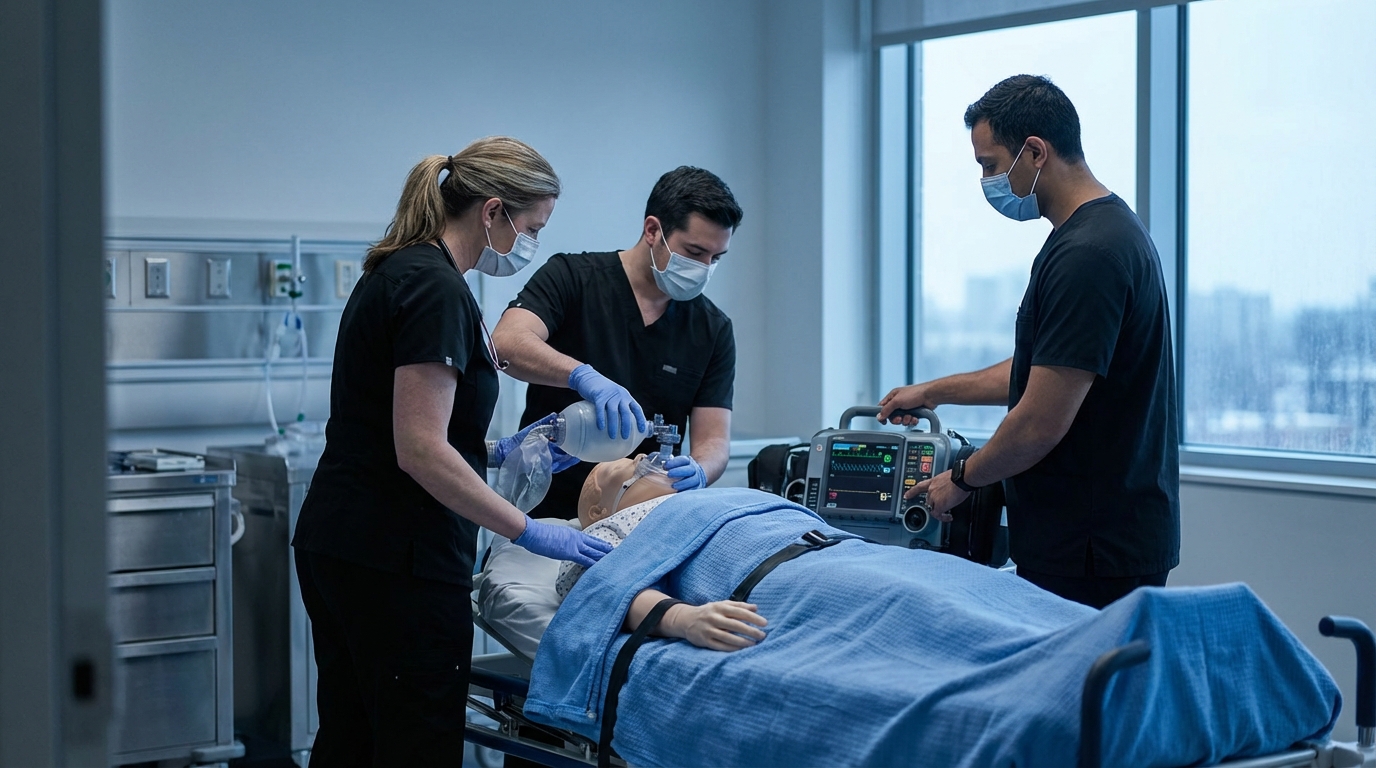
Drowning is one of the most common causes of preventable death worldwide – and poses a unique challenge even for experienced emergency medical personnel. Unlike the classic cardiac arrest, drowning is fundamentally a respiratory problem: hypoxia stands at the beginning of the pathophysiological cascade, and this demands a modified approach to rescue, resuscitation, and further therapy. Anyone who unreflectively applies the standard ACLS algorithm to drowning victims wastes valuable seconds and prognostically decisive interventions. This article covers the entire chain of survival – from water rescue through modified CPR to in-hospital management including hypothermia and prognostic assessment.
Definitions and Epidemiology
The Utstein recommendation defines drowning as a process resulting in primary respiratory impairment from submersion or immersion in a liquid. The distinction between "near-drowning," "dry drowning," or "secondary drowning" is deliberately no longer made – you should avoid these outdated terms in clinical practice, as they lead to misunderstandings. There are only two outcomes: the patient survives the drowning or dies from it.
The affected population is heterogeneous: toddlers in private pools, adolescents and adults in recreational accidents (frequently under the influence of alcohol), elderly individuals after syncopal events in the water, and professional water sports athletes. In Austria, seasonal clustering plays a role, with lakes and rivers being the typical accident locations.
Pathophysiology: Why Drowning Is Different
Understanding the pathophysiology is the key to the correct algorithm. Drowning follows a clear sequence:
- Initial phase: Conscious breath-holding after submersion, often accompanied by laryngospasm triggered by water contact with the glottis.
- Aspiration and hypoxia: After exhaustion of breathing reserves, water aspiration occurs – regardless of whether freshwater or saltwater. The aspirated volume is usually small in practice (1–3 ml/kg), but sufficient to wash out surfactant, cause atelectasis, and create an intrapulmonary right-to-left shunt.
- Hypoxemia → cardiac arrest: Progressive hypoxia leads first to bradycardia, then to pulseless electrical activity (PEA) or asystole. Ventricular fibrillation is rare in drowning (< 10% of cases), unless there is pre-existing cardiac disease, hypothermia, or electrolyte derangement.
- Hypothermia: Cold water (< 15°C) can cause significant hypothermia within minutes. This has a neuroprotective effect on one hand, but on the other, it promotes arrhythmias and complicates resuscitation.
The Old Debate: Freshwater vs. Saltwater
In clinical reality, the distinction between freshwater and saltwater aspiration plays a minor role. While freshwater theoretically causes hemodilution and saltwater causes hemoconcentration, the aspirated volume in surviving patients is generally too small to cause clinically relevant electrolyte shifts or hemolysis. The therapy does not differ. The key point is: both forms lead to ARDS through the same mechanism – surfactant washout and alveolar damage.
The Chain of Survival: From Water to Hospital
Water Rescue and Scene Safety
Before you think about medical management, scene safety comes first. Untrained bystanders regularly drown while attempting to rescue others. The rules of thumb are:
- Reach – Throw – Row – Go: First try to help from shore (pole, rope), then throw rescue devices, then use a boat, and only as a last option enter the water yourself.
- Cervical spine immobilization is only indicated with a clear trauma mechanism (diving into shallow water, water sports accident) and should not routinely delay the rescue.
- Ventilation can and should be initiated while still in the water, provided the rescuer is trained to do so. Chest compressions in the water are ineffective and not recommended.
Initial Management on Shore
Once the drowning victim has been recovered from the water, a modified BLS/ALS algorithm applies, which differs from the cardiac algorithm in one central point: Ventilation takes priority.
Approach for the unconscious patient:
- Open the airway – Inspect the mouth, remove visible foreign bodies. Routine attempts to "push water out of the lungs" (Heimlich maneuver, head-down positioning) are counterproductive, delay CPR, and increase the risk of gastric content aspiration.
- 5 initial rescue breaths – This is the key modification. The AHA guidelines recommend starting resuscitation with ventilation in drowning victims (as opposed to the C-A-B sequence in cardiac arrest). Each breath delivered over approximately 1 second, ideally with visible chest rise.
- Pulse check – After the initial rescue breaths: palpate the carotid pulse (maximum 10 seconds).
- CPR at a 30:2 ratio – If no pulse is palpable, immediately begin chest compressions. Standard CPR quality: compression depth 5–6 cm, rate 100–120/min, full recoil, minimal interruptions.
- Early oxygenation – As soon as available: bag-valve-mask ventilation with 100% O₂; in cases of persistent hypoxia, early endotracheal intubation or supraglottic airway.
Advanced Life Support (ALS)
The ALS algorithm follows the established principles, with the following key considerations:
- Defibrillation: Ventricular fibrillation and pulseless ventricular tachycardia are rare, but if present, defibrillation is performed per guidelines. At core body temperature < 30°C, you should attempt a maximum of 3 defibrillation attempts and consider further shocks only after rewarming to > 30°C.
- Epinephrine: 1 mg IV/IO every 3–5 minutes for non-shockable rhythms. In severe hypothermia (< 30°C), the intervals between epinephrine doses should be extended (every 6–10 minutes), as metabolism is drastically reduced and drug accumulation is a concern.
- Amiodarone: 300 mg IV for refractory ventricular fibrillation, second dose 150 mg. Restraint also applies here in hypothermia.
- Airway management: Drowning victims have a high aspiration risk. Early intubation is preferred. Consider placing a nasogastric tube after intubation, as drowning persons regularly swallow large volumes of water – a distended stomach impairs ventilation and increases the risk of regurgitation.
- Reversible causes (4 H's and 4 T's): In drowning, hypoxia and hypothermia are the primary concerns. Additionally, you should always consider trauma (cervical spine injury), intoxication (alcohol, drugs), long QT syndrome (especially in young drowning victims without identifiable cause), and hypoglycemia.
Hypothermia Management
Hypothermia in drowning is both a curse and a blessing. The neuroprotective effects of cold water are particularly pronounced in children – there are documented cases of neurologically intact survival after submersion times exceeding 30 minutes in ice-cold water. This gives rise to an important maxim:
"Nobody is dead until warm and dead."
As long as a hypothermic drowning victim has not been rewarmed to a core body temperature of at least 32–35°C, resuscitation must not be terminated – unless there are definitive signs of death or non-survivable concomitant injuries.
Practical Aspects of Rewarming
- Prehospital: Remove wet clothing, passive insulation (rescue blanket, wind protection), warm infusions (38–42°C) if available. No active peripheral rewarming (risk of "afterdrop" from return of cold peripheral blood to the core).
- In-hospital: At core body temperature < 28°C with cardiac arrest, extracorporeal rewarming (ECMO/ECLS) is the method of choice. All hospitals treating drowning victims should have a clearly defined transport pathway to an ECMO center.
- Temperature measurement: Esophageal or bladder temperature measurement is most reliable. Tympanic or axillary measurement is unreliable in hypothermia.
Classification of Hypothermia
| Severity | Core Temperature | Clinical Signs |
|---|---|---|
| Mild | 32–35°C | Shivering, tachycardia, vasoconstriction |
| Moderate | 28–32°C | Altered consciousness, shivering ceases, bradycardia |
| Severe | < 28°C | Coma, risk of ventricular fibrillation, asystole |
In-Hospital Management
Ventilation and ARDS
Aspiration-induced lung injury frequently leads to ARDS. Lung-protective ventilation is the standard:
- Tidal volume: 6 ml/kg ideal body weight
- PEEP: Early and sufficiently high (start with 8–10 cmH₂O, titrate according to ARDS Network table)
- Plateau pressure: < 30 cmH₂O
- FiO₂: As high as necessary, as low as possible. Target SpO₂ 92–96%
- Prone positioning: Consider early in severe ARDS (P/F ratio < 150)
Bronchoscopy may be indicated in cases of massive aspiration of foreign material (sand, mud, algae), but has no role in routine "lung lavage."
Additional Intensive Care Considerations
- Antibiotics: Prophylactic antibiotic administration is not recommended. Aspiration of contaminated water (sewage, stagnant water) can lead to pneumonia, but empiric antibiotic therapy should only be initiated when clinical signs of infection are present.
- Electrolytes: Close monitoring, especially potassium (hypothermia + resuscitation = unpredictable potassium shifts).
- Neuroprotection: Targeted temperature management (TTM) after successful resuscitation according to current recommendations – target temperature and duration according to your department's protocol.
- Imaging: CT head and CT cervical spine in unclear circumstances or suspected trauma. Chest X-ray or CT chest to assess pulmonary damage.
Prognostic Assessment
Prognostic assessment after drowning incidents is complex and should never be made prematurely. However, there are factors that significantly influence prognosis:
Favorable Prognostic Factors
- Submersion duration < 5 minutes
- Cold water (< 6°C), especially in children
- Early bystander CPR
- ROSC (Return of Spontaneous Circulation) within 25 minutes
- Preserved pupillary reaction at hospital admission
- Initial GCS > 5
Unfavorable Prognostic Factors
- Submersion duration > 25 minutes (in warm water > 20°C)
- No bystander CPR
- Asystole as initial rhythm
- ROSC not achieved until > 30 minutes
- pH < 6.8 on admission
- Bilaterally absent pupillary reaction after rewarming
Important: No single factor allows a reliable prognostic statement. Especially in children in cold water, seemingly hopeless cases with good neurological outcome have been described. Multimodal prognostication (clinical examination, EEG, somatosensory evoked potentials, NSE, MRI) should be performed no earlier than 72 hours after rewarming and normothermia – analogous to the approach after cardiac arrest.
Special Considerations in Children
Children are particularly vulnerable for several reasons and at the same time particularly "rescuable":
- Higher surface-area-to-mass ratio → faster cooling → potentially greater neuroprotection
- Diving reflex → more pronounced in small children: reflex bradycardia, peripheral vasoconstriction, and blood redistribution to the brain and heart upon facial immersion in cold water
- CPR modification: Ventilation volume and compression depth adapted to age (compression depth: at least one-third of the anteroposterior chest diameter). Initial sequence is identical: 5 rescue breaths first.
- Drug dosing: Epinephrine 10 µg/kg IV/IO (= 0.01 mg/kg), amiodarone 5 mg/kg
Algorithm at a Glance
For quick reference, here is a summarized algorithm for prehospital management:
- Ensure scene safety, organize water rescue
- Recover from the water – cervical spine protection only if trauma is suspected
- Check consciousness and breathing
- 5 initial rescue breaths (A-B approach!)
- Pulse check (maximum 10 seconds)
- CPR 30:2 if pulseless, high-quality compressions
- Early oxygenation – BVM with O₂, then intubation
- Defibrillation for VF/pVT; in hypothermia < 30°C maximum 3 shocks
- Epinephrine 1 mg every 3–5 min (extended intervals in hypothermia)
- Temperature management – initiate rewarming, transport to ECMO center in severe hypothermia
- Search for and treat reversible causes
- Do not terminate resuscitation until the patient is normothermic
Practical Training
Resuscitating drowning victims requires a shift in thinking compared to the standard algorithm – the switch from C-A-B to A-B-C approach, hypothermia management, and decisions regarding transport destination and resuscitation duration are clinical decision points that must be second nature under stress. In the Emergency Physician Refresher Course by Simulation Tirol, you can train exactly these scenarios in realistic simulations, sharpen your team management in extreme situations, and internalize the modified algorithms. Those who train regularly will make the right decisions faster in a real emergency – and thereby decisively improve patient survival.
More Articles
Acute Dyspnea: Differential Diagnosis and Immediate Management
Dyspnea has numerous causes ranging from asthma to heart failure to pulmonary embolism. This article presents a systematic approach to differentiation based on history, clinical examination, auscultation, and point-of-care diagnostics.
Acute Hypoglycemia: Emergency Management in Adults and Children
Threshold values, symptom recognition, oral glucose vs. IV dextrose vs. glucagon – with separate dosing for adult and pediatric patients. A common emergency presentation systematically reviewed.
Acute Adrenal Insufficiency: Addisonian Crisis in the Emergency Setting
Adrenal crisis is frequently misdiagnosed and can be fatal. This article describes at-risk patients, clinical signs, immediate hydrocortisone administration, and the management of accompanying hypoglycemia and hyperkalemia.