Difficult Airway: Cannot Intubate Cannot Oxygenate
The CICO scenario is the most feared situation in airway management. This article describes how to recognize the CICO situation, the decision-making logic between front-of-neck access techniques, and the structured approach according to the DAS guidelines.

Author: Dr. med. univ. Daniel Pehböck, DESA
Specialist in Anesthesiology and Intensive Care Medicine, AHA-certified ACLS/PALS Instructor, Course Director Simulation Tirol
Reading time approx. 9 min
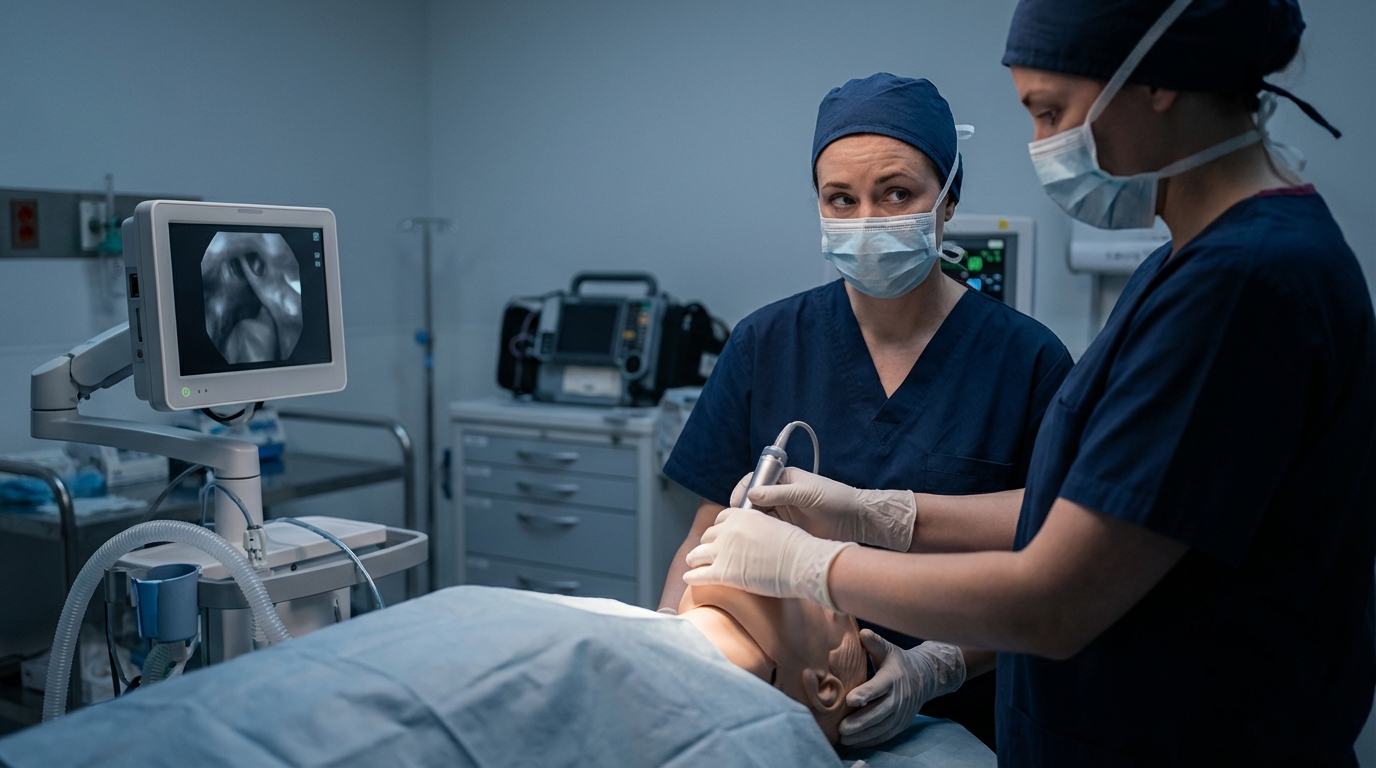
The "Cannot Intubate, Cannot Oxygenate" situation (CICO) represents the ultimate crisis in airway management. Despite all advances in technology and training, this scenario remains a real threat – and demands immediate, structured action from you. Mortality and the risk of hypoxic brain injury increase with every second without effective oxygenation. At the same time, analysis of critical incidents consistently reveals the same pattern: the main problem is not the failure of individual techniques, but rather the delayed recognition of the CICO situation and the failure to decide on Front-of-Neck Access (FONA). In this article, you will learn how to recognize a CICO situation early, what decision-making logic leads you to the surgical airway at the right time, and how to safely perform the individual FONA techniques.
Definition and Delineation of the CICO Situation
CICO means that neither endotracheal intubation nor oxygenation via supraglottic airway devices or bag-mask ventilation is successful. This is not isolated intubation failure – that alone could be managed through alternative strategies (videolaryngoscopy, supraglottic airways, wake-up). CICO is only present when all conventional options for oxygenation have failed and oxygen saturation is critically dropping.
The decisive criteria:
- Failed intubation: A maximum of three to four intubation attempts (depending on the algorithm), ideally using different techniques and operators
- Failed supraglottic oxygenation: Failure of the laryngeal mask or comparable devices
- Failed bag-mask ventilation: No adequate ventilation despite two-person technique, oropharyngeal/nasopharyngeal airways, and optimal head positioning
- Falling SpO₂: Typically below 90%, with a continuing downward trend
A common problem in practice: the clear declaration "This is now CICO" comes too late. This phenomenon is known as fixation error – the team persists with repeated intubation attempts even though a surgical airway is already indicated.
The Path to a CICO Situation: Risk Factors and Prevention
Not every difficult intubation leads to CICO. The combination of difficult intubation and difficult bag-mask ventilation and difficult supraglottic airway placement is the critical risk factor.
Predictors of Difficult Bag-Mask Ventilation
- Obesity (BMI > 30)
- Beard (poor mask seal)
- Edentulousness
- Obstructive sleep apnea / Mallampati III–IV
- Limited mouth opening
- Radiation therapy or tumors in the neck/facial area
Predictors of Difficult Intubation
- Limited mouth opening (< 3 cm)
- Limited cervical spine mobility
- Short thyromental distance (< 6 cm)
- Mallampati III–IV
- Retrognathia
- Pathologies: tumors, abscesses, edema, trauma in the upper airway area
Predictors of Difficult FONA
Equally important – and often forgotten – is the preoperative assessment of the anterior neck:
- Obesity with a short neck
- Goiter or other space-occupying lesions
- Previous neck radiation or surgery
- Non-palpable cricothyroid membrane
The pre-anesthetic evaluation should always include palpation of the cricothyroid membrane. In cases of anticipated difficult airway, marking with a pen before induction of anesthesia is advisable. Ultrasound can facilitate identification in cases of difficult anatomy.
The DAS Algorithm: A Structured Step-by-Step Approach
The Difficult Airway Society (DAS) has published one of the most widely used algorithms for unanticipated difficult airway management. It is organized into four plans:
Plan A: Bag-Mask Ventilation and Intubation
- Optimal positioning (sniffing position, ramping for obese patients)
- Preoxygenation with 100% O₂ for at least 3 minutes (target: etO₂ > 90%)
- Induction with anesthetic agent and neuromuscular blocking agent
- Laryngoscopy (direct or video) – maximum 3 attempts, the third by the most experienced person available
- If unsuccessful: Immediate switch to Plan B, no further intubation attempts
Crucial: Between attempts, oxygenation is maintained via bag-mask ventilation. If this is also suboptimal, urgency increases exponentially.
Plan B: Supraglottic Airway
- Insertion of a second-generation laryngeal mask (e.g., i-gel, LMA Supreme, Ambu AuraGain)
- Maximum three insertion attempts (recommended: two)
- Verification of ventilation: capnography is the gold standard here
- If oxygenation is successful: consider whether the procedure can continue via the laryngeal mask, or wake the patient and replan
Plan C: Bag-Mask Ventilation as a Fallback Option
Should the supraglottic airway also fail, bag-mask ventilation is reattempted – now as a rescue maneuver:
- Two-person technique (CE grip with both hands of one person, second person ventilates via bag)
- Insert oropharyngeal and nasopharyngeal airways
- Ensure neuromuscular blockade (complete paralysis improves bag-mask ventilation)
- If oxygenation succeeds: wake the patient and replan airway management
Plan D: Front-of-Neck Access – CICO Is Declared
When neither intubation, nor supraglottic airway, nor bag-mask ventilation achieves oxygenation, you are in the CICO situation. The surgical airway is now the only life-saving intervention. There is no Plan E.
Declaring the CICO Situation
One of the most critical moments is the explicit verbal declaration: "This is a CICO situation. We are now performing front-of-neck access." This announcement must be loud, clear, and unambiguous. It serves several purposes:
- Shared mental model: All team members know what is happening
- Overcoming the psychological barrier: The inhibition to surgically open the neck is significant. The explicit declaration helps to overcome this
- Role assignment: Who performs the cricothyroidotomy? Who assists? Who manages medications?
Studies on critical airway events consistently show that the average time from failed oxygenation to FONA is alarmingly long – often over 10 minutes. Every minute of hypoxia increases the risk of irreversible neurological damage.
Front-of-Neck Access: Techniques in Detail
Surgical Cricothyroidotomy (Scalpel-Bougie-Tube Technique)
The DAS guideline recommends surgical cricothyroidotomy as the technique of choice. The scalpel-bougie-tube technique is the best-evaluated method:
Step-by-step approach:
- Palpation of the cricothyroid membrane: Identify the thyroid cartilage, palpate the depression toward the cricoid cartilage. In difficult anatomy: vertical incision over the midline of the neck (approximately 8–10 cm vertically), then blunt dissection down to the cricothyroid membrane
- Horizontal stab incision through the cricothyroid membrane with a scalpel (blade No. 10 or 20). A horizontal incision minimizes the risk of vascular injury
- Rotate the scalpel 90° (blade edge pointing caudally) to keep the incision open – alternatively, immediately insert the bougie
- Insert a bougie (directed tracheally, toward caudal) through the incision. The tracheal rings should be palpable as a "clicking" sensation
- Advance a cuffed tube (ID 6.0 mm) over the bougie into the trachea
- Inflate the cuff, start ventilation, confirm placement via capnography
Important: This technique requires only three instruments – scalpel, bougie, tube. These should be readily available at every anesthesia and emergency workstation.
Needle Cricothyroidotomy
Percutaneous needle cricothyroidotomy with subsequent jet ventilation is mentioned as an alternative in some algorithms. However, its limitations are considerable:
- High failure rate (misdirected puncture, kinking of the cannula)
- Insufficient gas exchange with complete upper airway obstruction (expiration through the upper airway is required for jet ventilation)
- Risk of barotrauma with an obstructed expiratory pathway
- Not a definitive airway
Needle cricothyroidotomy is therefore not the recommended first-line technique in adults. In children under 8–10 years, the situation is different: needle cricothyroidotomy is preferred over the surgical approach due to anatomical considerations (small cricothyroid membrane, more elastic tissue).
Commercial Cricothyroidotomy Kits
Various commercial kits (e.g., Melker kit, Quicktrach) are available. Their advantages – Seldinger technique, familiar puncture technique – are offset by relevant disadvantages:
- Higher complication rate in stress situations compared to the surgical technique
- Dislocation during dilation
- Malpositioning (pretracheal, esophageal)
Current evidence and the DAS guideline favor the surgical scalpel technique as the simplest and most reliable method.
Anatomy of the Anterior Neck: What You Must Master
The cricothyroid membrane lies between the thyroid cartilage (cartilago thyroidea) and the cricoid cartilage (cartilago cricoidea). It measures on average 9 mm in height and 30 mm in width. The relevant anatomical relationships:
- Above: Thyroid cartilage (prominent Adam's apple, often less pronounced in women)
- Below: Cricoid cartilage
- Lateral: Superior cricothyroid artery (typically runs in the upper third of the membrane – therefore make the horizontal incision in the lower third)
- Anterior to the membrane: Subcutaneous tissue, considerable in obese patients
Correct identification is usually straightforward in slim men. In women, obese patients, and in the presence of neck edema, it can be extremely difficult. Techniques for identification:
- Laryngeal handshake: Gently grasp the larynx between thumb and index finger, then slide caudally over the prominence of the thyroid cartilage to the membrane
- Ultrasound: Linear probe, sagittal and transverse planes. Particularly valuable for preoperative marking in difficult anatomy
- Vertical incision as a surgical alternative: When the membrane is non-palpable, make an 8–10 cm vertical skin incision over the presumed midline, then bluntly retract tissue until the membrane is identified
Common Errors and Pitfalls
Analysis of CICO incidents reveals recurring patterns:
- Delayed declaration: The most common and most lethal error. Repeated intubation attempts instead of escalation to the surgical airway
- Lack of a mental algorithm: Without a previously thought-through and trained plan, the cognitive load during the crisis is too high for rational decision-making
- Equipment not readily available: Scalpel, bougie, and tube must be immediately accessible – not retrieved from a storage room
- Skin incision too small: Under stress, the incision is often made too timidly. A generous incision improves visualization and reduces the rate of malpositioning
- Failure to confirm placement: Even after cricothyroidotomy, capnography is mandatory. A pretracheally placed cannula is a fatal complication
- Fixation on one technique: If the surgical cricothyroidotomy does not succeed immediately, the incision must be extended and the access directly visualized – do not switch to needle cricothyroidotomy
Human Factors: The Underestimated Dimension
The CICO situation is not only a technical challenge but above all a human factors challenge. The following aspects deserve special attention:
- Authority gradients: Junior physicians hesitate to escalate the situation when senior colleagues are still attempting intubation. Flat hierarchies and an open error culture save lives
- Tunnel vision: Under stress, attention narrows. A dedicated decision maker on the team helps maintain situational awareness
- Action readiness: The psychological barrier to cutting open a person's neck is enormous. Regular training – ideally on cadaver models or realistic simulators – reduces this inhibition
- Cognitive aids: Laminated algorithm cards at the anesthesia workstation, checklists, and emergency cricothyroidotomy kits at a defined location provide support during the crisis
Management After Successful Cricothyroidotomy
Cricothyroidotomy is a temporary measure. After successful oxygenation:
- Confirm placement: Capnography, auscultation, bronchoscopy if needed
- Secure the tube: Careful fixation, as the insertion depth is shallow and the risk of dislocation is high
- Plan definitive airway management: Typically conversion to a formal tracheostomy by ENT/surgery under controlled conditions
- Documentation: Detailed documentation of airway management for future anesthetics (airway alert card)
- Debriefing: Post-event discussion with the entire team – both for clinical analysis and psychological processing
Special Considerations in Children
In children under 8–10 years, the cricothyroid membrane is significantly smaller and more difficult to identify. Surgical cricothyroidotomy is technically more challenging in this population. The recommendation is:
- Needle cricothyroidotomy with a cannula (14–16 G in small children, 14 G in older children)
- Transtracheal oxygenation via the cannula with low flow (1 L/kg/min as a guide, maximum 1 bar pressure)
- Beware of barotrauma: The expiratory pathway must remain open
- Early involvement of ENT/pediatric surgery
Practical Training
The CICO situation is rare – but when it occurs, every step must be second nature. Theoretical knowledge alone is not enough: surgical cricothyroidotomy, team communication under stress, and the decision to escalate can only be internalized through regular, realistic training. In the Emergency Physician Refresher Course by Simulation Tirol, you train exactly these high-risk scenarios in structured simulations – with feedback, debriefing, and the opportunity to build your confidence and competence for the real emergency.
More Articles
Acute Dyspnea: Differential Diagnosis and Immediate Management
Dyspnea has numerous causes ranging from asthma to heart failure to pulmonary embolism. This article presents a systematic approach to differentiation based on history, clinical examination, auscultation, and point-of-care diagnostics.
Acute Hypoglycemia: Emergency Management in Adults and Children
Threshold values, symptom recognition, oral glucose vs. IV dextrose vs. glucagon – with separate dosing for adult and pediatric patients. A common emergency presentation systematically reviewed.
Acute Adrenal Insufficiency: Addisonian Crisis in the Emergency Setting
Adrenal crisis is frequently misdiagnosed and can be fatal. This article describes at-risk patients, clinical signs, immediate hydrocortisone administration, and the management of accompanying hypoglycemia and hyperkalemia.