Cuff Pressure Measurement on the Endotracheal Tube: Target Values and Technique
Excessively high or low cuff pressure carries risks ranging from aspiration to tracheal ischemia. This article explains measurement methods, target values, and special considerations for cuffed pediatric tubes.

Author: Dr. med. univ. Daniel Pehböck, DESA
Specialist in Anesthesiology and Intensive Care Medicine, AHA-certified ACLS/PALS Instructor, Course Director Simulation Tirol
Reading time approx. 9 min
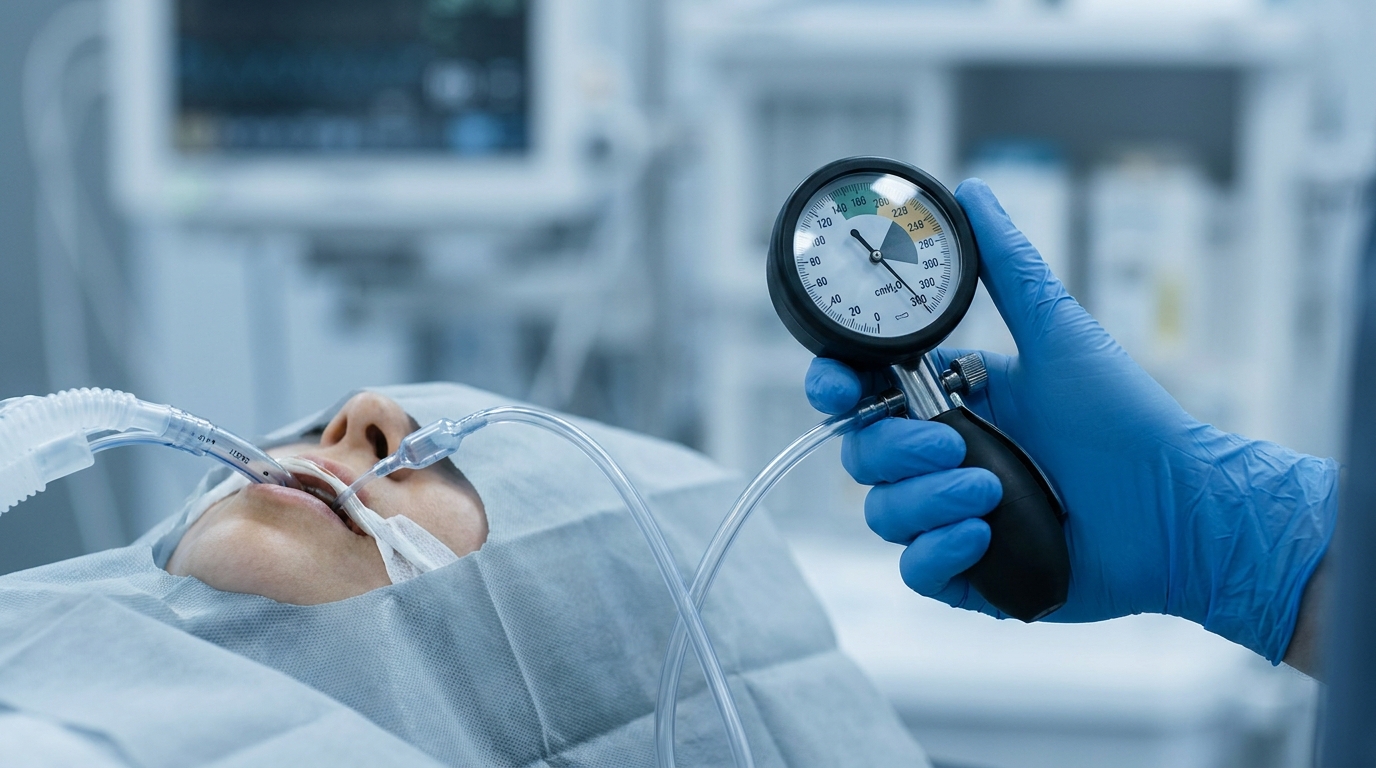
Correct cuff pressure measurement is one of those airway management measures that tends to be neglected in the hectic daily routine – whether in the trauma bay, the intensive care unit, or the prehospital setting. Yet cuff pressure on the endotracheal tube has a direct impact on two critical complications: aspiration of gastric secretions when pressure is too low, and tracheal ischemia when pressure is too high. Both scenarios can have fatal consequences for patients. Consistent measurement and documentation of cuff pressure is therefore not an optional quality feature but an essential component of every invasive airway management procedure.
Anatomical and Physiological Fundamentals
To understand the significance of cuff pressure, it is worth taking a brief look at the anatomy of the trachea. The human trachea consists of 16 to 20 horseshoe-shaped cartilaginous rings, connected dorsally by the pars membranacea – a muscular-connective tissue posterior wall. The tracheal mucosa is supplied by a capillary network with a perfusion pressure typically ranging between 25 and 35 mmHg.
When cuff pressure exceeds this capillary perfusion pressure, local ischemia of the tracheal mucosa occurs. If this condition persists for hours, mucosal necrosis, ulceration, and ultimately tracheal stenosis or tracheoesophageal fistulas may develop. Conversely, insufficient cuff pressure allows microaspiration of subglottic secretions – a major risk factor for ventilator-associated pneumonia (VAP).
The "Sweet Zone" of Cuff Pressure
The balance between aspiration protection and tissue preservation defines the recommended target range:
- Lower limit: 20 cmH₂O – below this value, reliable aspiration protection is not ensured
- Upper limit: 30 cmH₂O – above this value, the risk of mucosal ischemia increases significantly
- Optimal target range: 20–30 cmH₂O (approximately 15–22 mmHg)
These reference values apply to adults with high-volume low-pressure cuffs, which represent the standard in modern endotracheal tubes. Older low-volume high-pressure cuffs (red rubber tubes) have largely disappeared from clinical practice due to their unfavorable pressure profile.
Measurement Methods in Detail
Cuff Pressure Manometer (Gold Standard)
Measurement with a dedicated cuff pressure manometer is the method of choice. These handheld devices consist of a manometer, a connecting tube with Luer-Lock connector, and a valve for pressure regulation.
Step-by-Step Procedure:
- Connect the cuff pressure manometer to the pilot balloon port
- Read the current pressure on the manometer
- If pressure is too high: slowly release air via the relief valve until the target range is reached
- If pressure is too low: insufflate air using the integrated hand pump or an attached syringe
- Verify the target value and document
Important: When connecting the manometer, a so-called compliance error occurs – a small portion of the cuff air redistributes into the dead space of the manometer and the connecting tube, which can lead to an initial pressure drop. Modern manometers largely compensate for this error. Nevertheless, pressure should be rechecked after measurement.
Minimal Occluding Volume (MOV) / Minimal Leak Technique (MLT)
This method is used when no manometer is available – for example, in the prehospital setting or in emergency situations.
Minimal Occluding Volume Technique:
- Place the stethoscope laterally over the thyroid cartilage
- Completely deflate the cuff
- Slowly insufflate air into the pilot balloon via a syringe
- Simultaneously auscultate with the stethoscope for an audible leak
- Insufflate exactly the volume at which the leak sound just disappears
Minimal Leak Technique:
- The procedure is analogous to the MOV technique, but after the leak disappears, a minimal amount of air is released so that a just-audible leak remains at peak inspiration
- This technique further minimizes cuff pressure but provides less aspiration protection
Both techniques are less precise than manometric measurement and should be considered a stopgap solution. They do not replace verification with a manometer once one becomes available.
The "Palpation Check" – Why It Is Inadequate
Palpation of the pilot balloon between thumb and index finger is a widespread but demonstrably unreliable method. Studies show that even experienced personnel regularly overestimate or underestimate actual cuff pressure through palpation. In a widely cited study, over 50% of cuff pressures set by palpation were outside the recommended range.
Conclusion: Palpation of the pilot balloon is not acceptable as the sole method for cuff pressure adjustment. At best, it can serve as a rough guide until a manometer is used.
Automatic Cuff Pressure Regulators
For long-term ventilation in intensive care units, electronic and pneumatic cuff pressure regulators are available. These devices continuously maintain the cuff pressure within the target range and compensate for pressure fluctuations caused by position changes, temperature changes of the breathing gas, or diffusion processes.
Advantages:
- Continuous monitoring and adjustment
- Reduction of pressure peaks (e.g., during coughing or straining)
- Proven reduction in microaspiration rates
Disadvantages:
- Higher costs
- Technical failure points (tubing disconnection, device malfunction)
- No substitute for clinical monitoring
Common Causes of Cuff Pressure Deviations
In practice, cuff pressures outside the target range are found surprisingly often. The reasons are varied:
Excessively High Cuff Pressure (> 30 cmH₂O)
- Nitrous oxide (N₂O): Diffuses rapidly through the cuff membrane and increases cuff volume – particularly relevant in anesthesia during nitrous oxide-based general anesthesia. Regular checks every 30 minutes are mandatory in this setting.
- Over-inflation after intubation: Often caused by unconscious "safety inflation" – the mistaken assumption that more air in the cuff means more safety.
- Temperature increase: Warming of the insufflated gas (e.g., by body temperature or heated humidification) leads to volume expansion.
- Head and neck repositioning: Extension and flexion of the neck can change cuff pressure by up to 30%.
- Altitude changes: During helicopter transport, cuff pressure can rise significantly with increasing altitude – an often underestimated factor in helicopter emergency medical services.
Excessively Low Cuff Pressure (< 20 cmH₂O)
- Diffusion: Particularly during prolonged intubation, air slowly diffuses through the cuff membrane.
- Suctioning maneuvers: Tracheal suctioning can temporarily reduce cuff pressure.
- Leaks in the pilot balloon system: Defective valves or damaged supply lines.
- Tube malposition: If the cuff is positioned at the level of the larynx rather than in the trachea, it cannot adequately seal the trachea.
Measurement Frequency and Documentation
There are no uniform, internationally binding guidelines for measurement frequency. However, the following recommendations have become established as clinical standards:
- After every intubation: Immediate cuff pressure measurement
- Intensive care unit: At least every 6–8 hours, ideally at every shift change
- During nitrous oxide anesthesia: Every 30 minutes
- After repositioning or transport: Check immediately afterward
- In the prehospital setting: Measurement after intubation, again at hospital handover, and after every transport with altitude changes
- When clinical signs of aspiration are present: Immediate check
Documentation should include the measured value, the time, and any corrections made. Ideally, cuff pressure is recorded on the ventilation chart or in the anesthesia record.
Special Considerations for Cuffed Pediatric Tubes
The use of cuffed tubes in children was controversial for a long time but has increasingly become established as the standard based on current evidence and guideline recommendations – including in neonates and infants. Modern pediatric cuffs (e.g., Microcuff tubes) are specifically designed for pediatric anatomy and feature an optimized design.
Anatomical Considerations in Children
- The pediatric trachea is shorter, softer, and has a smaller diameter.
- The narrowest point in children is subglottic (at the level of the cricoid cartilage), not glottic.
- The tracheal mucosa is more vulnerable and more sensitive to pressure.
- The ratio of cuff contact area to tracheal surface area is less favorable than in adults.
Target Values in Children
- Recommended cuff pressure: maximum 20 cmH₂O – significantly lower than in adults
- Some authors even recommend values between 10 and 15 cmH₂O, provided adequate aspiration protection is maintained
- The Minimal Leak Technique is particularly valuable in children, as it ensures the lowest possible cuff pressure
Tube Selection and Cuff Design
Modern pediatric tubes such as the Microcuff feature an ultra-thin polyurethane cuff that conforms evenly and wrinkle-free to the tracheal wall. Unlike PVC cuffs, polyurethane cuffs develop fewer folds (so-called "channeling") through which subglottic secretions could be aspirated.
Recommendations for tube size in cuffed pediatric tubes:
- For children from 1 year of age: Internal diameter (mm) = (age in years / 4) + 3.5
- This formula applies specifically to cuffed tubes; for uncuffed tubes, a half-size larger is typically chosen
- The final tube size must always be clinically verified (leak test, cuff pressure)
Common Mistakes in Children
- Over-inflation: The most common mistake. Since pediatric cuffs respond more sensitively to volume changes, even small amounts of additional air lead to disproportionate pressure increases.
- No manometer measurement: Especially in children, palpation of the pilot balloon is even more unreliable than in adults.
- Forgetting to recheck after repositioning: Children are repositioned more frequently (e.g., during surgery), which can significantly alter cuff pressure.
Complications from Inadequate Cuff Pressure
Short-Term Complications
| Too Low Pressure (< 20 cmH₂O) | Too High Pressure (> 30 cmH₂O) |
|---|---|
| Microaspiration, macroaspiration | Mucosal ischemia |
| Leak with ineffective ventilation | Impaired mucociliary clearance |
| Unreliable capnography | Pain/coughing in awake patients |
| Contamination of the ventilation system | Nerve damage (recurrent laryngeal nerve) |
Long-Term Complications (with Prolonged Intubation)
- Tracheal stenosis: The most common serious long-term complication, often not becoming symptomatic until weeks after extubation
- Tracheoesophageal fistula: A rare but life-threatening complication with extreme cuff pressure in combination with a nasogastric tube
- Tracheomalacia: Softening of tracheal cartilage due to prolonged pressure
- Granulomas and scarring: Reactive tissue proliferation at the cuff contact site
Tips for Clinical Practice
- A cuff pressure manometer belongs at every intubation station – in the hospital as well as in the prehospital setting.
- Standardize routine measurement: Integrate cuff pressure as a fixed component in checklists and handover protocols.
- Don't forget documentation: What is not documented is considered not measured.
- Situational adjustment: Actively think about cuff pressure with nitrous oxide use, altitude changes, or repositioning.
- Children require special attention: Lower target values, more frequent checks, manometric measurement is mandatory.
- When in doubt, remeasure: Better to check one time too many than one time too few.
- Create team awareness: Cuff pressure management is not solely the responsibility of anesthesia – nursing staff and prehospital providers must also master the measurement.
Algorithm for Cuff Pressure Management
- Intubation performed → Inflate cuff
- Immediately: Measure cuff pressure with manometer
- Target value reached?
- Adults: 20–30 cmH₂O
- Children: ≤ 20 cmH₂O (ideally 10–15 cmH₂O with adequate seal)
- Too high: Release air via valve, remeasure
- Too low: Insufflate air, remeasure
- Document the value
- Regular checks according to the clinical situation
- Remeasure with every repositioning, every transport, change in ventilation parameters, or clinical suspicion of leak/aspiration
Practical Training
Correct cuff pressure measurement is a technically simple but clinically highly relevant skill that should be learned and regularly refreshed as part of structured airway management training. In our ACLS course at Simulation Tirol, you train not only advanced airway management – including correct cuff technique – but also all other aspects of cardiopulmonary resuscitation according to AHA guidelines. Hands-on work with simulators allows you to develop routines that can be recalled automatically in real emergencies. Because it is precisely the supposedly "small" measures – like controlled cuff pressure – that collectively make the difference for your patients' outcomes.
Want to practice this hands-on?
In our ACLS-Kurs (Advanced Cardiac Life Support) you practice this topic hands-on with high-tech simulators and experienced instructors.
More Articles
Acute Dyspnea: Differential Diagnosis and Immediate Management
Dyspnea has numerous causes ranging from asthma to heart failure to pulmonary embolism. This article presents a systematic approach to differentiation based on history, clinical examination, auscultation, and point-of-care diagnostics.
Acute Hypoglycemia: Emergency Management in Adults and Children
Threshold values, symptom recognition, oral glucose vs. IV dextrose vs. glucagon – with separate dosing for adult and pediatric patients. A common emergency presentation systematically reviewed.
Acute Adrenal Insufficiency: Addisonian Crisis in the Emergency Setting
Adrenal crisis is frequently misdiagnosed and can be fatal. This article describes at-risk patients, clinical signs, immediate hydrocortisone administration, and the management of accompanying hypoglycemia and hyperkalemia.