Crush Syndrome: Pathophysiology and Field Emergency Management
After extrication from entrapment, life-threatening reperfusion injury looms. This article explains the pathomechanisms, volume therapy before extrication, and hyperkalemia prophylaxis.

Author: Dr. med. univ. Daniel Pehböck, DESA
Specialist in Anesthesiology and Intensive Care Medicine, AHA-certified ACLS/PALS Instructor, Course Director Simulation Tirol
Reading time approx. 9 min
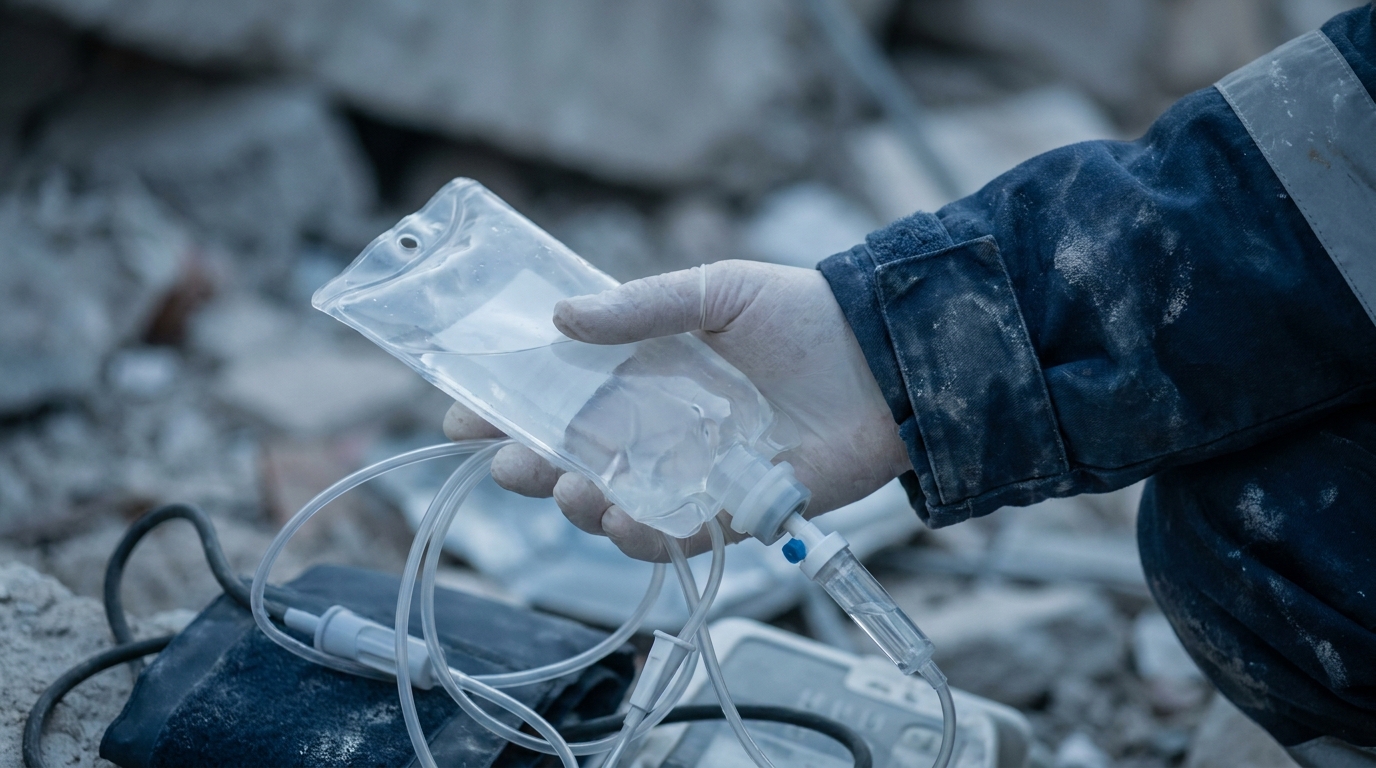
Crush syndrome is one of the most insidious emergencies in prehospital medicine. While the trapped person may still be conscious and seemingly stable beneath the rubble, the real danger lurks at the moment of extrication: with reperfusion of the ischemic musculature, toxic metabolites are flushed into the systemic circulation, potentially causing lethal cardiac arrhythmias, renal failure, and irreversible shock within minutes. Understanding crush syndrome means recognizing the critical time-dependency between compression duration, volume therapy, and the timing of extrication — and being able to decisively influence the patient's survival through targeted interventions even before liberation.
Definitions and Differentiation
Before diving into the pathophysiology, it is worth establishing clear terminology, as the nomenclature is often used imprecisely in the literature.
Crush Injury vs. Crush Syndrome
- Crush Injury: Refers to the local tissue damage caused by direct mechanical compression — regardless of whether systemic complications occur.
- Crush Syndrome (Bywaters Syndrome): Describes the systemic manifestation following reperfusion of crushed musculature: rhabdomyolysis, hyperkalemia, metabolic acidosis, acute renal failure, and shock.
- Traumatic Rhabdomyolysis: An umbrella term for skeletal muscle breakdown of traumatic origin; crush syndrome is its most common and clinically most significant subtype.
The critical clinical insight: Compression alone does not kill immediately — decompression does. This understanding is the foundation of all field therapy.
Epidemiology and Typical Scenarios
Crush syndrome classically occurs in:
- Earthquakes and building collapses (up to 20% of survivors trapped under rubble)
- Burial under avalanches, mudslides, or industrial accidents
- Entrapment in motor vehicle accidents with prolonged extrication times
- Unconscious individuals after intoxication (positional trauma on an extremity over hours)
Compression of more than one hour on a significant muscle mass — particularly thighs, buttocks, or trunk — is sufficient to trigger a life-threatening crush syndrome upon reperfusion. Mortality without adequate therapy ranges from 30–50%, depending on severity.
Pathophysiology: What Happens at the Cellular Level?
Understanding the pathomechanisms is the key to rational therapy. The process can be divided into three phases.
Phase 1: Compression and Ischemia
Sustained mechanical pressure leads to:
- Direct myocyte destruction through mechanical cell disruption
- Ischemia due to compression of the supplying vessels
- Edema formation within the compartment with secondary perfusion deterioration
- ATP depletion in muscle cells: The Na⁺/K⁺-ATPase and the Ca²⁺-ATPase of the sarcoplasmic reticulum fail
The intracellular potassium content of a muscle cell is approximately 150 mmol/L — upon cell death, this potassium is released. Simultaneously, calcium floods uncontrollably into the cell and activates proteolytic enzymes that accelerate cell destruction.
Phase 2: Reperfusion — the "Lethal Flush"
With decompression and restoration of blood flow, the following substances are abruptly flushed into the systemic circulation:
| Substance | Pathological Effect |
|---|---|
| Potassium (K⁺) | Hyperkalemia → cardiac arrhythmias up to asystole |
| Myoglobin | Tubular obstruction → acute renal failure |
| Phosphate | Complex formation with calcium → hypocalcemia |
| Lactate and organic acids | Metabolic acidosis → potentiates hyperkalemia effects |
| Uric acid | Additional nephrotoxicity |
| Thromboplastin | DIC (disseminated intravascular coagulation) |
Additionally, massive third-space fluid loss occurs: the reperfused, damaged musculature absorbs enormous volumes of fluid — up to 12 liters in the first 48 hours. This leads to hypovolemic shock, even in the absence of external hemorrhage.
Phase 3: Systemic Complications
The cascade of systemic complications develops over the hours and days following reperfusion:
- Hyperkalemia: Occurs within minutes of decompression. The combination of hyperkalemia and acidosis is particularly arrhythmogenic. Potassium levels as low as 6.5 mmol/L can be lethal in the setting of concurrent acidosis.
- Acute renal failure: Myoglobin precipitates in the acidic environment of the tubules and forms obstructing casts. Additionally, free myoglobin is directly nephrotoxic through the generation of reactive oxygen species.
- Hypovolemic shock: Due to fluid sequestration into the damaged musculature.
- Compartment syndrome: The reperfused musculature swells massively — pre-existing compartment pressure elevations worsen.
- DIC: Due to released thromboplastin and tissue factor.
- ARDS: Due to systemic inflammation and capillary leak.
Prehospital Management: Therapy Before Extrication
Crush syndrome is one of the few emergency situations in which therapy must begin before definitive extrication. The time window between gaining access to the trapped person and actual extrication is the critical intervention phase.
Fundamental Decision: When Should You Anticipate Crush Syndrome?
Rules of thumb for risk assessment:
- Compression time > 1 hour on a larger muscle mass → high risk
- Compression time > 4 hours → near-certain occurrence when large muscle groups are involved
- Compression time < 1 hour on a single extremity → low risk, but not excluded
- Significant muscle mass involved: Thigh > lower leg > upper arm; trunk musculature is particularly dangerous
Volume Therapy: Aggressive Fluid Administration Before Decompression
Intravenous volume therapy is the single most important intervention and should ideally be initiated before extrication — provided vascular access can be established.
Recommended approach:
- Fluid of choice: Normal saline (NaCl 0.9%)
- Initial bolus: 1,000–2,000 mL NaCl 0.9% before decompression, ideally over 1 hour
- Why NaCl 0.9% and not balanced solutions? Ringer's lactate and other balanced solutions contain potassium (typically 4–5 mmol/L) — this is counterproductive when hyperkalemia is imminent. NaCl 0.9% is potassium-free.
- Continuation after extrication: 1,000–1,500 mL/h for the first hours, targeting urine output of 200–300 mL/h
- Total volume in the first 24 hours: Often 6–12 liters or more, depending on compression duration and affected muscle mass
Aggressive volume administration pursues several goals simultaneously: dilution of released toxins, maintenance of renal perfusion, increasing tubular flow to prevent myoglobin precipitation, and compensation of third-space losses.
Hyperkalemia Prophylaxis and Treatment
Since hyperkalemia is the most immediately life-threatening complication, it must be anticipated and treated aggressively.
Stepwise hyperkalemia treatment in the field:
Calcium gluconate 10% — Membrane stabilization:
- Dose: 10–30 mL (equivalent to 1–3 ampoules of 10 mL) slow IV push
- Mechanism of action: Antagonizes the cardiotoxic effect of potassium on the myocardium but does not lower the potassium level
- Onset of action: 1–3 minutes
- Duration of action: 30–60 minutes
- May be repeated if ECG changes persist
- Caution: In patients on digitalis — administer slowly over 20 minutes
Sodium bicarbonate 8.4%:
- Dose: 50–100 mmol (50–100 mL of the 8.4% solution) IV
- Mechanism of action: Alkalinizes the blood → shifts potassium intracellularly; additionally alkalinizes the urine to protect the tubules from myoglobin precipitation
- Particularly useful in the setting of concurrent metabolic acidosis
Glucose-insulin infusion:
- Dose: 10 IU regular insulin + 25 g glucose (e.g., 50 mL D50% or 250 mL D10%) IV
- Mechanism of action: Insulin activates Na⁺/K⁺-ATPase → intracellular potassium shift
- Onset of action: 15–30 minutes
- Potassium reduction: approximately 0.5–1.5 mmol/L
- Mandatory: Frequent blood glucose monitoring
Salbutamol (albuterol) nebulized:
- Dose: 10–20 mg nebulized (4 to 8 times the standard asthma dose!)
- Mechanism of action: β₂-stimulation → intracellular potassium shift
- Additive effect with glucose-insulin therapy
- Caution: Tachycardia
ECG Monitoring: Non-Negotiable
Continuous 12-lead ECG or at minimum rhythm monitoring is mandatory from the moment access to the trapped person is gained. The typical sequence of hyperkalemia-associated ECG changes:
- Tall, peaked, symmetrical T-waves (earliest sign)
- Prolongation of the PR interval
- Flattening of P-waves progressing to loss
- QRS widening
- Sine wave configuration
- Ventricular fibrillation or asystole
Calcium gluconate must be administered as soon as peaked T-waves appear — waiting for laboratory results is unacceptable in the field context.
Tourniquets: A Controversial Bridging Measure
Placement of a tourniquet proximal to the trapped extremity before decompression is a long-debated concept:
- Rationale: Prevents the immediate washout of toxins and buys time for volume therapy
- Risks: Prolonged ischemia of the already damaged extremity, worsening of tissue injury, renewed reperfusion surge upon tourniquet removal
- Current assessment: May be considered as a bridging measure when adequate volume therapy before decompression is not feasible. Not a substitute for volume therapy. If applied, controlled, stepwise release under monitoring
Urine Alkalinization
Urine alkalinization is a central protective measure against myoglobin-induced tubular necrosis:
- Target urine pH: > 6.5 (ideally > 7.0)
- Method: Sodium bicarbonate 8.4% added to the infusion solution (e.g., 50 mmol NaHCO₃ per 1,000 mL NaCl 0.9%)
- Rationale: Myoglobin precipitates at acidic pH; in an alkaline environment, it remains in solution and is renally excreted
- Monitoring: Urine pH test strips, if available
Field Algorithm: Step-by-Step Approach
For the structured management of a trapped person with suspected crush syndrome, the following approach is recommended:
- Safety and access: Ensure scene safety, establish access to the patient
- Primary assessment: ABCDE approach, level of consciousness, vital signs
- Entrapment history: Estimated compression time? Which body regions are affected? Muscle mass involved?
- Vascular access: At least 2 large-bore IVs (≥ 18 G), ideally in an unaffected extremity
- Initiate ECG monitoring
- Begin volume therapy: 1,000–2,000 mL NaCl 0.9% before extrication
- Hyperkalemia prophylaxis: Calcium gluconate 10% — 10 mL IV prophylactically if compression > 4 hours
- Sodium bicarbonate: 50 mmol IV for acidosis buffering and urine alkalinization
- Coordinate extrication: Close communication with the rescue team — decompression only after volume therapy has been initiated
- Post-decompression monitoring: Frequent vital signs checks, immediate hyperkalemia treatment if ECG changes occur
- Transport: Destination hospital with dialysis capability and intensive care unit
In-Hospital Continuation of Care: What Awaits the Patient?
Although this article focuses on field therapy, understanding the in-hospital management is relevant for prehospital decision-making:
- Hemodialysis: Often necessary within the first 24 hours for potassium elimination and volume control
- Continued aggressive volume therapy: Target remains a diuresis of 200–300 mL/h
- Compartment syndrome management: Fasciotomy when compartment pressure > 30 mmHg or clinical signs are present
- Amputation: In select cases required as a life-saving measure when the extent of rhabdomyolysis is not survivable
- Intensive care monitoring: Electrolytes every 2–4 hours, myoglobin trends, renal function, coagulation status
Special Situations and Pitfalls
The "Talking Dead"
A classic and tragic phenomenon: patients who are fully awake and oriented while trapped under rubble die within minutes of extrication from ventricular fibrillation caused by hyperkalemia. This phenomenon underscores the necessity of therapy before decompression.
Mass Casualty Incidents (MCI)
In earthquakes or large-scale disaster events with multiple trapped victims, crush syndrome poses a particular challenge for triage: ambulatory, responsive individuals under rubble may become the most acutely endangered patients after extrication. Sufficient quantities of NaCl 0.9%, calcium gluconate, and sodium bicarbonate must be calculated in advance.
Hypothermia as a Cofactor
Particularly in avalanche burials, hypothermia adds an additional risk factor to the compression. This combination is especially dangerous, as the hypothermic myocardium is even more sensitive to hyperkalemia. Treatment of hyperkalemia takes absolute priority in these cases.
Positional Trauma in Intoxicated Individuals
An often-overlooked scenario: unconscious individuals after alcohol or drug intoxication who have been lying on an extremity for hours. Crush syndrome is frequently recognized late in these cases, as the initial focus is on the intoxication. In every person with prolonged unconsciousness and a swollen, painful extremity, crush syndrome must be considered.
Summary of Key Points
- Crush syndrome is a reperfusion syndrome — the danger arises during decompression
- Hyperkalemia is the immediately lethal threat
- Volume therapy with NaCl 0.9% must begin before extrication
- Calcium gluconate stabilizes the myocardium against the cardiotoxic effects of potassium
- Sodium bicarbonate corrects acidosis and alkalinizes the urine to protect the kidneys
- Destination hospital: facility with dialysis capability
- ECG monitoring from the moment access to the trapped person is established
- The tourniquet concept is a bridging measure, not a substitute for volume therapy
Practical Training
Crush syndrome is one of those emergencies that occurs rarely but can rapidly become fatal if initial management is inadequate. The decision-making chains — from recognizing the risk constellation, to volume therapy before extrication, to hyperkalemia treatment under time pressure — can only be internalized through practical training. In the emergency physician refresher course by Simulation Tirol, exactly these complex scenarios are practiced in realistic simulation environments, so that the algorithms are second nature when it counts. You can find more information at www.simulationtirol.com.
More Articles
Acute Dyspnea: Differential Diagnosis and Immediate Management
Dyspnea has numerous causes ranging from asthma to heart failure to pulmonary embolism. This article presents a systematic approach to differentiation based on history, clinical examination, auscultation, and point-of-care diagnostics.
Acute Hypoglycemia: Emergency Management in Adults and Children
Threshold values, symptom recognition, oral glucose vs. IV dextrose vs. glucagon – with separate dosing for adult and pediatric patients. A common emergency presentation systematically reviewed.
Acute Adrenal Insufficiency: Addisonian Crisis in the Emergency Setting
Adrenal crisis is frequently misdiagnosed and can be fatal. This article describes at-risk patients, clinical signs, immediate hydrocortisone administration, and the management of accompanying hypoglycemia and hyperkalemia.