Altered Mental Status: Systematic Assessment Using the ABCDE Approach
The structured initial assessment of patients with altered consciousness is essential in both prehospital and in-hospital settings. This article describes the ABCDE approach, GCS assessment, important differential diagnoses (stroke, hypoglycemia, intoxication), and immediate interventions.

Author: Dr. med. univ. Daniel Pehböck, DESA
Specialist in Anesthesiology and Intensive Care Medicine, AHA-certified ACLS/PALS Instructor, Course Director Simulation Tirol
Reading time approx. 9 min
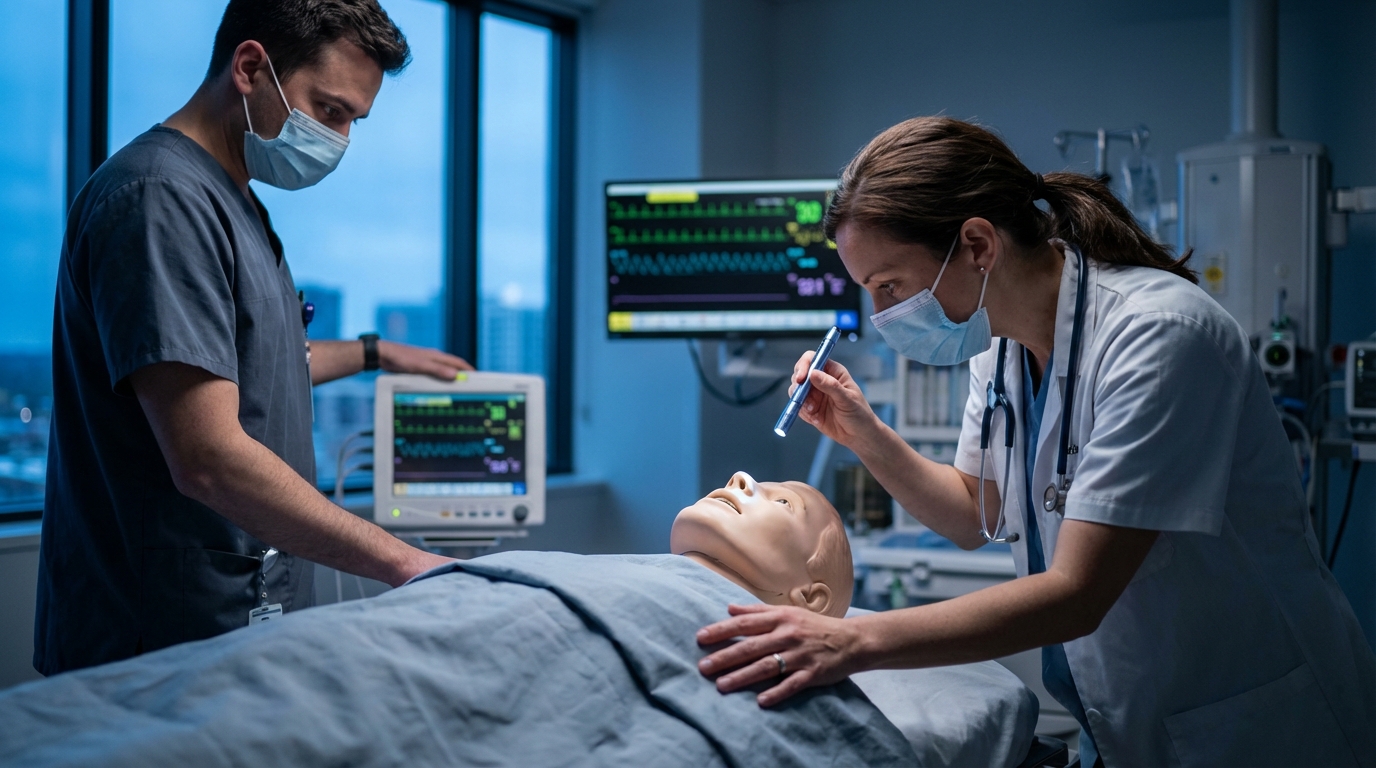
Patients with altered mental status are among the most challenging and most common situations in emergency medicine. Whether in the resuscitation bay, the intensive care unit, or the prehospital setting: if you master the structured approach, you gain time and minimize the risk of overlooking treatable causes. The ABCDE approach gives you exactly this toolkit. It forces you into a clear sequence, prioritizes life-threatening conditions, and prevents you from getting lost in differential diagnoses before vital functions are secured. In the following, we walk through the systematic initial assessment of patients with altered consciousness step by step – from airway management to the Glasgow Coma Scale (GCS) and the critical differential diagnoses.
Why Structure Is Crucial
Altered mental status ranges from mild somnolence to deep coma. The causes are diverse: metabolic, vascular, traumatic, toxic, infectious, epileptic. Precisely because the spectrum is so broad, there is a danger of getting bogged down in diagnostic considerations while the patient deteriorates due to an unsecured airway. The ABCDE approach – originally established as the "Primary Survey" in trauma management – has proven itself as a universal framework for any acute threat. It follows the principle: Treat first what kills first. Each letter represents an area that is assessed and stabilized before you move on to the next. Only after A through E have been completed does the targeted search for the underlying cause follow.
A – Airway: Secure the Airway
In patients with altered mental status, the airway is the first and most critical concern. The loss of protective reflexes – cough reflex, swallowing reflex – makes aspiration an immediate danger.
Immediate Interventions
- Inspection: Open the oral cavity and oropharynx, remove foreign bodies or vomitus (manual extraction, suctioning).
- Basic maneuvers: Prefer the jaw thrust maneuver, especially when cervical spine trauma is suspected. Alternatively, head-tilt-chin-lift if trauma has been ruled out.
- Adjuncts: Oropharyngeal airway (OPA) when protective reflexes are absent, nasopharyngeal airway (NPA) when reflexes are still present.
- Definitive airway management: Endotracheal intubation or supraglottic airway device (laryngeal mask airway, laryngeal tube) for GCS ≤ 8 or absent protective reflexes. The decision to intubate should not be unnecessarily delayed.
Practical Tip
A GCS score of ≤ 8 is the classic threshold for definitive airway management – but it is not a rigid dogma. The clinical assessment is what matters: a patient with a GCS of 9 who is repeatedly vomiting and shows no adequate cough reflex also needs a definitive airway. Conversely, in a rapidly reversible condition (e.g., postictal phase), a watch-and-wait approach under close monitoring may be appropriate.
B – Breathing: Ventilation and Oxygenation
After securing the airway, you assess ventilation. A patent airway alone is useless if respiratory mechanics or gas exchange are impaired.
Clinical Assessment
- Respiratory rate: Tachypnea (> 20/min), bradypnea (< 10/min), or pathological breathing patterns (Cheyne-Stokes, Biot's respiration, Kussmaul breathing) provide clues to the cause of the altered consciousness.
- Auscultation: Equal bilateral air entry? Crackles suggesting aspiration or pulmonary edema?
- SpO₂ monitoring: Target ≥ 94% (88–92% in COPD patients).
- Capnography: If available, end-tidal CO₂ provides valuable information – regarding both ventilation and circulatory status.
Pathological Breathing Patterns as Diagnostic Clues
| Breathing Pattern | Possible Cause |
|---|---|
| Cheyne-Stokes | Bihemispheric lesion, heart failure, elevated intracranial pressure |
| Central hyperventilation | Midbrain lesion, metabolic acidosis |
| Kussmaul breathing | Diabetic ketoacidosis, uremia, metabolic acidosis |
| Ataxic breathing (Biot's) | Pontine/medullary lesion – warning sign for impending respiratory arrest |
| Apneic episodes | Medullary damage, severe intoxication |
C – Circulation: Assess the Circulatory Status
Hemodynamic instability can be both a cause and a consequence of altered mental status. Shock of any etiology – hypovolemic, cardiogenic, septic, anaphylactic – leads to impaired consciousness through cerebral hypoperfusion.
Systematic Approach
- Pulse: Rate, rhythm, quality (thready?). Carotid pulse as a minimum in unconscious patients.
- Blood pressure: Treat hypotension (MAP < 65 mmHg) immediately. Hypertensive emergency may indicate elevated intracranial pressure (Cushing reflex: hypertension + bradycardia) or hypertensive encephalopathy.
- Capillary refill time: > 3 seconds as a sign of shock.
- 12-lead ECG: Arrhythmias as the cause of hypoperfusion? Bradyarrhythmias, ventricular tachycardias, AV blocks.
- Large-bore IV access: At least one peripheral IV (preferably two, 16–18 G) for fluid and medication administration.
Immediate Interventions for Circulatory Instability
- Fluid resuscitation: Crystalloids (balanced electrolyte solution) as an initial bolus of 500 mL, then reassess the effect.
- Vasopressors: For volume-refractory hypotension, norepinephrine via infusion pump (starting dose 0.05–0.1 µg/kg/min); alternatively, epinephrine in anaphylactic shock (0.3–0.5 mg intramuscular as the initial intervention).
- Trendelenburg positioning: In hypotension without signs of elevated intracranial pressure, elevate the legs.
D – Disability: Neurological Status
This is where you get to the core of the altered mental status. The neurological assessment within the ABCDE approach is deliberately focused – it is not intended to replace a complete neurological examination but rather to provide essential information in the shortest time possible.
Glasgow Coma Scale (GCS)
The GCS remains the standard for quantitative assessment of the level of consciousness. It comprises three components:
Eye Opening (E – Eye Response):
- 4 = Spontaneous
- 3 = To voice
- 2 = To pain
- 1 = No response
Verbal Response (V – Verbal Response):
- 5 = Oriented, conversant
- 4 = Confused, disoriented
- 3 = Inappropriate words
- 2 = Incomprehensible sounds
- 1 = No verbal response
Motor Response (M – Motor Response):
- 6 = Obeys commands
- 5 = Localizes pain
- 4 = Withdrawal (flexion)
- 3 = Abnormal flexion (decorticate)
- 2 = Extension (decerebrate)
- 1 = No motor response
Important: Always document the individual component scores (e.g., E2V3M4 = GCS 9), not just the total. The motor component has the highest predictive value. Be aware of confounders: intubated patients cannot give a verbal response (note Vt = tube), periorbital swelling prevents assessment of eye opening.
Pupils
- Bilaterally dilated and fixed: Cerebral anoxia, severe brainstem injury, epinephrine administration, atropine effect.
- Unilaterally dilated and fixed: Ipsilateral herniation (transtentorial herniation) – absolute emergency!
- Bilaterally constricted (miosis): Opioid intoxication, pontine hemorrhage.
- Anisocoria with preserved light reaction: Physiological in approximately 20% of the population – consider the clinical context.
Additional Rapid Neurological Checks
- Measure blood glucose – immediately! Hypoglycemia is the most common rapidly reversible cause of altered mental status.
- Lateralizing signs: Hemiparesis, facial asymmetry, unilateral Babinski sign → stroke?
- Neck stiffness: Meningism suggesting meningitis or subarachnoid hemorrhage (caution in trauma – do not test cervical spine mobility before imaging).
E – Exposure/Environment: Undress and Assess the Environment
The last step of the primary survey is often neglected but frequently provides crucial clues.
What You Should Look For
- Body temperature: Hyperthermia (sepsis, serotonin syndrome, malignant hyperthermia, heat stroke) or hypothermia (exposure, myxedema coma, intoxication).
- Skin inspection: Petechiae (meningococcal sepsis), jaundice (liver failure), needle marks (drug abuse), rash (anaphylaxis), cyanosis.
- Signs of trauma: Contusions, hematomas, Battle's sign (mastoid hematoma), raccoon eyes, CSF leakage from the nose or ear.
- Environmental information: Medication packaging, suicide notes, drug paraphernalia, CO detectors.
- Thermal protection: After inspection, immediately cover the patient again – hypothermia worsens the prognosis in virtually all emergencies.
Key Differential Diagnoses at a Glance
After completing the primary survey and stabilization, the targeted search for the underlying cause begins. The acronym AEIOU-TIPS is a well-established mnemonic:
- A – Alcohol, Acidosis
- E – Epilepsy, Electrolyte disturbances, Encephalopathy
- I – Insulin (Hypoglycemia/Hyperglycemia)
- O – Opiates, Overdose (Intoxication)
- U – Uremia
- T – Trauma, Temperature
- I – Infection (Meningitis, Encephalitis, Sepsis)
- P – Psychiatric, Porphyria
- S – Stroke, Subarachnoid hemorrhage, Shock
Three Differential Diagnoses in Detail
Stroke
Time-critical like almost no other diagnosis. Look for acute-onset focal neurological deficits: hemiparesis, aphasia, dysarthria, visual field defect, gaze deviation. Use the FAST test (Face–Arm–Speech–Time) as a screening tool. If suspected: immediate imaging (non-contrast CT to rule out hemorrhage). The target time from symptom onset to thrombolysis (alteplase 0.9 mg/kg body weight, maximum 90 mg, 10% as a bolus, the remainder over 60 minutes) or mechanical thrombectomy is crucial for outcome. Lower blood pressure only if > 220/120 mmHg (if thrombolysis is planned, > 185/110 mmHg).
Hypoglycemia
Known as "The Great Imitator" – it can mimic any neurological symptom: from mild confusion to focal deficits, coma, and seizures. Blood glucose measurement therefore belongs in the D-step of every ABCDE assessment. Treatment:
- In alert patients: oral glucose intake (dextrose tablets, juice).
- In patients with altered consciousness: Dextrose 40% 10–20 mL IV (= 4–8 g glucose), titrated to effect. Alternatively, glucagon 1 mg IM/SC/IN if no IV access is available.
- Follow-up: Recheck blood glucose after 15 minutes; recurrence risk is particularly high in sulfonylurea intoxication or insulin overdose.
Intoxication
Patients with altered mental status due to intoxication require particular attention to airway management. Important toxidromes:
- Opioid intoxication: Miosis, bradypnea/apnea, unconsciousness. Antidote: Naloxone 0.4–2 mg IV/IM/IN, titrated. Caution: shorter half-life than most opioids → redosing or monitoring required.
- Benzodiazepines: Sedation, dysarthria, ataxia. Antidote: Flumazenil 0.2 mg IV, titrated in 0.1 mg increments (Caution: seizures in chronic benzodiazepine use or mixed intoxication – when in doubt, do not administer).
- Anticholinergic syndrome: Tachycardia, mydriasis, dry skin, hyperthermia, agitation, urinary retention. "Mad as a hatter, red as a beet, dry as a bone, blind as a bat, hot as a hare."
- Carbon monoxide (CO): Often nonspecific – headache, nausea, altered mental status. Pulse oximetry is falsely high! SpCO measurement or blood gas analysis with CO-Hb is required. Treatment: 100% oxygen, consider hyperbaric oxygen therapy.
The "Second Survey" and Further Diagnostics
After the primary survey and stabilization, the in-depth workup follows:
- Laboratory diagnostics: ABG (pH, lactate, electrolytes, blood glucose, CO-Hb), comprehensive panel (complete blood count, coagulation, liver/kidney function, CRP, TSH, ammonia, drug levels if intoxication is suspected), urine drug screen.
- Imaging: Non-contrast CT head as the initial study for unexplained altered mental status; CT angiography if stroke is suspected; MRI if encephalitis, posterior reversible encephalopathy syndrome (PRES), or cerebral venous sinus thrombosis is suspected.
- Lumbar puncture: If meningitis/encephalitis or subarachnoid hemorrhage with unremarkable CT is suspected – after ruling out contraindications (mass lesion, coagulopathy).
- EEG: If non-convulsive status epilepticus is suspected – a frequently overlooked cause of prolonged altered mental status.
Common Pitfalls
- Blood glucose not measured: The most common avoidable error. Measure blood glucose in every case of altered mental status, without exception.
- Anchoring on a single diagnosis: A patient smelling of alcohol can simultaneously have a subdural hematoma. Intoxication is a diagnosis of exclusion.
- Documenting GCS as a sum only: The individual components are more clinically meaningful. A GCS of 9 can mean E2V3M4 or E3V1M5 – with entirely different clinical implications.
- Airway secured too late: When in doubt, intubate early rather than risk aspiration.
- Testing neck stiffness in a trauma patient: In trauma, the cervical spine must be immobilized until injury is radiologically excluded.
- Overlooking non-convulsive status epilepticus: If altered mental status does not resolve after a seizure or no other cause is found, consider ordering an EEG.
Summary: Algorithm at a Glance
- Safety: Personal safety, scene assessment
- A – Airway: Open and secure the airway. GCS ≤ 8 → consider definitive airway management
- B – Breathing: Respiratory rate, SpO₂, auscultation, capnography. Ventilate if inadequate
- C – Circulation: Pulse, blood pressure, ECG, IV access, fluids/vasopressors as needed
- D – Disability: GCS (E/V/M individually), pupils, blood glucose, lateralizing signs, meningism
- E – Exposure: Undress, temperature, skin, signs of trauma, environment. Thermal protection!
- Reassessment: Repeat ABCDE, detect deterioration early
- Targeted diagnostics: Labs, imaging, lumbar puncture if indicated, EEG
Practical Training
The systematic initial assessment of patients with altered mental status is easy to understand in theory – but the decisive difference is made in practical application under stress. In the emergency training courses at Simulation Tirol, you practice the ABCDE approach using realistic simulation scenarios, train airway management on manikins, and learn to set the right priorities under time pressure. The scenarios are designed so that you recognize common pitfalls and lead your team through critical situations in a structured manner. Because those who train regularly act with confidence when it matters.
Want to practice this hands-on?
In our Notfalltraining in deiner Arztpraxis oder Klinik you practice this topic hands-on with high-tech simulators and experienced instructors.
More Articles
Acute Dyspnea: Differential Diagnosis and Immediate Management
Dyspnea has numerous causes ranging from asthma to heart failure to pulmonary embolism. This article presents a systematic approach to differentiation based on history, clinical examination, auscultation, and point-of-care diagnostics.
Acute Hypoglycemia: Emergency Management in Adults and Children
Threshold values, symptom recognition, oral glucose vs. IV dextrose vs. glucagon – with separate dosing for adult and pediatric patients. A common emergency presentation systematically reviewed.
Acute Adrenal Insufficiency: Addisonian Crisis in the Emergency Setting
Adrenal crisis is frequently misdiagnosed and can be fatal. This article describes at-risk patients, clinical signs, immediate hydrocortisone administration, and the management of accompanying hypoglycemia and hyperkalemia.