Applying a Pelvic Binder: Technique and Common Errors
Pelvic stabilization is one of the time-critical immediate interventions in polytrauma. This article demonstrates the correct application of commercial and improvised pelvic binders, proper positioning height, and typical application errors.

Author: Dr. med. univ. Daniel Pehböck, DESA
Specialist in Anesthesiology and Intensive Care Medicine, AHA-certified ACLS/PALS Instructor, Course Director Simulation Tirol
Reading time approx. 9 min
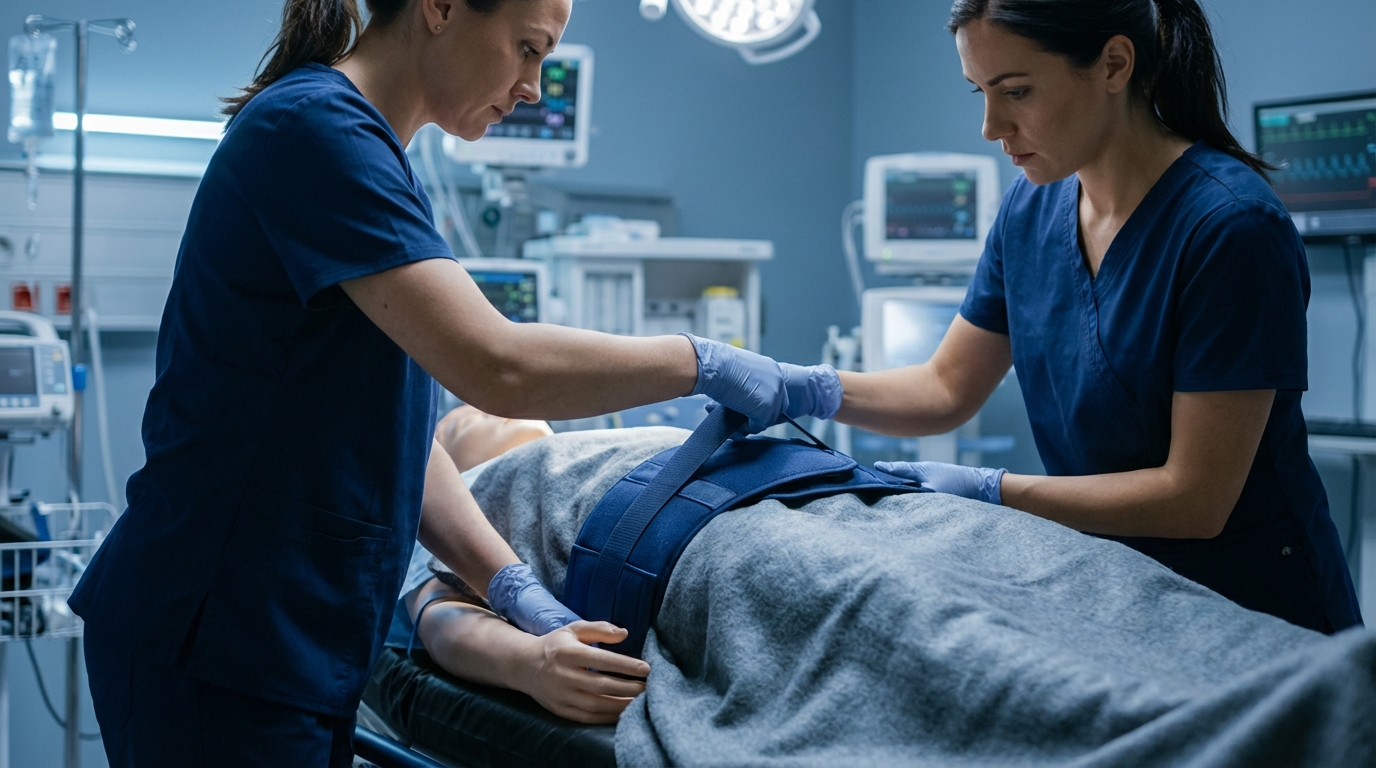
An unstable pelvic fracture is among the most life-threatening injuries in the context of polytrauma. Massive retroperitoneal hemorrhage of several liters is possible, as the pelvis, a bony ring, harbors both arterial and venous vascular plexuses. Adequate mechanical stabilization with a pelvic binder can reduce intrapelvic volume, approximate bone fragments, and thereby support a tamponade effect. Correct application is crucial – a poorly positioned pelvic binder can be ineffective or even worsen the situation. This article covers the anatomical fundamentals, correct technique for commercial and improvised systems, common errors, and the clinical decision points surrounding this time-critical intervention.
Anatomy and Pathophysiology: Why the Pelvic Binder Works
The bony pelvis forms a ring consisting of the ilium, ischium, pubis, and sacrum, connected by the symphysis and the sacroiliac joints. In high-energy trauma – motor vehicle collisions, falls from significant height, crush injuries – ring disruptions occur, which are classified according to the Young-Burgess or AO/OTA classification.
For prehospital management, one distinction is relevant:
- Open-book injuries (APC type): External rotation of the hemipelves, symphyseal disruption, massive volume increase in the true pelvis. The pelvic binder provides the greatest benefit here, as compression reduces volume and tamponades the hemorrhage.
- Lateral compression fractures (LC type): The pelvis is already "compressed." Additional compression from a pelvic binder can theoretically cause fragment displacement, but current guideline recommendations still advise application, as reliable clinical differentiation is not possible in the prehospital setting.
- Vertical shear injuries (VS type): Craniocaudal instability. The pelvic binder alone is often insufficient here but supports initial management.
Hemorrhage Volumes and Time Pressure
The retroperitoneal compartment can accommodate several liters of blood before clinically apparent deterioration occurs. The bleeding predominantly originates from:
- The presacral venous plexus (approx. 80% of cases)
- Branches of the internal iliac artery (approx. 15%)
- Cancellous bone fracture surfaces (approx. 5%)
Venous hemorrhage is controllable through volume reduction and tamponade – this is precisely where the pelvic binder is effective. A reduction in intrapelvic volume by just a few percent can already generate a relevant pressure increase and significantly reduce the bleeding rate.
Indication: When Is the Pelvic Binder Applied?
The pelvic binder belongs to the
- Mechanism of injury with high energy (high-speed collision, fall >3 m, motorcycle/bicycle accident, pedestrian struck, entrapment/burial)
- Clinical signs: Pelvic instability (leg length discrepancy, external rotation deformity, perineal hematoma, blood at the urethral meatus), hemodynamic instability without another identifiable source of hemorrhage
- When in doubt: In polytrauma patients with a relevant mechanism of injury and unclear hemodynamic status, the pelvic binder is applied – it is a low-risk intervention with potentially high benefit.
When NOT to Apply?
- Obviously isolated injuries to other body regions without evidence of pelvic involvement
- Third-trimester pregnancy only with particular caution (individual risk-benefit assessment)
- An open pelvic fracture is NOT a contraindication – the pelvic binder is still applied
Correct Technique: Commercial Pelvic Binder
Commercial products such as the SAM Pelvic Sling, the T-POD, or the Prometheus Pelvic Splint are available in most emergency physician systems and ambulances. The fundamental application technique is similar across all systems:
Step-by-Step Instructions
Preparation: Remove the pelvic binder from its packaging and unfold to full width. In unconscious patients, ideally prepare before the log roll.
Positioning under the pelvis: The binder is slid under the pelvis – either by carefully lifting the pelvis (caution: minimize manipulation if spinal injury is suspected), during the log roll, or by sliding it underneath through the natural lumbar lordosis. For patients on a vacuum mattress, application should ideally occur BEFORE packaging.
Correct height – THE critical point:
- The pelvic binder must be positioned at the level of the greater trochanters.
- This means: NOT on the iliac crests (cristae iliacae), but significantly lower.
- The trochanters can be identified by palpation: lateral thigh, proximal, at the level of the inguinal crease.
- The center of the binder should be at the level of the trochanters.
Closure and compression: Close the Velcro or ratchet mechanism according to the manufacturer's instructions. Compression should be moderate – the goal is reposition of the hemipelves into an anatomical position, not maximum compression.
Leg positioning: The legs are placed in slight internal rotation, ideally with the knees and ankles tied together. This supports reposition and prevents re-external rotation.
Fixation: The pelvic binder remains in place until definitive management (CT diagnostics, external fixator, surgical intervention). It is NOT removed for X-ray or CT, as most commercial models are radiolucent.
Compression Control
The SAM Pelvic Sling features an integrated force limiter (autostop buckle) that prevents further compression at approximately 150 Newtons. With the T-POD, compression is adjusted via the pull strap. General rule: If you can still slightly lift the binder off the skin with one finger, the tension is adequate.
Improvised Pelvic Binder: When No Commercial Product Is Available
In situations without a commercial product – during mass casualty incidents, in resource-limited settings, or during unexpected first-response scenarios – a pelvic binder can be improvised.
Suitable Materials
- Bed sheet: A standard bed sheet is folded to a width of approximately 20–25 cm (approximately one hand's width)
- Wide carrying straps or ratchet straps
- SAM Splint in combination with a triangular bandage (not very practical, but described in the literature)
Application Technique with a Bed Sheet
- Fold the sheet to approximately 20–25 cm width – too narrow increases point pressure and can cause soft tissue damage, too wide reduces effectiveness.
- Slide it under the pelvis, positioning at the level of the greater trochanters (identical to the commercial binder).
- Cross both ends over the anterior aspect.
- Critical step: Secure the ends with a clamp (Kocher clamp or Péan clamp) or tie a knot. The knot must be placed so that moderate compression is achieved.
- Alternative: Twist the ends and then secure with tape or a cable tie.
Limitations of the Improvised Version
- No standardized force limitation – risk of over- or under-compression
- More difficult to apply, more helping hands required
- More prone to slipping, especially during transport
- Nevertheless: An improvised pelvic binder is ALWAYS better than no pelvic binder
Common Errors in Pelvic Binder Application
The pelvic binder is conceptually simple – and that very simplicity leads to a deceptive sense of confidence. The following errors are regularly observed in clinical practice and simulation training:
Error 1: Incorrect Positioning Height
The most frequent and most serious error. The binder is placed at the level of the iliac crests (cristae iliacae) instead of at the level of the greater trochanters. Consequence: The compressive force is transmitted to the iliac wings, not to the actual fracture area. Volume reduction in the true pelvis does not occur, and the binder is ineffective.
Remember: The greater trochanters are located significantly lower than most practitioners intuitively assume – typically at the level of the symphysis or the inguinal crease. When in doubt, aim one finger-breadth too low rather than too high.
Error 2: Application Too Loose
A pelvic binder that sits loosely over the pelvis has no therapeutic effect. It must provide sufficient compression to reposition the hemipelves. Common reason: Fear of causing pain to the patient, or unfamiliarity with the closure mechanism.
Error 3: Application Too Tight
The opposite is equally problematic: Over-compression can cause secondary fragment displacement in lateral compression fractures and can theoretically compromise internal organs. Commercial products with force limiters minimize this risk – with improvised binders, particular attention is required.
Error 4: Failure to Internally Rotate the Legs
The pelvic binder alone only repositions in the transverse plane. Without internal rotation of the legs, an external rotation component persists that counteracts the compression mechanism. Tying the knees and ankles together with a bandage is a simple and effective adjunctive measure.
Error 5: Forgotten Over Clothing – Slippage
If the binder is applied over multiple layers of clothing, it can slip during transport and lose its position. Ideally, the binder is applied directly on the skin or over a single thin layer of clothing. If this is not possible (hypothermia, weather conditions), the position must be regularly checked.
Error 6: Premature Removal
The pelvic binder remains in place until definitive management. It is NOT removed for clinical examination, X-ray, or CT scan. "Briefly opening it to take a look" can reactivate a tamponaded hemorrhage. Removal occurs only in the operating room or after definitive fixation.
Error 7: Failure to Apply
The worst error: The pelvic binder is not applied despite a clear indication – due to time pressure, uncertainty, or because the pelvis "appears stable." Clinical assessment of pelvic stability (manual compression test) has low sensitivity and can moreover worsen an unstable fracture. The current trend in trauma care clearly favors liberal stabilization when a relevant mechanism is present.
Integration into the Trauma Bay Algorithm
The pelvic binder is not an isolated intervention but part of a comprehensive hemorrhage control concept:
- Prehospital: Application at the scene, ideally during the primary survey (C-problem). In parallel: permissive hypotension (target SBP 80–90 mmHg in penetrating trauma, 90–100 mmHg in blunt trauma with TBI), tranexamic acid 1 g IV (within 3 hours of trauma), hypothermia prevention.
- Trauma bay: eFAST to identify free fluid, pelvic AP radiograph (if no immediate CT), contrast-enhanced CT if hemodynamically stable.
- Damage control: In cases of persistent instability: external fixator, pelvic C-clamp, packing, interventional embolization – depending on availability and clinical situation.
The pelvic binder is the first step on this escalation ladder and is the only measure that can already be performed in the prehospital setting.
Special Situations
Obese Patients
In severely obese patients, the standard pelvic binder may be too short. Many commercial models offer extensions or are available in different sizes. In an emergency: Tie two bed sheets together. Positioning at the level of the greater trochanters is more difficult in obesity due to increased soft tissue coverage – careful palpation is all the more important here.
Children
Pediatric pelvic fractures are rare but possible in high-energy trauma. Commercial pelvic binders are often too large – a cloth folded to the appropriate width can be used instead. The anatomical landmarks remain identical.
Open Pelvic Fractures
Open pelvic fractures carry a mortality rate of up to 50%. The pelvic binder is still applied. Open wounds are initially covered with sterile dressings. The combination of external compression, aggressive coagulation therapy, and early surgical intervention is critical for survival.
Summary of Key Points
- Positioning height: At the level of the greater trochanters – NOT on the iliac crests
- Compression: Moderate – reposition yes, over-compression no
- Legs: Internal rotation, tie knees and ankles together
- Timing: As early as possible, already in the prehospital setting
- Leave in place: Until definitive management, do not remove for diagnostics
- When in doubt: Apply – the risk of non-application far outweighs the risk of unnecessary application
Practical Training
Applying a pelvic binder sounds simple in theory – the reality in the field under time pressure, with challenging patient scenarios, and under stress regularly reveals how much practice this intervention actually requires. Correctly identifying the greater trochanters, integrating the binder into the overall polytrauma management algorithm, and coordinating with the team are best internalized through realistic simulation training. In the Emergency Physician Refresher Course by Simulation Tirol, you train exactly these scenarios hands-on under realistic conditions – including feedback on typical error sources. More information is available at simulation.tirol/kurse/notarzt-refresher.
More Articles
Acute Dyspnea: Differential Diagnosis and Immediate Management
Dyspnea has numerous causes ranging from asthma to heart failure to pulmonary embolism. This article presents a systematic approach to differentiation based on history, clinical examination, auscultation, and point-of-care diagnostics.
Acute Hypoglycemia: Emergency Management in Adults and Children
Threshold values, symptom recognition, oral glucose vs. IV dextrose vs. glucagon – with separate dosing for adult and pediatric patients. A common emergency presentation systematically reviewed.
Acute Adrenal Insufficiency: Addisonian Crisis in the Emergency Setting
Adrenal crisis is frequently misdiagnosed and can be fatal. This article describes at-risk patients, clinical signs, immediate hydrocortisone administration, and the management of accompanying hypoglycemia and hyperkalemia.