ACLS Cardiac Arrest Algorithm: Sequence and Medications
The complete ACLS cardiac arrest algorithm according to AHA guidelines, including defibrillation scheme, epinephrine timing, and antiarrhythmic administration. One of the most searched algorithms in emergency medicine, relevant for exam preparation and clinical practice.

Author: Dr. med. univ. Daniel Pehböck, DESA
Specialist in Anesthesiology and Intensive Care Medicine, AHA-certified ACLS/PALS Instructor, Course Director Simulation Tirol
Reading time approx. 8 min
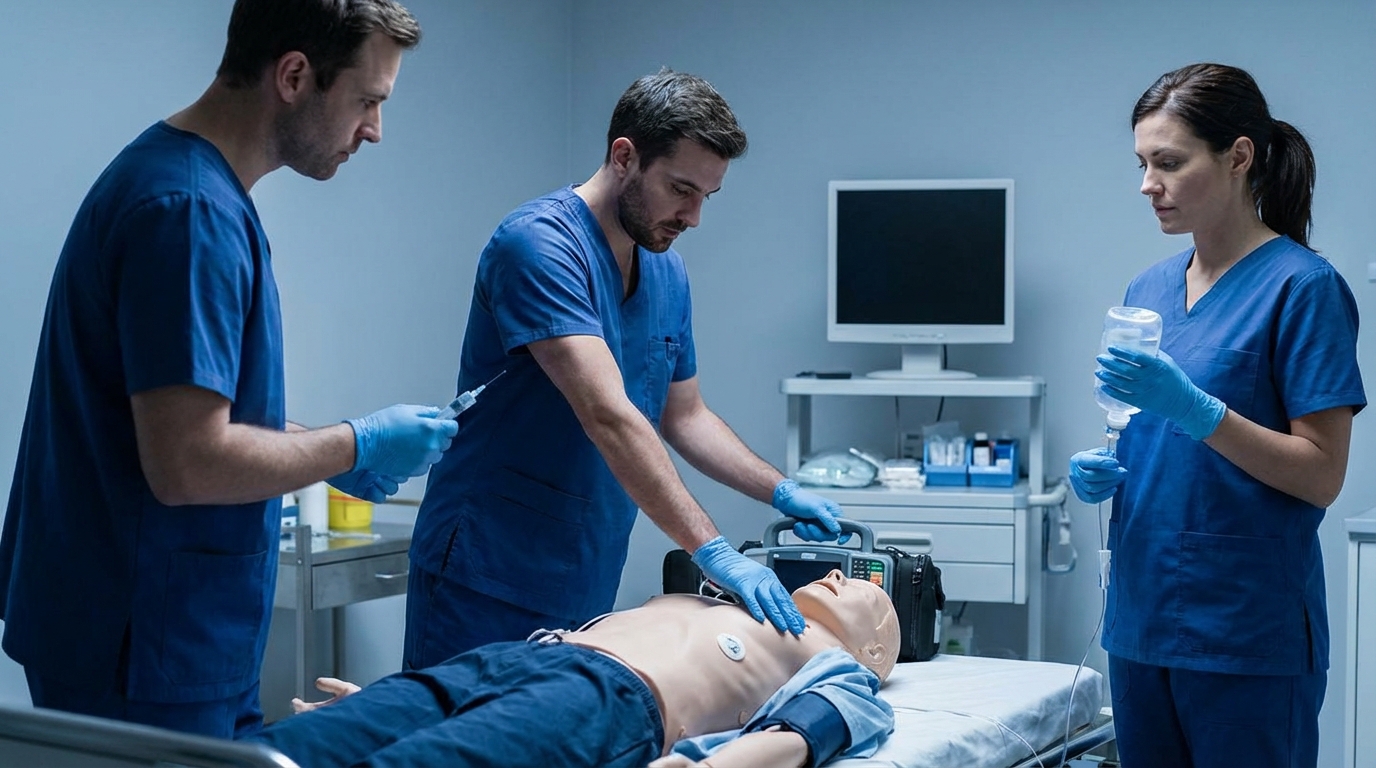
The ACLS cardiac arrest algorithm is the central framework for advanced resuscitation in adults. Whether in the emergency department, the intensive care unit, or the ambulance – if you have mastered this algorithm, you will make the right decisions at the right time in critical situations. It's not just about memorizing a sequence, but about understanding the pathophysiology behind each step: Why is epinephrine given only after the second shock in shockable rhythms? When is amiodarone indicated? And why does high-quality CPR remain the most important factor for survival? This article guides you systematically through the complete algorithm, including all medications, dosages, and clinical decision points.
Core Principle: Two Pathways, One Goal
The AHA cardiac arrest algorithm splits into two parallel pathways immediately after rhythm analysis:
- Shockable rhythms: Ventricular fibrillation (VF) and pulseless ventricular tachycardia (pVT)
- Non-shockable rhythms: Asystole and pulseless electrical activity (PEA)
Both pathways are connected by a common backbone: uninterrupted, high-quality chest compressions. The distinction determines whether and when defibrillation is performed and in what order medications are administered. Crucially, you must re-evaluate the rhythm every two minutes – this is the cadence that structures the entire algorithm.
High-Quality CPR as the Foundation
Before you focus on medications and defibrillation, one thing must be clear: No intervention replaces high-quality chest compressions. The AHA guidelines define the quality criteria unequivocally:
- Rate: 100–120 compressions per minute
- Depth: at least 5 cm (2 inches), but no more than 6 cm (2.4 inches)
- Full chest recoil after each compression
- Minimal interruptions: Hands-off time under 10 seconds for rhythm analysis and shock delivery
- Avoidance of hyperventilation: 10 breaths per minute with an advanced airway, 30:2 ratio without an advanced airway
Rescuer rotation should occur every two minutes – ideally synchronized with rhythm analysis. Fatigue leads to measurable quality decline in compressions after just 60–90 seconds, even if the rescuer does not subjectively perceive it.
The Algorithm for Shockable Rhythms (VF/pVT)
First Cycle: Shock and CPR
Upon identification of a shockable rhythm:
- Defibrillation at maximum available energy:
- Biphasic: 120–200 J (manufacturer-dependent; when in doubt, use maximum energy)
- Monophasic: 360 J
- Immediate CPR for 2 minutes – no pulse check after the shock
- During CPR: establish IV/IO access if not already in place
No medications are given during this first cycle. The focus is entirely on the shock and uninterrupted CPR. The shock should be delivered as quickly as possible – every second of delay reduces the defibrillation success rate.
Second Cycle: Re-analysis and Epinephrine
After 2 minutes of CPR:
- Rhythm analysis – still VF/pVT?
- Second defibrillation at maximum energy
- Immediate CPR for 2 minutes
- Epinephrine 1 mg IV/IO – as early as possible in this cycle
- Consider advanced airway management (if not already performed)
The timing of epinephrine is a common exam pitfall: In shockable rhythms, epinephrine is administered only after the second unsuccessful shock. The rationale is that VF/pVT is primarily terminated by defibrillation – epinephrine is meant to optimize coronary and cerebral perfusion pressure, but should not delay defibrillation.
Third Cycle: Antiarrhythmic
After another 2 minutes of CPR:
- Rhythm analysis – does VF/pVT persist?
- Third defibrillation at maximum energy
- Immediate CPR for 2 minutes
- Amiodarone 300 mg IV/IO bolus – the first-line antiarrhythmic
- Epinephrine is not given in this cycle (interval: every 3–5 minutes, so it is due again in the next cycle)
If VF/pVT remains refractory, a second dose of amiodarone 150 mg IV/IO can be given two cycles later.
Lidocaine is an alternative when amiodarone is unavailable:
- First dose: 1–1.5 mg/kg IV/IO
- Subsequent doses: 0.5–0.75 mg/kg IV/IO every 5–10 minutes
- Maximum dose: 3 mg/kg
Subsequent Cycles: The Pattern
From the fourth cycle onward, the algorithm follows a repeating pattern:
- Every 2 minutes: Rhythm analysis → Defibrillation (if still shockable) → immediate CPR
- Epinephrine 1 mg IV/IO every 3–5 minutes (in practice: every other cycle)
- Reversible causes systematically evaluated (Hs and Ts – more on this below)
This cycle continues until either return of spontaneous circulation (ROSC) is achieved, resuscitation is terminated, or the rhythm changes to a non-shockable rhythm. In the latter case, you switch to the asystole/PEA pathway.
The Algorithm for Non-Shockable Rhythms (Asystole/PEA)
First Cycle
- Rhythm analysis reveals asystole or PEA
- Immediate CPR for 2 minutes
- Epinephrine 1 mg IV/IO as soon as possible – here, in contrast to shockable rhythms, epinephrine is given immediately
- Establish IV/IO access
- Consider advanced airway management
The critical difference: In non-shockable rhythms, there is no defibrillation – epinephrine is therefore administered without delay in the first cycle. The rationale is clear: Without the option of electrical therapy, pharmacological circulatory support is the central therapeutic intervention alongside CPR from the very beginning.
Subsequent Cycles
- Every 2 minutes: Rhythm analysis → continue CPR
- Epinephrine 1 mg IV/IO every 3–5 minutes (every other cycle)
- At each analysis point: Check whether the rhythm has changed to VF/pVT → then immediate defibrillation and switch to the shockable pathway
- No atropine – Atropine is no longer included in the cardiac arrest algorithm
For asystole: Always confirm in at least two leads and rule out artifacts. A "flat line" may also be a technical problem (cable, electrode defect, wrong lead).
Medication Overview: At a Glance
| Medication | Dose | Indication | Timing |
|---|---|---|---|
| Epinephrine | 1 mg IV/IO | All rhythms | VF/pVT: after 2nd shock; Asystole/PEA: immediately; then every 3–5 min |
| Amiodarone | 1st dose: 300 mg IV/IO; 2nd dose: 150 mg IV/IO | Refractory VF/pVT | After 3rd shock; 2nd dose for persistent VF/pVT |
| Lidocaine | 1–1.5 mg/kg IV/IO; then 0.5–0.75 mg/kg | Alternative to amiodarone | Same timing as amiodarone |
| Sodium bicarbonate | 1 mEq/kg IV | Hyperkalemia, severe acidosis, TCA toxicity | Only for specific indications |
| Calcium chloride 10% | 20 mg/kg IV (typically 1–2 g) | Hyperkalemia, hypocalcemia, calcium channel blocker overdose | Only for specific indications |
| Magnesium sulfate | 1–2 g IV/IO | Torsades de Pointes | For documented polymorphic VT of the Torsades type |
| Lipid emulsion 20% | 1.5 mL/kg bolus, then 0.25 mL/kg/min | Local anesthetic toxicity | When lipid-soluble toxin exposure is suspected |
Important: All medications are given as a rapid IV/IO bolus, followed by a 20 mL normal saline flush. The preferred access is IV; if this cannot be established within a few minutes, IO access (intraosseous) is the preferred alternative and offers comparable pharmacokinetics.
The Hs and Ts: Systematically Addressing Reversible Causes
No algorithm in the world will save a patient whose cardiac arrest is caused by an untreated reversible cause. The AHA guidelines structure the reversible causes into two groups:
The 5 Hs
- Hypovolemia → Volume resuscitation, blood products, hemorrhage control
- Hypoxia → Airway management, optimize oxygenation
- Hydrogen ions (Acidosis) → Sodium bicarbonate, ventilation
- Hypo-/Hyperkalemia → Calcium, insulin/glucose, bicarbonate
- Hypothermia → Rewarming, prolonged resuscitation
The 5 Ts
- Tension pneumothorax → Needle decompression, thoracostomy
- Tamponade (cardiac) → Pericardiocentesis
- Toxins → Specific antidotes (naloxone, lipid emulsion, bicarbonate for TCA)
- Thrombosis, coronary → Consider PCI, consider thrombolysis during resuscitation
- Thrombosis, pulmonary → Systemic thrombolysis, surgical/interventional thrombectomy
Systematic evaluation of the Hs and Ts should be actively integrated into the algorithm starting from the second cycle. In practice, it helps to explicitly assign one team member to the "detective work": obtaining a history, interpreting blood gas analysis, performing point-of-care ultrasound.
Role of Ultrasound
Focused emergency echocardiography (e.g., using the FEEL or RUSH protocol) can provide critical information:
- Pericardial effusion → Tamponade
- Dilated right ventricle → Pulmonary embolism
- Empty hyperkinetic left ventricle → Hypovolemia
- Absent cardiac activity → Prognostically unfavorable
Crucially: Ultrasound must not interrupt chest compressions. Imaging is performed during the rhythm analysis pause that is already taking place (under 10 seconds).
Common Errors in Practice
Even experienced teams make avoidable errors under stress. The most common pitfalls:
- Excessive hands-off time: Every interruption of CPR beyond 10 seconds dramatically reduces coronary perfusion pressure. Pre-charge the defibrillator while compressions are ongoing.
- Epinephrine timing mix-up: In VF/pVT, only after the 2nd shock; in asystole/PEA, immediately. A common exam error and clinical mistake alike.
- Amiodarone too early or too late: Only after the 3rd shock – not earlier and not forgotten.
- Hyperventilation: Excessively rapid ventilation increases intrathoracic pressure, reduces venous return, and worsens hemodynamics. Strictly maintain 10 breaths per minute with an advanced airway.
- Failure to search for reversible causes: Especially in PEA and asystole, systematic evaluation of the Hs and Ts is often the only chance for ROSC.
- Lack of team communication: Closed-loop communication and clear role assignment are not soft skills – they are survival-critical.
Return of Spontaneous Circulation: What Comes Next?
When ROSC is achieved, post-cardiac arrest care begins. The core elements:
- Hemodynamic stabilization: Target MAP ≥ 65 mmHg, vasopressors and volume resuscitation as needed
- Airway management: Target SpO₂ 92–98%, avoidance of hyperoxia; target PaCO₂ 35–45 mmHg
- Targeted temperature management (TTM): Constant target temperature of 32–36 °C for at least 24 hours in comatose patients
- 12-lead ECG: ST elevations? → Consider immediate coronary angiography
- Etiology workup: Continue the detective work (Hs and Ts), laboratory tests, imaging
Special Situations
Certain situations require modifications to the standard algorithm:
- Hypothermia (< 30 °C): Maximum of three shocks and no epinephrine until rewarming above 30 °C. Above 30 °C: extend epinephrine intervals. Continue resuscitation until rewarming – "Nobody is dead until warm and dead."
- Pregnancy: From 20 weeks of gestation, perform left uterine displacement; consider emergency cesarean delivery within 5 minutes if ROSC is not achieved. Medication dosages remain unchanged.
- Pulmonary embolism: Systemic thrombolysis (e.g., alteplase 50 mg IV bolus) may be considered during ongoing resuscitation. Continue CPR for at least 60–90 minutes.
- Opioid-associated cardiac arrest: Standard ACLS algorithm; naloxone has no proven benefit in cardiac arrest but is recommended for respiratory arrest with a pulse still present (2 mg intranasal or 0.4 mg IV).
Practical Training
The cardiac arrest algorithm is manageable on paper – the challenge lies in confident application under real-world conditions with time pressure, team dynamics, and unexpected complications. Systematic simulation training is the most effective way to internalize these workflows and eliminate common errors. In the ACLS course by Simulation Tirol, you train the complete algorithm in realistic scenarios – with structured debriefing and AHA certification. Details and dates can be found at simulationtirol.com/acls.
Want to practice this hands-on?
In our ACLS-Kurs (Advanced Cardiac Life Support) you practice this topic hands-on with high-tech simulators and experienced instructors.
More Articles
ABCDE Approach: Structured Primary Assessment in Emergencies
The ABCDE approach is the universal framework of emergency care. This article explains each step with concrete assessment techniques, re-evaluation loops, and common pitfalls in application.
Asthma Exacerbation: Step-by-Step Emergency Therapy
Acute asthma exacerbation requires rapid severity assessment and escalated therapy. This article covers the stepwise treatment approach from salbutamol through ipratropium to magnesium and epinephrine, including dosages for adults.
Bradycardia Algorithm: Atropine, Pacing, Epinephrine
When does bradycardia require treatment? The ACLS bradycardia algorithm step by step, including atropine dosing, transcutaneous pacing, and differential diagnoses for symptomatic bradycardia.