ABCDE Approach: Structured Primary Assessment in Emergencies
The ABCDE approach is the universal framework of emergency care. This article explains each step with concrete assessment techniques, re-evaluation loops, and common pitfalls in application.

Author: Dr. med. univ. Daniel Pehböck, DESA
Specialist in Anesthesiology and Intensive Care Medicine, AHA-certified ACLS/PALS Instructor, Course Director Simulation Tirol
Reading time approx. 9 min
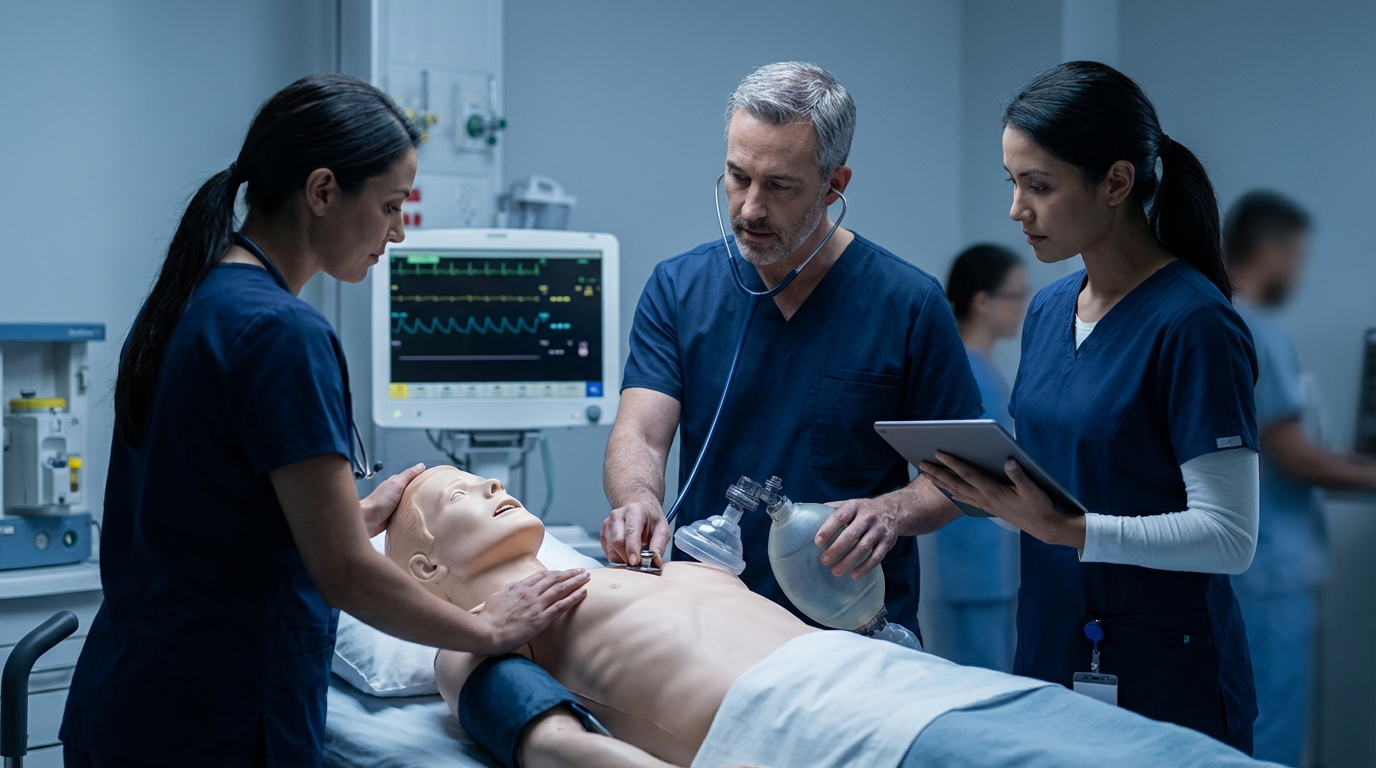
The ABCDE approach forms the backbone of every structured emergency assessment – from the prehospital setting to the in-hospital trauma bay. Whether trauma, sepsis, anaphylactic shock, or unexplained unconsciousness: this systematic approach ensures that you as the treating clinician identify and address immediately life-threatening problems first. A central principle applies: Treat first what kills first. Each step is completed before moving on to the next – and every identified problem is addressed immediately. Only then does further assessment follow. This approach demonstrably reduces cognitive load in stressful situations and prevents critical findings from being missed.
Core Principles of the ABCDE Approach
The ABCDE approach follows a clear hierarchy: airway obstruction kills faster than a tension pneumothorax, and a tension pneumothorax kills faster than massive hemorrhage. This physiological order determines the sequence of assessment. Three fundamental rules are key:
- Sequential approach: A before B before C before D before E – no shortcuts.
- Immediate intervention: If a problem is identified, it is treated before the next letter is evaluated.
- Re-evaluation: After every intervention and after completing the full assessment, the schema is restarted from the beginning to verify the effectiveness of interventions and to identify new problems.
Before you begin the ABCDE approach, there is always the safety check: scene safety, situational awareness, and assessing the patient's responsiveness (verbal stimulus, pain stimulus). If there is no response and no normal breathing, you are in the cardiac arrest algorithm – the ABCDE approach is not the primary tool here; rather, the BLS/ALS algorithm applies.
A – Airway
The airway has absolute priority. An obstructed airway leads to hypoxic cardiac arrest within minutes. Assessment begins with a simple question: Is the patient speaking? A patient who speaks in clear, full sentences has a patent airway and adequate ventilation at that moment.
Assessment Techniques
- Inspection: Inspect the oral cavity for foreign bodies, blood, vomit, swelling (angioedema, epiglottitis), and dentures. Look for retractions (jugular, intercostal).
- Auscultation: Stridor (inspiratory → supraglottic obstruction; expiratory → subglottic/tracheal pathology), gurgling sounds, snoring.
- Breath sound assessment: Silence over the airways despite respiratory effort is an ominous sign of complete obstruction.
Immediate Interventions
- Basic maneuvers: Jaw thrust (especially when cervical spine injury is suspected), head-tilt-chin-lift, suctioning, foreign body removal under direct vision.
- Airway adjuncts: Oropharyngeal airway (only in the absence of protective reflexes), nasopharyngeal airway (better tolerated when reflexes are intact).
- Definitive airway management: Endotracheal intubation or supraglottic airway devices (laryngeal mask airway, laryngeal tube) for ongoing airway compromise. In anticipated difficult airways: consider a surgical airway (cricothyrotomy) early.
Pitfalls
A common mistake is false reassurance from an initially patent airway. In inhalation injury, angioedema, or progressive swelling following cervical spine trauma, the airway can become completely obstructed within minutes. The rule here is: Anticipate deterioration. Early intubation is safer than an emergency cricothyrotomy on a completely edematous airway.
In trauma patients, the airway is always secured with manual in-line stabilization of the cervical spine. The jaw thrust is preferred over head extension in this setting.
B – Breathing
A patent airway does not automatically mean adequate ventilation and oxygenation. Under "B," you assess the effectiveness of breathing.
Assessment Techniques
- Respiratory rate: Arguably the most underestimated vital sign measurement. Normal value 12–20/min in adults. A respiratory rate > 25/min or < 10/min is a warning sign. Tachypnea is often the earliest sign of clinical deterioration.
- Inspection: Symmetry of chest excursion, use of accessory muscles, paradoxical breathing, visible injuries (open pneumothorax, flail chest).
- Percussion: Hyperresonance (pneumothorax) vs. dullness (hemothorax, pleural effusion).
- Auscultation: Compare both sides! Diminished or absent breath sounds on one side? Crackles, wheezing, rhonchi?
- Palpation: Subcutaneous emphysema (crepitus), chest wall instability, tracheal position (deviation as a late sign in tension pneumothorax).
- Pulse oximetry: SpO₂ value. Caution: falsely normal in CO poisoning and methemoglobinemia! Unreliable in shock and peripheral vasoconstriction.
Immediate Interventions
- Oxygen therapy: In critically ill patients, initially high-flow via non-rebreather mask (10–15 L/min), target SpO₂ 94–98% (in COPD: 88–92%).
- Tension pneumothorax: Clinical diagnosis! Do not wait for a chest X-ray. Immediate decompression via needle decompression (2nd intercostal space midclavicular line or 4th/5th intercostal space anterior axillary line, depending on protocol) followed by chest tube insertion.
- Open pneumothorax: Three-sided occlusive dressing or commercial chest seal.
- Massive hemothorax: Large-bore chest tube (28–32 Fr).
- Severe bronchospasm: Salbutamol 2.5–5 mg nebulized, ipratropium bromide 0.5 mg nebulized, epinephrine 0.3–0.5 mg IM if anaphylaxis is the cause.
- Non-invasive ventilation (NIV) for cardiogenic pulmonary edema or exacerbated COPD, provided the patient is cooperative.
Pitfalls
The most common trap in "B" is isolated fixation on SpO₂. A patient with a respiratory rate of 35/min and an SpO₂ of 96% is not "stable" – they are maximally compensating and can decompensate at any moment. Respiratory rate is the more sensitive parameter. Likewise, tension pneumothorax is too often misunderstood as a radiological diagnosis: never wait for a chest X-ray when the clinical picture is clear (unilateral absent breath sounds, hypotension, distended neck veins, tracheal deviation).
C – Circulation
Under "C," the focus is on identifying and treating shock states and controlling life-threatening hemorrhage. Note: In trauma patients with massive external bleeding, the <C>ABCDE concept advocates hemorrhage control even before airway management – this applies to critical extremity hemorrhage that can be immediately controlled with a tourniquet.
Assessment Techniques
- Pulse quality: Radial pulse palpable → systolic BP roughly > 80 mmHg. Only carotid pulse palpable → systolic BP roughly > 60 mmHg. Rate, rhythm, volume.
- Capillary refill time: Compress the nail bed for 5 seconds, normal < 2 seconds. Prolonged in centralization (caution: ambient temperature affects the result).
- Skin signs: Pale, cool and clammy, mottled → shock. Warm and flushed → distributive shock (sepsis, anaphylaxis).
- Blood pressure and heart rate: Tachycardia is an early sign, hypotension a late sign of shock. A young patient can lose up to 30% of their blood volume before blood pressure drops.
- 12-lead ECG: With any suspicion of a cardiac cause.
- External bleeding sources: Systematically inspect the entire body (including the back!).
Immediate Interventions
- Hemorrhage control: Direct pressure, tourniquet for extremity bleeding, wound packing with hemostatic agents.
- Volume resuscitation: Two large-bore peripheral IV lines (≥ 18 G, preferably 16 G or 14 G). If unsuccessful: intraosseous access. Crystalloids (balanced electrolyte solution, e.g., Ringer's acetate or lactate) initial 500 mL bolus, assess response. In hemorrhagic shock: aim for early transfusion, permissive hypotension (target systolic BP 80–90 mmHg in penetrating trauma without TBI).
- Vasopressors: Norepinephrine in distributive shock (sepsis, anaphylaxis after epinephrine administration) when volume alone is insufficient.
- Epinephrine: 0.3–0.5 mg IM for anaphylaxis, repeatable every 5–15 minutes.
- Cardiac tamponade: Clinical triad (Beck's triad: hypotension, distended neck veins, muffled heart sounds) → pericardiocentesis or emergency thoracotomy depending on the setting.
Pitfalls
A normal blood pressure does not rule out shock. Especially in young, fit patients, compensation can be maintained impressively long – until sudden decompensation occurs. The combination of tachycardia, prolonged capillary refill time, and cool extremities should alarm you, even with a "normal" blood pressure. Similarly, the significance of pelvic and intra-abdominal hemorrhage in trauma is frequently underestimated because it is not externally visible. A pelvic binder should be applied liberally.
D – Disability (Neurological Assessment)
This step involves a focused neurological assessment.
Assessment Techniques
- Level of consciousness: AVPU scale (Alert – Voice – Pain – Unresponsive) for rapid assessment, Glasgow Coma Scale (GCS) for more detailed documentation.
- Pupils: Size, symmetry, light reactivity. Unilateral dilated, fixed pupil → suspect transtentorial herniation (ipsilateral compression of the oculomotor nerve). Bilateral pinpoint pupils → opioid intoxication, pontine hemorrhage. Bilateral dilated and fixed → severe hypoxia, catecholamines, atropine.
- Blood glucose: ALWAYS measure! Hypoglycemia is one of the most common treatable causes of altered consciousness and is alarmingly often forgotten.
- Lateralizing signs: Asymmetric motor function, Babinski sign.
- Temperature: Hypothermia as a cause of altered consciousness and as an aggravating factor in trauma.
Immediate Interventions
- Hypoglycemia: Dextrose 40% 10–20 mL IV (= 4–8 g glucose), alternatively glucagon 1 mg IM.
- Opioid intoxication: Naloxone 0.4–2 mg IV, titrated to effect. Caution: shorter half-life than most opioids → repeat doses or continuous infusion may be necessary.
- Raised intracranial pressure: Elevate head of bed to 30°, head in neutral position, target normoventilation (etCO₂ 35–40 mmHg), consider mannitol 20% (0.5–1 g/kg IV) or hypertonic saline.
- Seizure: Benzodiazepines as first-line – midazolam 0.1–0.2 mg/kg IV/IM/intranasal or lorazepam 0.1 mg/kg IV.
Pitfalls
The biggest pitfall in "D" is assuming that altered consciousness is primarily neurological without having adequately addressed the preceding letters. Hypoxia (A/B problem) and shock (C problem) are more common causes of altered consciousness than a primary neurological event. Likewise, blood glucose measurement is forgotten in the heat of the moment – with potentially fatal consequences, given that hypoglycemia is so simple to treat.
E – Exposure/Environment
The final step serves for complete examination and protection from environmental factors.
Assessment Techniques
- Complete exposure: The entire body is inspected – back (log roll in trauma patients), axillae, groins, perineum. Look for hidden injuries, skin findings (petechiae in meningococcal sepsis, urticaria in anaphylaxis), injection sites, medication patches (fentanyl patches!).
- Temperature measurement: Core temperature when possible. Hypothermia (< 35°C) impairs coagulation and cardiac function. Hyperthermia may indicate sepsis, heat stroke, malignant hyperthermia, or serotonin syndrome.
Immediate Interventions
- Heat preservation: Cover the patient immediately after examination (warming blankets, forced-air warming device). Warmed IV fluids. The "lethal triad" in trauma (hypothermia, acidosis, coagulopathy) begins with heat loss.
- Burns: Estimate extent using the rule of nines, cooling only if < 10% TBSA and < 10 minutes after the event.
- Decontamination: If chemical or radiological exposure is suspected.
Pitfalls
Exposure is often performed incompletely due to time pressure or misguided modesty. A stab wound in the back, a fentanyl patch on the thigh, or petechiae on the trunk are only found when actively looked for. At the same time, heat loss from unnecessarily prolonged exposure is underestimated – especially in air-conditioned trauma bays, undressed patients cool down rapidly.
The Re-Evaluation Loop
After completing the primary ABCDE assessment, re-evaluation begins. This cycle is not optional but an integral part of the approach. After every intervention and at regular intervals (every 5–10 minutes in unstable patients), the schema is repeated from the beginning.
Re-evaluation serves three purposes:
- Effectiveness check: Did the intervention achieve the desired effect? Is the airway secure after intubation? Is SpO₂ improving after chest tube insertion?
- Identification of new problems: The clinical condition is dynamic. An initially stable airway can deteriorate, an occult hemorrhage can become hemodynamically significant.
- Trending: The trajectory of vital signs over time is often more informative than a single measurement. A rising heart rate with stable blood pressure indicates deterioration before the blood pressure drops.
Team Communication
The ABCDE approach is not only a clinical assessment tool but also a communication framework. During handoffs to EMS, in the trauma bay, or during transfer to the ICU, the schema structures information delivery. Phrases such as "A is secured with a 7.5 ETT, B shows bilateral equal air entry with SpO₂ 98% at FiO₂ 1.0, C shows sinus tachycardia at 110/min with BP 95/60 after 1000 mL Ringer's…" allow the receiving team immediate orientation.
For team communication during patient care, the closed-loop communication principle is ideal: order – repeat back – execute – confirm. Combined with the ABCDE approach, this creates a structured, error-resistant workflow.
Practical Training
The ABCDE approach may seem simple on paper – but consistent application under stress, in a team, and with complex patient presentations requires regular hands-on training. Especially the decision of when an intervention must happen immediately, when a step may be deferred, and how re-evaluation loops are effectively integrated is best practiced using realistic simulation scenarios. In the emergency training courses by Simulation Tirol, you train the ABCDE approach hands-on with simulated patients, reinforcing the systematic approach for real-life emergencies.
Want to practice this hands-on?
In our Notfalltraining in deiner Arztpraxis oder Klinik you practice this topic hands-on with high-tech simulators and experienced instructors.
More Articles
ACLS Cardiac Arrest Algorithm: Sequence and Medications
The complete ACLS cardiac arrest algorithm according to AHA guidelines, including defibrillation scheme, epinephrine timing, and antiarrhythmic administration. One of the most searched algorithms in emergency medicine, relevant for exam preparation and clinical practice.
Asthma Exacerbation: Step-by-Step Emergency Therapy
Acute asthma exacerbation requires rapid severity assessment and escalated therapy. This article covers the stepwise treatment approach from salbutamol through ipratropium to magnesium and epinephrine, including dosages for adults.
Bradycardia Algorithm: Atropine, Pacing, Epinephrine
When does bradycardia require treatment? The ACLS bradycardia algorithm step by step, including atropine dosing, transcutaneous pacing, and differential diagnoses for symptomatic bradycardia.