Supraventricular Tachycardia: How to Correctly Perform Vagal Maneuvers
Modified Valsalva, carotid sinus massage, and ice water technique in children – step-by-step instructions with contraindications and success rates. A practical overview for everyday clinical practice.

Author: Dr. med. univ. Daniel Pehböck, DESA
Specialist in Anesthesiology and Intensive Care Medicine, AHA-certified ACLS/PALS Instructor, Course Director Simulation Tirol
Reading time approx. 8 min
Supraventricular tachycardia (SVT) is one of the most common symptomatic arrhythmias in the emergency setting. Before adenosine or electrical cardioversion are used, AHA guidelines recommend attempting vagal maneuvers as a first-line intervention in hemodynamically stable patients. The idea behind this is elegant: by stimulating the vagus nerve, conduction through the AV node is slowed – and ideally, the reentry mechanism breaks down. In practice, however, the success rate of vagal maneuvers depends considerably on correct technique. Between a poorly performed Valsalva maneuver and the modified Valsalva technique, there is a difference of over 20 percentage points in conversion rate. This article provides you with a practical step-by-step guide for the most important vagal maneuvers in adults and children, including contraindications and evidence-based success rates.
Pathophysiological Background
Vagal maneuvers work through activation of the parasympathetic nervous system. The efferent fibers of the vagus nerve innervate the sinus node and – crucially in SVT – the AV node. An increase in vagal tone leads to:
- Prolongation of the refractory period in the AV node
- Slowing of AV conduction
- Interruption of the reentry circuit, provided the AV node is part of the circuit
This mechanism explains why vagal maneuvers are particularly effective in AV nodal reentrant tachycardia (AVNRT) and AV reentrant tachycardia (AVRT) via accessory pathways – precisely those forms of SVT that account for the majority of regular narrow complex tachycardias. In atrial tachycardias or atrial flutter, vagal maneuvers may temporarily reduce the ventricular rate, thereby providing diagnostic clarity, but they typically do not terminate the arrhythmia itself.
Indications and Prerequisites
Vagal maneuvers are indicated for:
- Regular narrow complex tachycardia (QRS < 120 ms) with stable hemodynamics
- Clinical suspicion of AVNRT or AVRT
- As a diagnostic aid to unmask atrial activity (e.g., flutter)
Prerequisites Before Performing
- 12-lead ECG documented, ideally under continuous monitoring
- Intravenous access established (in case pharmacological conversion becomes necessary)
- Defibrillator/cardioverter within reach
- Adenosine drawn up and ready
- Patient informed about the maneuver
The Modified Valsalva Maneuver
The classic Valsalva maneuver – straining against a closed glottis – has a rather modest conversion rate of approximately 5–20% as a standalone measure. The modified Valsalva technique (also referred to as "postural modification") increased the success rate to approximately 43% in the REVERT trial and is therefore considered the most effective form of the Valsalva maneuver.
Step-by-Step Instructions
- Position the patient in a semi-recumbent position (approximately 45° head-of-bed elevation on the stretcher)
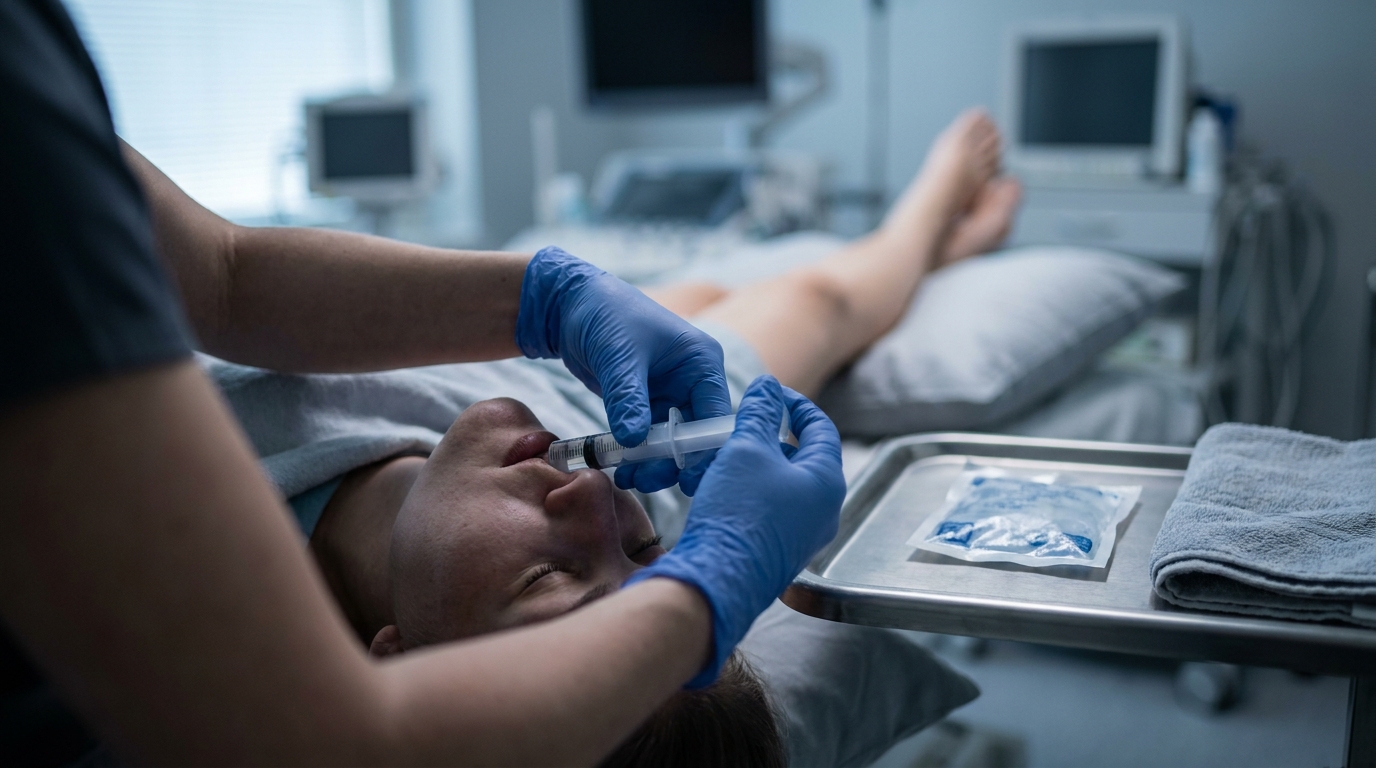
- Have a 10 mL syringe ready – the patient blows against the plunger of the syringe to generate a standardized intrathoracic pressure of approximately 40 mmHg
- Strain for 15 seconds – the patient blows forcefully and continuously into the syringe without moving the plunger. Alternatively: strain as if having a bowel movement with a closed glottis
- Immediately after the 15 seconds: lay the patient flat – immediately lower the stretcher flat or actively lay the patient down
- Passive leg elevation – the legs are raised to approximately 45° for 15 seconds (by a helper or by raising the foot of the stretcher)
- Maintain leg elevation for 15 seconds, then return the patient to a semi-recumbent position
- Assess the ECG rhythm – conversion frequently occurs during the leg elevation phase or immediately afterward
Why Does the Modification Work Better?
The supine positioning with passive leg elevation enhances venous return to the heart. The resulting increase in preload triggers additional vagal activation via baroreceptors, potentiating the effect of straining. The "vagal rebound" after the straining maneuver is thereby significantly amplified.
Repetition
The modified Valsalva maneuver can be repeated up to three times if unsuccessful before escalating to pharmacological therapy. There should be at least 1–2 minutes between attempts.
Carotid Sinus Massage
Carotid sinus massage stimulates the baroreceptors in the carotid sinus and triggers a reflex vagal response. It is considered an effective vagal maneuver but is increasingly being placed after the modified Valsalva due to its potential for complications.
Step-by-Step Instructions
- Position the patient supine, head turned slightly to the opposite side and slightly extended
- Auscultate both carotid arteries – if a bruit is heard on the respective side: absolute contraindication for that side
- Locate the carotid sinus – at the level of the thyroid cartilage, at the anterior border of the sternocleidomastoid muscle, over the carotid bifurcation
- Massage with the index and middle fingers: apply firm, circular pressure for 5–10 seconds
- Always unilateral only – never bilateral simultaneously
- Perform under continuous ECG monitoring
- If unsuccessful, after a 1–2 minute pause: attempt on the contralateral side
Success Rate
The conversion rate of carotid sinus massage ranges from 25–35% depending on study design, placing it in a similar range to the modified Valsalva maneuver. Combining both techniques can further increase the overall success rate.
Contraindications for Carotid Sinus Massage
- Carotid bruit on auscultation
- Known carotid stenosis (> 50%) or history of carotid endarterectomy
- Stroke or TIA in history (within the last 3 months – relative contraindication; in patients with a history of stroke, carefully weigh risks in general)
- Children – carotid sinus massage is not recommended in the pediatric population
- Myocardial infarction in the acute phase (risk of bradycardia and hypotension)
- Digitalis toxicity (risk of malignant bradycardias)
Complications
Rare but relevant complications include:
- Cerebral embolism in the presence of pre-existing carotid plaques
- Prolonged asystole (particularly in sick sinus syndrome)
- Hypotension
Vagal Maneuvers in Children: The Diving Reflex
In infants and toddlers, neither the Valsalva maneuver nor carotid sinus massage can be meaningfully performed. Here, the ice water technique (triggering the diving reflex) is the primary approach. In older, cooperative children, a modified Valsalva – such as blowing through a straw or into a syringe – can be attempted.
Ice Water Technique in Infants and Toddlers
The diving reflex is a phylogenetically ancient reflex: a cold stimulus applied to the face (innervation territory of the trigeminal nerve) triggers a pronounced vagal activation with bradycardia and peripheral vasoconstriction. In infants, this reflex is particularly strong.
Step-by-Step Instructions
- Prepare ice water: fill a plastic bag (e.g., a freezer bag) with ice water – not with pure ice, to avoid cold injuries
- Place the child supine, airway clear
- Place the bag of ice water on the child's face – covering the eyes, nose, and forehead, while keeping the airway clear (mouth and nose must not be occluded)
- Application duration: 15–20 seconds (some sources recommend a maximum of 10 seconds in neonates)
- Under continuous ECG monitoring
- If unsuccessful: single repeat after 1–2 minutes
Alternatives in Older Children
- Submerging the face in cold water (if the child cooperates)
- Placing a cold washcloth on the face
- Blowing into a syringe (modified Valsalva, realistic from approximately 5–6 years of age)
- Headstand or handstand – accepted playfully by some children, increases venous return
Success Rate in Children
The ice water technique achieves conversion rates of 30–60% in infants and toddlers, depending on the study and correct technique. The higher success rate compared to adults is explained by the more pronounced diving reflex in childhood.
Contraindications and Precautions in Children
- Do not submerge the entire face in water in infants (aspiration risk)
- No direct ice contact with the skin (cold injuries)
- No carotid sinus massage in children
- No ocular pressure – no longer recommended for any age group (risk of retinal detachment and ocular injury)
- In hemodynamic instability: immediate synchronized cardioversion (0.5–1 J/kg), no vagal maneuvers
General Contraindications and Pitfalls
Contraindications for All Vagal Maneuvers
- Hemodynamic instability: hypotension, shock, altered level of consciousness, severe heart failure → immediate cardioversion
- Wide complex tachycardia (QRS ≥ 120 ms) → suspect ventricular tachycardia, vagal maneuvers not indicated
- Suspected digitalis toxicity → risk of prolonged bradycardia/asystole
- Ocular pressure (eyeball massage) → obsolete, no longer recommended by AHA and ERC
Common Mistakes in Practice
- Straining too weakly or too briefly during Valsalva – the intrathoracic pressure must reach 40 mmHg and be maintained for 15 seconds
- Omitting the position change during the modified Valsalva – the postural modification is the key to success
- Delaying pharmacological therapy – after a maximum of 2–3 attempts, escalation to adenosine should occur
- Vagal maneuvers in irregular tachycardia – in atrial fibrillation, vagal maneuvers are not useful for rhythm control
- Forgetting parallel documentation – rhythm monitoring during the maneuver can provide valuable diagnostic information (e.g., brief unmasking of P waves or flutter)
Algorithm: SVT Management with Vagal Maneuvers
For everyday clinical practice, the following algorithm can be summarized:
- Regular narrow complex tachycardia identified
- Assess hemodynamic stability
- Unstable → synchronized cardioversion (adults: 50–100 J biphasic; children: 0.5–1 J/kg)
- Stable → proceed to step 3
- 12-lead ECG, IV access, monitoring, defibrillator prepared
- Modified Valsalva maneuver (adults) or ice water technique (infants/toddlers)
- Up to 3 attempts
- If unsuccessful: adenosine
- Adults: 6 mg rapid IV → if unsuccessful 12 mg → if needed another 12 mg
- Children: 0.1 mg/kg (max. 6 mg) → if unsuccessful 0.2 mg/kg (max. 12 mg)
- Administration: rapid bolus via large-bore, preferably proximal IV access, followed by a 20 mL normal saline flush (adults) or 5 mL flush (children)
- If adenosine is unsuccessful: calcium channel blockers (verapamil/diltiazem – not in children < 1 year and not in WPW!) or beta-blockers, alternatively synchronized cardioversion
Evidence and Success Rates at a Glance
| Maneuver | Population | Success Rate | Level of Evidence |
|---|---|---|---|
| Classic Valsalva | Adults | 5–20% | Moderate |
| Modified Valsalva (REVERT) | Adults | 43% | High (RCT) |
| Carotid sinus massage | Adults | 25–35% | Moderate |
| Ice water technique (diving reflex) | Infants/Toddlers | 30–60% | Moderate |
| Valsalva variants (straw, syringe) | Older children | 20–50% | Low–Moderate |
The data clearly show that the modified Valsalva technique in adults is the maneuver of choice – the postural modification nearly doubles the conversion rate compared to conventional performance.
Documentation and Follow-Up
After each vagal maneuver, the following should be documented:
- Type of maneuver and number of attempts
- ECG rhythm before, during, and after the maneuver
- Hemodynamic parameters (blood pressure, level of consciousness)
- Result: conversion to sinus rhythm, transient slowing, unsuccessful
- Complications: bradycardia, asystole, hypotension
Patients with a first episode of SVT or recurrent episodes should receive a cardiology workup including a resting ECG (evaluating for pre-excitation/delta wave) and, if indicated, an electrophysiology study.
Practical Training
Vagal maneuvers are simple in theory – but correct performance under time pressure, the decision between Valsalva and carotid sinus massage, recognizing contraindications, and the seamless transition to pharmacological therapy with adenosine require regular hands-on practice. In the ACLS course by Simulation Tirol, you train the entire SVT algorithm including vagal maneuvers, adenosine administration, and synchronized cardioversion in realistic simulation scenarios – under expert guidance and according to American Heart Association standards.
Want to practice this hands-on?
In our ACLS-Kurs (Advanced Cardiac Life Support) you practice this topic hands-on with high-tech simulators and experienced instructors.
More Articles
Acute Heart Failure: Emergency Management and Differentiation
From pulmonary edema to cardiogenic shock – acute heart failure requires rapid hemodynamic classification. This article explains the clinical classification and first-line therapy with nitrates, diuretics, and vasopressors.
Acute Coronary Syndrome: Initial Management and the MONA Approach
ACS is one of the most common cardiac emergencies. This article covers initial diagnostics (12-lead ECG, troponin), risk stratification, pharmacological first-line treatment, and decision pathways for reperfusion therapy.
ECG Rhythm Interpretation: The Most Important Emergency Rhythms
From ventricular fibrillation to pulseless electrical activity to third-degree AV block – this article presents typical ECG patterns of the most critical emergency cardiac arrhythmias with recognition criteria and immediate therapy.