Resuscitation in the Opioid Crisis: Key Differences in Management
Opioid-associated respiratory failure requires adapted algorithms with a focus on ventilation. This article explains when naloxone alone is sufficient and when full CPR is necessary.

Author: Dr. med. univ. Daniel Pehböck, DESA
Specialist in Anesthesiology and Intensive Care Medicine, AHA-certified ACLS/PALS Instructor, Course Director Simulation Tirol
Reading time approx. 8 min
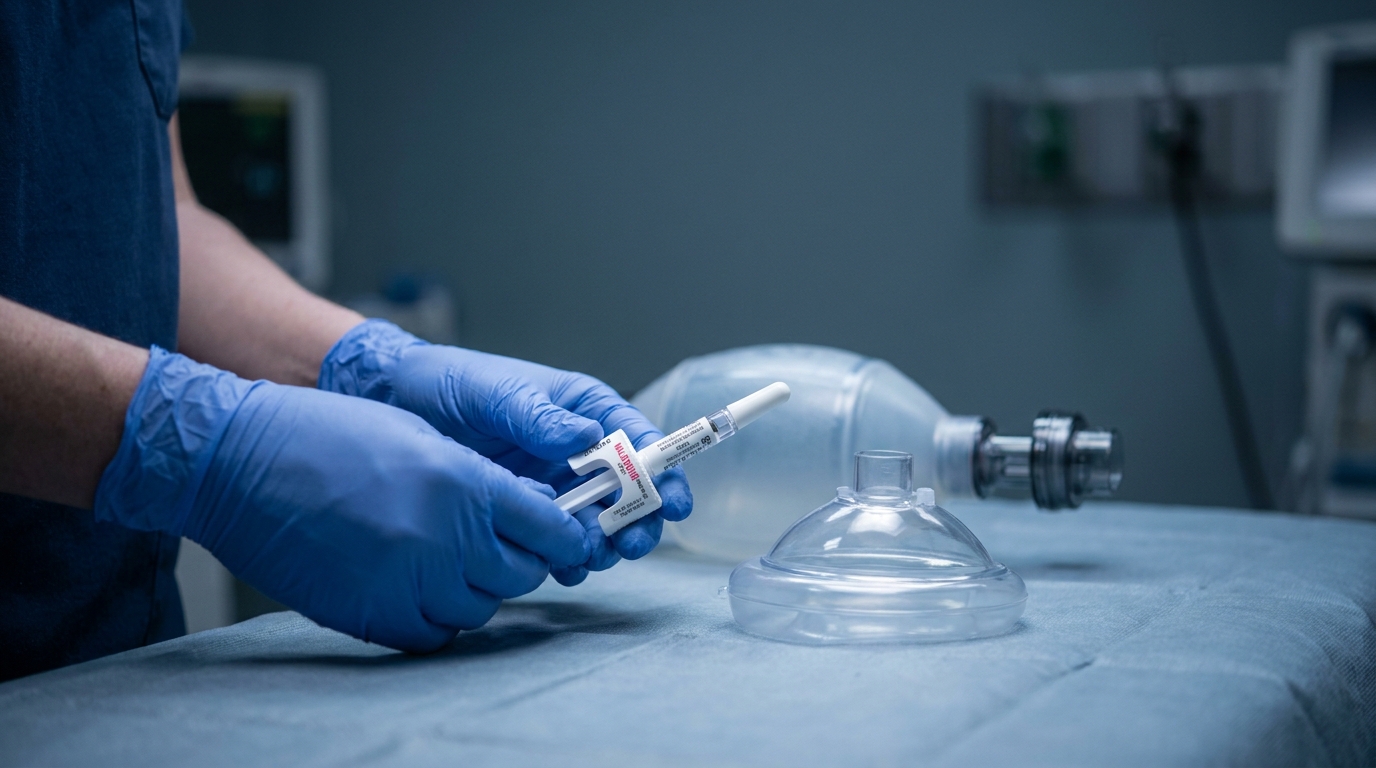
The opioid-associated emergency is one of those clinical scenarios where a differentiated approach determines outcome. Not every opioid intoxication requires full cardiopulmonary resuscitation – and not every case responds to naloxone alone. The spectrum ranges from pure respiratory depression to respiratory arrest to cardiac arrest, and the therapeutic response must precisely match the stage. The AHA has therefore published a dedicated algorithm for opioid-associated emergencies that differs from standard CPR in key aspects. The critical paradigm shift: in opioid intoxications, ventilation takes priority because the pathophysiological pathway to cardiac arrest almost always leads through hypoxia.
Pathophysiology: Why Opioid Emergencies Are Different
To understand the adapted algorithm, it's worth looking at the pathophysiology. Opioids – whether heroin, fentanyl, methadone, oxycodone, or synthetic derivatives – primarily act via μ-opioid receptors in the brainstem, suppressing the respiratory center. The cascade typically unfolds as follows:
- Respiratory depression: Reduction in respiratory rate and tidal volume
- Hypercapnia and hypoxia: Progressive CO₂ rise, falling oxygen saturation
- Respiratory arrest: Complete cessation of respiratory activity
- Hypoxic cardiac arrest: Secondary circulatory arrest due to prolonged hypoxia
This progression takes minutes to hours depending on the substance, dose, and route of administration. This means: there is a therapeutic window in which cardiac arrest can be prevented solely by securing ventilation. In contrast to primary cardiac arrest (e.g., ventricular fibrillation), opioid-associated arrest is a hypoxic arrest – and this has direct consequences for therapy.
Special Considerations: Fentanyl and Synthetic Opioids
Fentanyl and its derivatives (carfentanil, acetylfentanyl) deserve special attention. Their extremely high potency leads to:
- Rapid progression from an alert state to respiratory arrest – sometimes within seconds
- Possible need for higher or repetitive naloxone doses
- Chest wall rigidity (Wooden Chest Syndrome), which can massively impair bag-mask ventilation
- Prolonged duration of action with some derivatives that exceeds the effective duration of naloxone
Chest wall rigidity in particular is a clinically relevant phenomenon: the thoracic wall musculature contracts so severely that adequate ventilation becomes virtually impossible. In such cases, neuromuscular blocking agents (succinylcholine) and endotracheal intubation may be necessary – a critical point in the prehospital setting with limited resources.
The AHA Algorithm for Opioid-Associated Emergencies
The AHA guidelines provide a stepwise algorithm based on clinical presentation. The central decision point is the question: Is cardiac arrest present or not?
Step 1: Recognition and Initial Assessment
Suspicion of opioid intoxication arises from:
- Clinical signs: Miosis (pinpoint pupils), reduced respiratory rate (< 12/min) or apnea, altered consciousness to coma, cyanosis
- Contextual information: Known substance use, paraphernalia found at the scene, known opioid medication, environment
- Red flags: Agonal breathing (gasping), no response to painful stimuli, pulselessness
It is important to differentiate from other diagnoses that can present similarly:
- Hypoglycemia
- Intoxication with other CNS depressants (benzodiazepines, GHB, barbiturates)
- Postictal state
- Intracranial pathology (hemorrhage, ischemia)
- Hypothermia
Step 2: Airway and Ventilation – The Key
If the patient is unresponsive but still has a palpable pulse:
- Open the airway: Head tilt, chin lift. If cervical spine trauma is suspected: jaw thrust maneuver
- Begin ventilation: Bag-mask ventilation with oxygen (15 L/min, reservoir)
- Respiratory rate: One breath every 5–6 seconds (10–12/min) for adults with a pulse but insufficient or absent spontaneous breathing
This phase is the critical therapeutic window. Many opioid emergencies can be stabilized through consistent ventilation alone – even before naloxone is administered. The AHA explicitly emphasizes that naloxone administration must not delay basic interventions.
Step 3: Naloxone Administration
Naloxone is a competitive antagonist at μ-opioid receptors and reverses the respiratory depressant effect. It is administered alongside ventilation, not instead of it.
Dosing and routes of administration:
| Route | Dose | Considerations |
|---|---|---|
| Intravenous (IV) | 0.4 mg initial, titrated | Fastest onset (1–2 min), best controllability |
| Intramuscular (IM) | 0.4 mg | Onset 3–5 min, good option when IV access is unavailable |
| Intranasal (IN) | 2–4 mg | Suitable for lay use, onset 3–5 min |
| Subcutaneous (SC) | 0.4 mg | Alternative when access is difficult |
| Endotracheal | 2–4 mg | Only with endotracheal tube in place, unreliable absorption |
Titration: In the professional setting, IV titration is the method of choice. Starting with 0.04–0.1 mg IV in patients with known opioid dependence, you can gradually increase the dose. The goal is to restore adequate spontaneous breathing – not full arousal. Overly rapid, complete antagonization can trigger a severe withdrawal syndrome with:
- Massive sympathetic activation (hypertension, tachycardia)
- Vomiting with aspiration risk
- Agitation and aggression
- In rare cases: pulmonary edema, seizures
Repeat dosing: The half-life of naloxone is 30–90 minutes, which is shorter than that of most opioids. Rebound respiratory depression is likely, especially with long-acting substances (methadone: half-life up to 60 hours). Therefore, close monitoring for at least 4 hours after naloxone administration is mandatory. In fentanyl intoxications, cumulative doses of 10 mg or more may be necessary.
Step 4: Decision Point – Pulse or No Pulse?
This is where the pathways diverge:
Pulse present but inadequate breathing:
- Continue ventilation
- Administer/repeat naloxone
- Monitoring (SpO₂, capnography, ECG)
- Consider advanced airway management (supraglottic or endotracheal)
- Transport decision
No pulse palpable → Cardiac arrest:
- Immediately begin CPR per standard AHA algorithm
- Naloxone has NO role as primary therapy in cardiac arrest
- Focus on high-quality chest compressions and early ventilation
- Defibrillation for shockable rhythms
This point is frequently misunderstood: Naloxone is not a substitute for CPR. In cardiac arrest, naloxone alone is ineffective because it requires a functioning circulation to reach its site of action. The AHA does recommend naloxone administration in cardiac arrest as a supplement (it does no harm), but the core therapy remains mechanical circulatory support.
Special Considerations for CPR in Opioid-Associated Cardiac Arrest
Rhythm Analysis
The typical rhythm in opioid-associated cardiac arrest is pulseless electrical activity (PEA) or asystole – i.e., a non-shockable rhythm. This follows logically from the pathophysiology: prolonged hypoxia leads to a bradycardic rhythm that progresses to PEA and eventually asystole. Ventricular fibrillation is rare but can occur with:
- Concomitant cocaine or amphetamine intoxication
- Pre-existing structural heart disease
- QTc prolongation from methadone
- Hypokalemia
Ventilation Takes Priority
In contrast to primary cardiac arrest, where the AHA considers compression-only CPR acceptable for untrained lay rescuers, the following applies explicitly to opioid-associated arrest: Ventilation is essential. The rationale is clear – in a hypoxic arrest, oxygenation is the decisive factor. The AHA recommends:
- Standard CPR with 30:2 (compressions:ventilations) with an unsecured airway
- Continuous compressions with asynchronous ventilation (every 6 seconds) with a secured airway
- High FiO₂ (100% oxygen) from the start
- Early advanced airway management
Reversible Causes – The Extended H's and T's
Even in suspected opioid arrest, all reversible causes must be systematically evaluated. Polysubstance intoxications are the rule, not the exception. Particularly relevant:
- Hypoxia: Primary cause – aggressive oxygenation and ventilation
- Hypovolemia: With concurrent trauma, gastrointestinal bleeding
- Hypothermia: Exposure risk in unconscious patients found outdoors
- Hyperkalemia: In chronic renal insufficiency (common comorbidity)
- Toxins: Mixed intoxications (benzodiazepines, cocaine, alcohol, tricyclic antidepressants)
- Tension pneumothorax: Possible with chest wall rigidity and aggressive positive pressure ventilation
- Tamponade: In infective endocarditis (IV drug use)
Post-Resuscitation Phase
After successful resuscitation from opioid-associated arrest:
- Consider continuous naloxone infusion: ⅔ of the initial effective dose per hour
- Continuous monitoring for at least 24 hours
- Actively screen for aspiration pneumonia (chest X-ray, bronchoscopy if suspected)
- Rule out rhabdomyolysis (CK, myoglobin, renal function) – prolonged lying on hard surfaces
- Evaluate for compartment syndrome of the extremities
- Hypoxic-ischemic encephalopathy: Neuroprognostication per standard protocol
- Targeted Temperature Management (TTM): Per current protocol, no opioid-specific modification
Common Errors and Pitfalls
In clinical practice and simulations, recurring errors emerge in opioid-associated emergencies:
1. Naloxone is treated as a cure-all Naloxone without ventilation in an apneic patient wastes precious minutes. The effect doesn't set in for 1–5 minutes – time during which hypoxia continues to progress.
2. No pulse check before starting CPR Under stress, chest compressions are sometimes initiated in an apneic but still hemodynamically stable patient. The 10-second pulse check (carotid artery) is critical for determining the course of action: ventilation alone vs. full CPR.
3. Naloxone overdose Especially in dependent individuals, abrupt antagonization causes acute withdrawal. An agitated, vomiting patient who pulls out the IV line and refuses treatment is an avoidable complication.
4. Premature discharge The half-life of naloxone is shorter than that of most opioids. A patient who appears alert and cooperative after naloxone administration can fall back into respiratory arrest 60–90 minutes later. The obligation for continued monitoring is regularly underestimated.
5. Tunnel vision on opioids Mixed intoxications are common. Benzodiazepines, alcohol, cocaine, synthetic cannabinoids – failure to improve after naloxone should always prompt consideration of co-intoxications or alternative diagnoses.
6. Neglecting personal safety Fentanyl contamination in the environment is a real risk. Wear gloves and FFP masks when powdered substances are present. Percutaneous intoxication from fentanyl derivatives is rare but has been documented.
Special Situation: Opioid Emergencies in Pain Patients and the Postoperative Setting
Not every opioid emergency occurs in the context of illicit drug use. In clinical practice, you regularly encounter opioid-induced respiratory depression:
- Postoperatively: PCA overdose, opioid accumulation in renal insufficiency
- Palliative care: Dose escalation, medication errors
- Pain management: Initial dose titration, fentanyl patches (depot effect over hours)
- Pediatrics: Accidental ingestion by children
In these settings, naloxone titration is particularly important because you don't want to completely reverse the analgesic effect. Microtitration (0.04 mg IV, repeated every 2 minutes) allows gradual antagonization of respiratory depression while maintaining some degree of analgesia.
Summary: The Common Thread
The opioid-associated emergency follows a clear logic:
- Recognize: Clinical signs + context → suspicion of opioid intoxication
- Ventilate: Secure the airway and ventilate – this is the single most important intervention
- Administer naloxone: Alongside ventilation, titrated, via the appropriate route
- Pulse check: Cardiac arrest yes or no?
- In cardiac arrest: Standard CPR with emphasis on ventilation, search for all reversible causes
- Monitoring: Long-term surveillance due to rebound risk
Understanding the pathophysiology – respiratory depression → hypoxia → cardiac arrest – is the key to taking the right action. Once you have internalized this relationship, you will make the right decision at every stage.
Practical Training
Differentiating between respiratory depression and cardiac arrest, correct naloxone titration, and the seamless transition to full CPR upon deterioration are skills best trained in realistic simulation scenarios. In the ACLS Refresher Course from Simulation Tirol, opioid-associated emergencies are practiced as dedicated scenarios – including algorithm-based decision training, airway management, and team communication. If you want to refresh your ACLS certification or deepen your competence in toxicological emergencies, you can find all information at simulation.tirol.
Want to practice this hands-on?
In our ACLS-Refresher you practice this topic hands-on with high-tech simulators and experienced instructors.
More Articles
Acute Heart Failure: Emergency Management and Differentiation
From pulmonary edema to cardiogenic shock – acute heart failure requires rapid hemodynamic classification. This article explains the clinical classification and first-line therapy with nitrates, diuretics, and vasopressors.
Acute Coronary Syndrome: Initial Management and the MONA Approach
ACS is one of the most common cardiac emergencies. This article covers initial diagnostics (12-lead ECG, troponin), risk stratification, pharmacological first-line treatment, and decision pathways for reperfusion therapy.
ECG Rhythm Interpretation: The Most Important Emergency Rhythms
From ventricular fibrillation to pulseless electrical activity to third-degree AV block – this article presents typical ECG patterns of the most critical emergency cardiac arrhythmias with recognition criteria and immediate therapy.