Pulseless Electrical Activity: Causes and Treatment
PEA is one of the most common initial rhythms in in-hospital cardiac arrest. This article covers the systematic search for causes, targeted treatment of reversible triggers, and the difference between pseudo-PEA and true PEA.

Author: Dr. med. univ. Daniel Pehböck, DESA
Specialist in Anesthesiology and Intensive Care Medicine, AHA-certified ACLS/PALS Instructor, Course Director Simulation Tirol
Reading time approx. 8 min
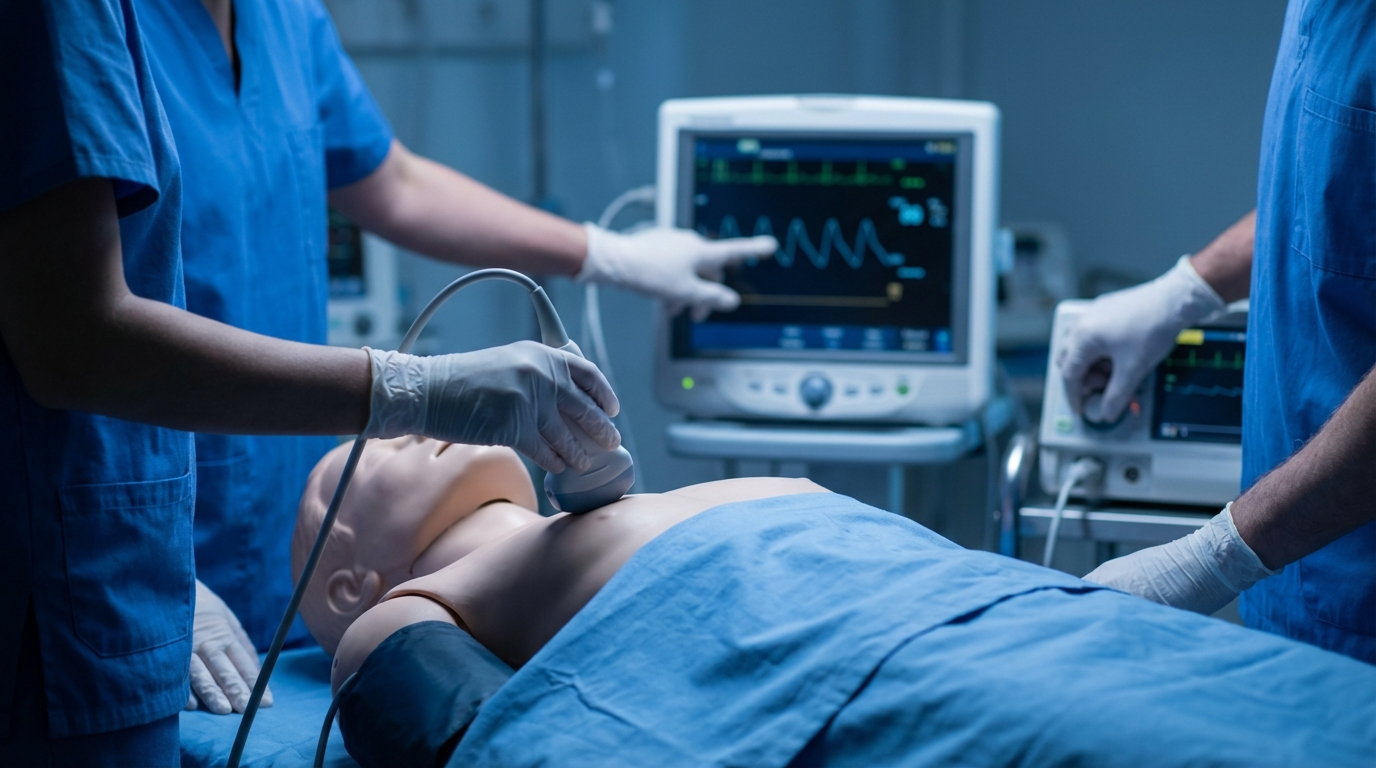
Pulseless electrical activity (PEA) represents one of the most challenging situations in resuscitation. Unlike ventricular fibrillation, where defibrillation offers a clear therapeutic approach, PEA requires systematic diagnostic thinking under maximum time pressure. In the in-hospital setting, PEA is one of the most common initial rhythms in cardiac arrest – and at the same time the one with the highest chance of reversibility, provided the underlying cause is rapidly identified and treated. This is precisely where the clinical challenge lies: PEA is not a disease entity in itself but is always a symptom of a treatable underlying disorder.
Definition and Pathophysiological Concept
PEA is defined as the presence of organized electrical activity on the ECG that would normally be expected to produce a palpable pulse – but no pulse is present. The electrical activity ranges from narrow QRS complexes with a normal rate to wide, slow complexes. The key point: this is a non-shockable rhythm. Defibrillation is ineffective and not indicated.
Pathophysiologically, PEA is caused either by mechanical pump failure with preserved electrical excitation or by such profound circulatory depression that the peripherally palpable pulse is lost – even though the heart may still be contracting. This distinction is of enormous clinical importance.
Pseudo-PEA Versus True PEA
The differentiation between pseudo-PEA and true PEA has direct therapeutic consequences:
Pseudo-PEA (COPD – Cardiac Output Producing Disorder): The heart still shows mechanical contractions and generates a – albeit massively reduced – cardiac output. The pulse is not palpable peripherally, but measurable circulatory activity exists. Point-of-care ultrasound (POCUS) can demonstrate cardiac contractions. Arterial blood pressure can often still be detected as a minimal pressure waveform with invasive monitoring. The prognosis for these patients is significantly better than for true PEA.
True PEA (electromechanical dissociation): The electrical activity on the ECG is completely uncoupled from mechanical cardiac action. The heart does not contract. Ultrasound reveals a standstill heart despite ECG complexes. The prognosis is considerably worse and, without rapid correction of the cause, approaches that of asystole.
For clinical practice this means: every PEA should be evaluated sonographically as early as possible. Pseudo-PEA has a real chance of achieving ROSC if the cause is treated promptly. The use of POCUS during rhythm analysis – i.e., during the brief pauses in chest compressions – is a central tool of modern resuscitation.
Systematic Cause Identification: The Hs and Ts
The AHA guidelines structure the reversible causes of cardiac arrest into the well-established framework of the 5 Hs and 5 Ts. In PEA, this systematic approach is particularly relevant because treating the underlying cause is the only path to survival.
The 5 Hs
Hypovolemia: One of the most common causes, particularly in trauma, gastrointestinal hemorrhage, ruptured aortic aneurysm, or postoperatively. Clinical clues include flat neck veins, known bleeding sources, and hemodynamic instability prior to arrest. Treatment: aggressive volume resuscitation, massive transfusion in hemorrhage, and surgical bleeding control.
Hypoxia: Particularly relevant in airway obstruction, aspiration, severe asthma, or ARDS. Treatment: airway management, 100% oxygen, verify tube position (capnography!). Consider tube dislodgement if an already intubated patient develops PEA.
Hypothermia: PEA can occur in accidental hypothermia. Important: medication administration and defibrillation have limited efficacy at core temperatures < 30 °C. Treatment: active rewarming, ideally extracorporeal (ECLS/ECMO). "Nobody is dead until warm and dead."
Hyper-/Hypokalemia (and other electrolyte disturbances): Hyperkalemia is one of the most common reversible causes in the in-hospital setting, especially in dialysis-dependent patients or acute renal failure. Typical ECG signs (peaked T waves, widened QRS complexes, sinus bradycardia) can be indicative. Treatment for hyperkalemia: calcium gluconate 10% 30 mL IV (or calcium chloride 10% 10 mL via central line), sodium bicarbonate 50 mmol IV, insulin-glucose infusion. Hypokalemia: IV potassium replacement.
Hydrogen ions (acidosis): Severe metabolic acidosis (e.g., in sepsis, diabetic ketoacidosis, intoxication) can trigger PEA. Treatment: sodium bicarbonate 50 mmol IV as an initial bolus, treat the underlying cause. Bicarbonate is not a routine measure in resuscitation but is indicated in known or suspected severe acidosis.
The 5 Ts
Tension pneumothorax: Classically occurs after trauma, central line placement, mechanical ventilation, or in COPD/asthma. Clinical signs: unilaterally absent breath sounds, subcutaneous emphysema, distended neck veins, tracheal deviation (late sign). The diagnosis must be made clinically – do not wait for a chest X-ray during cardiac arrest. Treatment: immediate relief via needle decompression (2nd intercostal space midclavicular line or 4th/5th intercostal space anterior axillary line, large-bore cannula or commercial decompression needle catheter), followed by chest tube insertion.
Tamponade (cardiac tamponade): Common after cardiac surgery, in trauma, pericarditis, or malignancy. Clinical signs during cardiac arrest are difficult to elicit – POCUS is the diagnostic tool of choice here (pericardial effusion, compressed ventricles, "swinging heart"). Treatment: pericardiocentesis or surgical decompression. Subxiphoid puncture under ultrasound guidance, ideally using Seldinger technique.
Thrombosis, coronary (myocardial infarction): An extensive STEMI can lead to PEA, particularly in right ventricular infarction or free wall rupture. ECG diagnosis is limited under resuscitation conditions, but ST elevations can be indicative. Treatment: consider emergency PCI under ongoing resuscitation (if logistically feasible) or systemic thrombolysis as a last resort.
Thrombosis, pulmonary (pulmonary embolism): Massive pulmonary embolism is one of the most common causes of PEA. Clinical clues: preceding immobilization, known DVT, acute dyspnea prior to cardiac arrest, right heart strain signs on ECG, dilated right ventricle on POCUS. Treatment: systemic thrombolysis with alteplase 50 mg IV bolus; if ineffective, followed by an additional 50 mg. After thrombolysis: continue resuscitation for at least 60–90 minutes. Alternatively, catheter-directed or surgical thrombectomy may be considered if the infrastructure is available.
Toxins (intoxication): Numerous substances can cause PEA – beta-blockers, calcium channel blockers, tricyclic antidepressants, digoxin, local anesthetics. The history (medication list, empty packaging, suicide attempt) is crucial. Specific antidotes:
- Beta-blockers: glucagon 5–10 mg IV, high-dose insulin euglycemia therapy (HIE)
- Calcium channel blockers: calcium gluconate, HIE therapy
- Tricyclic antidepressants: sodium bicarbonate 1–2 mmol/kg IV
- Local anesthetics (LAST): Lipid Rescue with Intralipid® 20% – initial bolus 1.5 mL/kg, followed by continuous infusion 0.25 mL/kg/min
- Digoxin: digoxin-specific antibody fragments (Fab fragments)
- Opioids: naloxone (rarely the sole cause of PEA; usually respiratory arrest with secondary hypoxia)
Algorithm for PEA in the ACLS Context
The ACLS algorithm for PEA follows the non-shockable arm of the cardiac arrest algorithm:
- Recognize cardiac arrest – unresponsive, no normal breathing, no pulse
- Start CPR – high-quality chest compressions (rate 100–120/min, depth 5–6 cm, full recoil), ventilation at a ratio of 30:2 or continuous compressions with a secured airway at 10 breaths/min
- Rhythm analysis – organized rhythm without a pulse = PEA → non-shockable algorithm
- Epinephrine 1 mg IV as early as possible, then repeat every 3–5 minutes
- Begin cause identification – systematically work through the Hs and Ts in parallel with CPR
- Rhythm and pulse check every 2 minutes
- POCUS during the rhythm analysis pause – cardiac activity? Pericardial effusion? RV dilation? Hypovolemia?
- Treat reversible causes – this is the decisive step
Practical Tips for Cause Identification During Resuscitation
Systematically working through the Hs and Ts sounds straightforward in theory but is a true team effort under the conditions of an ongoing resuscitation. The following approaches have proven effective:
- Use cognitive aids: Attach laminated cards with the Hs and Ts to the resuscitation cart. Many teams overlook reversible causes under stress.
- Team communication: The team leader should ask loudly and explicitly: "Which reversible causes are we considering for this patient?"
- Context-based prioritization: Not all Hs and Ts are equally likely. In a dialysis-dependent patient, hyperkalemia is at the top of the list. After central line placement, think of tension pneumothorax first. Postoperatively after cardiac surgery, tamponade is the primary consideration.
- Point-of-care diagnostics: In addition to POCUS, an arterial blood gas analysis provides information within seconds about potassium, pH, hemoglobin, and lactate – four parameters with direct therapeutic consequences.
- Monitor capnography: A sudden rise in end-tidal CO₂ (etCO₂) can be an early sign of ROSC. Persistently low etCO₂ values (< 10 mmHg) despite good compression quality suggest a poor prognosis or should raise suspicion of pulmonary embolism.
Prognostic Considerations
The prognosis of PEA depends critically on three factors:
- Type of PEA: Pseudo-PEA with demonstrable cardiac activity on POCUS has a significantly better ROSC rate than true electromechanical dissociation.
- Reversibility of the cause: Tension pneumothorax, hyperkalemia, and hypovolemia are readily treatable with rapid recognition. Massive pulmonary embolism has a worse prognosis but one that can be influenced by thrombolysis.
- Time factor: The narrower the QRS complex and the higher the heart rate on the ECG during PEA, the more likely it is pseudo-PEA and the better the prognosis. Wide, slow complexes are prognostically unfavorable and suggest progression toward asystole.
A QRS complex < 0.12 seconds in PEA should always prompt consideration of a mechanical cause (tamponade, tension pneumothorax, pulmonary embolism, hypovolemia), while a wide QRS complex is more suggestive of metabolic causes (hyperkalemia, intoxication) or terminal myocardial failure.
Special Clinical Scenarios
PEA After Intubation
If a patient develops PEA immediately after intubation, think first of:
- Esophageal misplacement (capnography!)
- Tension pneumothorax (especially with a difficult airway or trauma)
- Reflex bradycardia/vasovagal reaction (rare as the sole cause of PEA)
- Medication effect (induction agents, especially in hemodynamically unstable patients)
PEA in Dialysis Patients
The most common cause is hyperkalemia. Administer calcium gluconate 10% 30 mL IV and sodium bicarbonate 50 mmol IV empirically. Obtain a blood gas analysis as quickly as possible to confirm the potassium level.
PEA in Trauma
In the trauma setting, four causes predominate: hypovolemia (hemorrhage), tension pneumothorax, cardiac tamponade, and severe hypoxia. Resuscitation in trauma follows a modified protocol focusing on hemorrhage control, bilateral chest decompression, and massive transfusion. Resuscitative thoracotomy in the emergency department is an established option in penetrating trauma with PEA within defined time windows.
Practical Training
PEA is a prime example of why algorithm knowledge alone is not enough. The cognitive load during resuscitation – simultaneously coordinating high-quality CPR, working through differential diagnoses, performing POCUS, and initiating specific therapies – requires regular, hands-on training. In the ACLS course by Simulation Tirol, you train exactly these scenarios: PEA management with systematic cause identification, POCUS integration, and team communication under realistic conditions. This transforms theoretical knowledge into a reliable action plan that can save lives in a real emergency.
Want to practice this hands-on?
In our ACLS-Kurs (Advanced Cardiac Life Support) you practice this topic hands-on with high-tech simulators and experienced instructors.
More Articles
Acute Heart Failure: Emergency Management and Differentiation
From pulmonary edema to cardiogenic shock – acute heart failure requires rapid hemodynamic classification. This article explains the clinical classification and first-line therapy with nitrates, diuretics, and vasopressors.
Acute Coronary Syndrome: Initial Management and the MONA Approach
ACS is one of the most common cardiac emergencies. This article covers initial diagnostics (12-lead ECG, troponin), risk stratification, pharmacological first-line treatment, and decision pathways for reperfusion therapy.
ECG Rhythm Interpretation: The Most Important Emergency Rhythms
From ventricular fibrillation to pulseless electrical activity to third-degree AV block – this article presents typical ECG patterns of the most critical emergency cardiac arrhythmias with recognition criteria and immediate therapy.