Peri-Arrest Arrhythmias: Recognition and Immediate Management
Peri-arrest arrhythmias are rhythm disturbances that can rapidly deteriorate into cardiac arrest. This article covers the systematic recognition of critical warning rhythms, differentiation from benign arrhythmias, and time-critical interventions according to AHA guidelines.

Author: Dr. med. univ. Daniel Pehböck, DESA
Specialist in Anesthesiology and Intensive Care Medicine, AHA-certified ACLS/PALS Instructor, Course Director Simulation Tirol
Reading time approx. 8 min
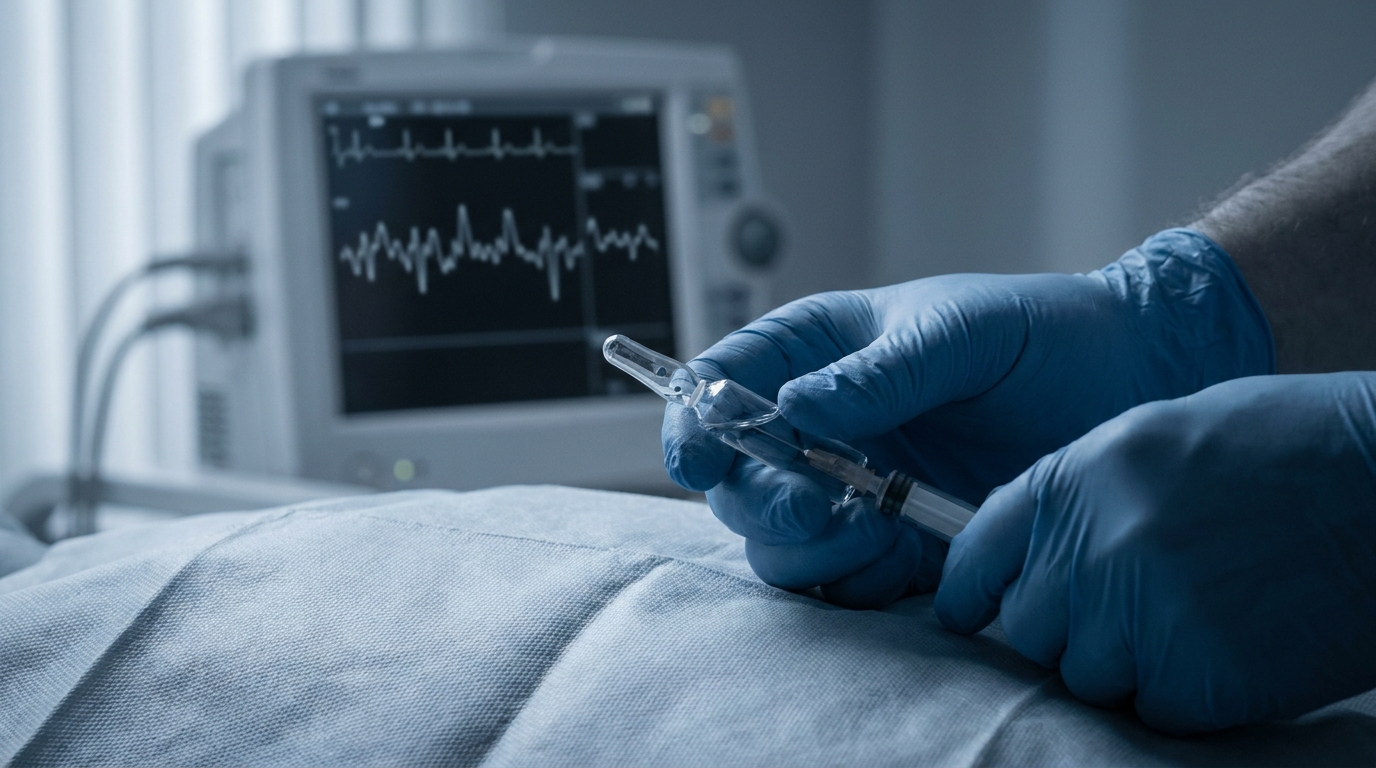
Peri-arrest arrhythmias are among the most critical situations in clinical practice. They mark the narrow time window between a still-present circulation and impending cardiac arrest. As a physician or nurse, you are regularly confronted with rhythm disturbances – and the crucial question every time is: Is this arrhythmia benign, or is cardiovascular collapse imminent? Systematic recognition and time-critical management of these warning rhythms can make the difference between a stable patient and a resuscitation situation. This article gives you the tools to confidently identify peri-arrest arrhythmias and treat them in an algorithm-based approach – before arrest occurs.
What Are Peri-Arrest Arrhythmias?
The term "peri-arrest" describes the phase immediately before or immediately after cardiac arrest. Peri-arrest arrhythmias are cardiac rhythm disturbances that are hemodynamically significant enough that, without intervention, they will very likely progress to cardiac arrest – or that occur in the immediate post-resuscitation phase and can trigger re-arrest.
The AHA guidelines divide these arrhythmias into two major groups:
- Tachyarrhythmias (heart rate > 100/min)
- Bradyarrhythmias (heart rate < 50/min with symptoms)
Clinical decision-making follows one central principle: It is not the rhythm alone that determines therapy, but the hemodynamic impact on the patient. A sinus tachycardia of 130/min due to fever requires a different approach than a ventricular tachycardia at 180/min with altered consciousness – even though both are classified as "tachycardia."
The Clinical Assessment: Stable or Unstable?
Before you dive into ECG analysis, one question comes first: Does the patient show signs of hemodynamic instability? This step is time-critical and determines the entire subsequent algorithm.
Signs of Hemodynamic Instability
- Hypotension: Systolic blood pressure < 90 mmHg or clinical signs of shock (cold and clammy skin, mottled skin, prolonged capillary refill time)
- Altered mental status: Confusion, somnolence, syncope
- Chest pain: Suggestive of myocardial ischemia as a consequence of the arrhythmia
- Acute heart failure: Pulmonary edema, distended neck veins, dyspnea
If one or more of these signs are present, you are dealing with an unstable arrhythmia. Therapy must be initiated immediately – for tachycardias, this generally means electrical cardioversion; for bradycardias, atropine and/or transcutaneous pacing.
Stable Arrhythmia – No Reason for Inaction
Even in stable patients, peri-arrest arrhythmias require thorough diagnostics and treatment. "Stable" merely means you have more time for rhythm analysis and pharmacological therapy. It does not mean there is no danger.
Tachycardic Peri-Arrest Arrhythmias
Narrow Complex Tachycardias (QRS < 0.12 s)
Narrow complex tachycardias originate above the bundle of His. The most common forms in the peri-arrest setting are:
- Atrial fibrillation with rapid ventricular response: Irregular rhythm, no P waves, irregular RR intervals. The most common tachyarrhythmia in clinical practice.
- Atrial flutter: Sawtooth flutter waves (typically ~300/min), often with 2:1 conduction (ventricular rate ~150/min). A ventricular rate of exactly 150/min should always prompt consideration of atrial flutter.
- AV nodal reentrant tachycardia (AVNRT): Regular narrow complex tachycardia, usually 150–250/min. P waves often hidden within the QRS complex or visible as pseudo-r' in V1.
- AV reentrant tachycardia (AVRT): With accessory pathway (e.g., WPW syndrome). Regular, narrow complex with orthodromic conduction.
Management of unstable narrow complex tachycardia:
Synchronized cardioversion. Starting energy:
- Atrial fibrillation: 120–200 J biphasic
- Atrial flutter and SVT: 50–100 J biphasic
Management of stable narrow complex tachycardia:
- Vagal maneuvers: Valsalva maneuver (modified: bearing down for 15 seconds, then leg elevation and lying flat), carotid sinus massage (unilateral only, only after auscultation of the carotids to exclude significant stenosis).
- Adenosine: 6 mg as a rapid IV bolus, followed by a 20 mL normal saline flush. If ineffective after 1–2 minutes: 12 mg. If unsuccessful again: another 12 mg. Adenosine should be administered via an IV access as proximal to the heart as possible (antecubital vein or central venous access).
- Calcium channel blockers or beta-blockers: Verapamil 2.5–5 mg IV over 2 minutes or diltiazem 15–20 mg IV (0.25 mg/kg) for rate control of atrial fibrillation/flutter. Alternatively, metoprolol 5 mg IV, repeatable up to 3 times.
Important: Adenosine is not useful in atrial fibrillation/flutter – it is intended for the diagnosis and treatment of AV nodal reentrant tachycardias. However, adenosine can be used diagnostically to unmask underlying atrial activity by producing transient AV block in regular narrow complex tachycardias.
Caution with WPW syndrome and atrial fibrillation: This presents as an irregular wide complex rhythm. AV node-blocking agents (adenosine, verapamil, digoxin) are strictly contraindicated, as they facilitate conduction over the accessory pathway and can trigger ventricular fibrillation. Treatment of choice: procainamide or electrical cardioversion.
Wide Complex Tachycardias (QRS ≥ 0.12 s)
Every wide complex tachycardia must be treated as ventricular tachycardia (VT) until proven otherwise. This fundamental rule saves lives, because misinterpreting a VT as a supraventricular tachycardia with bundle branch block can have fatal consequences.
Causes of wide complex tachycardias:
- Ventricular tachycardia (VT): Most common cause (~80% in structural heart disease). Monomorphic VT: regular, uniform QRS complexes. Polymorphic VT: varying QRS morphology.
- SVT with aberrant conduction: Pre-existing or rate-dependent bundle branch block.
- SVT with anterograde conduction over an accessory pathway (antidromic AVRT, WPW with atrial fibrillation).
Features suggesting ventricular origin (Brugada criteria, AV dissociation):
- AV dissociation (independent P waves)
- Fusion beats or capture beats
- Concordance of precordial leads (all QRS complexes in V1–V6 in the same direction)
- RS interval > 100 ms in any precordial lead
- Absence of RS complexes in all precordial leads
Management of unstable wide complex tachycardia:
Immediate synchronized cardioversion starting at 100 J biphasic, escalating to 200 J if unsuccessful, then 300 J, then 360 J.
In pulseless VT or degeneration into ventricular fibrillation: Immediate defibrillation (unsynchronized!) at maximum energy and initiation of the ACLS cardiac arrest algorithm.
Management of stable monomorphic VT:
- Amiodarone: 150 mg IV over 10 minutes, followed by a maintenance infusion (1 mg/min for 6 hours, then 0.5 mg/min for 18 hours). Maximum daily dose: 2.2 g.
- Procainamide: 20–50 mg/min IV until rhythm conversion, hypotension, QRS widening > 50%, or maximum dose of 17 mg/kg. Limited availability in Austria.
- Lidocaine: 1–1.5 mg/kg IV bolus, followed by 0.5–0.75 mg/kg every 5–10 minutes (maximum dose 3 mg/kg). Particularly an option in ischemia-related VT.
Management of polymorphic VT:
Polymorphic VT requires a differentiated approach:
- Normal QT interval: Treat as monomorphic VT. Investigate and treat ischemia as the underlying cause.
- Prolonged QT interval (Torsades de Pointes): Magnesium sulfate 1–2 g IV over 15 minutes. Immediately discontinue QT-prolonging medications. Correct electrolytes (potassium, magnesium). If unstable: defibrillation (unsynchronized, as synchronized cardioversion is unreliable due to the changing morphology). Isoproterenol or temporary overdrive pacing may be considered to increase heart rate and relatively shorten the QT interval.
Bradycardic Peri-Arrest Arrhythmias
In the ACLS context, a bradycardia is defined as clinically relevant when the heart rate is < 50/min and symptoms of hemodynamic compromise are present.
Common Causes
- Second-degree AV block, Mobitz type II: Sudden failure of conduction without preceding PR prolongation. High risk of progression to complete heart block.
- Third-degree AV block (complete heart block): Complete dissociation of atrial and ventricular activity. Ventricular escape rhythm is often bradycardic and hemodynamically insufficient.
- Sinus bradycardia: Due to increased vagal tone, medications (beta-blockers, calcium channel blockers, digoxin), hypothermia, hypothyroidism, elevated intracranial pressure.
- Sinus arrest / SA block: Absent P waves with pauses.
- Atrial fibrillation with slow ventricular response: Particularly in digitalis toxicity or AV nodal disease.
Bradycardia Treatment Algorithm
Step 1 – Atropine:
- 0.5 mg IV, repeatable every 3–5 minutes
- Maximum dose: 3 mg (0.04 mg/kg)
- Atropine acts on the sinus node and AV node. In infranodal block (third-degree AV block with wide escape rhythm, second-degree AV block Mobitz type II), atropine is often ineffective – nevertheless, a treatment attempt is recommended while pacing is being prepared.
- Caution: Atropine doses < 0.5 mg can paradoxically worsen bradycardia!
Step 2 – Transcutaneous Pacing:
If atropine is ineffective, transcutaneous pacing is initiated:
- Place pads in anterior-posterior or anterior-lateral position
- Set rate to 60–80/min
- Gradually increase current until electrical capture is achieved (every pacing spike produces a QRS complex)
- Then set 10 mA above the capture threshold as a safety margin
- Verify mechanical capture: palpate pulse, measure blood pressure, assess pulse oximetry waveform
- Do not forget analgesia/sedation – transcutaneous pacing is painful!
Step 3 – Pharmacological Bridge:
If pacing is not immediately available or as a bridging measure:
- Epinephrine infusion: 2–10 µg/min IV (titrate to heart rate and blood pressure)
- Dopamine: 5–20 µg/kg/min IV
- Isoproterenol: 2–10 µg/min IV (particularly in transplanted hearts, as they are denervated and atropine-resistant)
Step 4 – Transvenous Pacing:
For ongoing pacing requirements, arrange for transvenous pacemaker placement early. Transcutaneous pacing is a bridging measure, not a long-term solution.
Reversible Causes: The Foundation of Every Treatment
In parallel with rhythm-specific therapy, you must always search for reversible causes. The 5 H's and 5 T's of the ACLS algorithm also apply in the peri-arrest setting:
5 H's:
- Hypovolemia
- Hypoxia
- Hypothermia
- Hypo-/Hyperkalemia (and other electrolyte disturbances)
- Hydrogen ions (acidosis)
5 T's:
- Thrombosis (coronary – acute myocardial infarction)
- Thrombosis (pulmonary – pulmonary embolism)
- Tamponade (cardiac)
- Tension pneumothorax
- Toxins (poisoning, medications)
An example: Bradycardia caused by hyperkalemia will not be resolved by atropine and pacing alone, but rather by calcium gluconate (10 mL of a 10% solution IV over 2–3 minutes), insulin-glucose therapy, sodium bicarbonate, and dialysis. Without treating the underlying cause, any antiarrhythmic therapy remains incomplete.
Documentation and Team Communication
In the peri-arrest setting, structured communication is essential. Use closed-loop communication: clear instruction – read-back – confirmation. Document the rhythm continuously – many defibrillators and monitors offer storage functions. A 12-lead ECG should be obtained as early as possible in stable patients, as it significantly facilitates differentiation between supraventricular and ventricular origin.
Summary: Key Clinical Decisions
| Situation | Immediate Action |
|---|---|
| Unstable tachycardia (any QRS) | Synchronized cardioversion |
| Pulseless VT / ventricular fibrillation | Defibrillation (unsynchronized) + CPR |
| Stable narrow complex tachycardia (regular) | Vagal maneuvers → Adenosine |
| Stable wide complex tachycardia | Amiodarone (VT until proven otherwise) |
| Torsades de Pointes | Magnesium 1–2 g IV |
| Symptomatic bradycardia | Atropine 0.5 mg → Pacing → Epinephrine infusion |
Practical Training
Peri-arrest arrhythmias demand fast, confident decisions under stress. The ability to recognize an unstable rhythm within seconds and recall the correct algorithm cannot be acquired through reading alone – it must be practiced regularly in hands-on training. In the ACLS course by Simulation Tirol, you train exactly these scenarios: from systematic rhythm assessment to synchronized cardioversion and transcutaneous pacing, hands-on with simulators and in an interprofessional team. That way, you are prepared when it matters most.
Want to practice this hands-on?
In our ACLS-Kurs (Advanced Cardiac Life Support) you practice this topic hands-on with high-tech simulators and experienced instructors.
More Articles
Acute Heart Failure: Emergency Management and Differentiation
From pulmonary edema to cardiogenic shock – acute heart failure requires rapid hemodynamic classification. This article explains the clinical classification and first-line therapy with nitrates, diuretics, and vasopressors.
Acute Coronary Syndrome: Initial Management and the MONA Approach
ACS is one of the most common cardiac emergencies. This article covers initial diagnostics (12-lead ECG, troponin), risk stratification, pharmacological first-line treatment, and decision pathways for reperfusion therapy.
ECG Rhythm Interpretation: The Most Important Emergency Rhythms
From ventricular fibrillation to pulseless electrical activity to third-degree AV block – this article presents typical ECG patterns of the most critical emergency cardiac arrhythmias with recognition criteria and immediate therapy.