Opioid Overdose: Naloxone Dosing and Post-Treatment Monitoring
With rising opioid prescriptions, the number of intoxications is increasing. This article covers recognition of the opioid triad, naloxone dosing (i.v., i.m., nasal), titration, rebound risk, and the required monitoring duration.

Author: Dr. med. univ. Daniel Pehböck, DESA
Specialist in Anesthesiology and Intensive Care Medicine, AHA-certified ACLS/PALS Instructor, Course Director Simulation Tirol
Reading time approx. 9 min
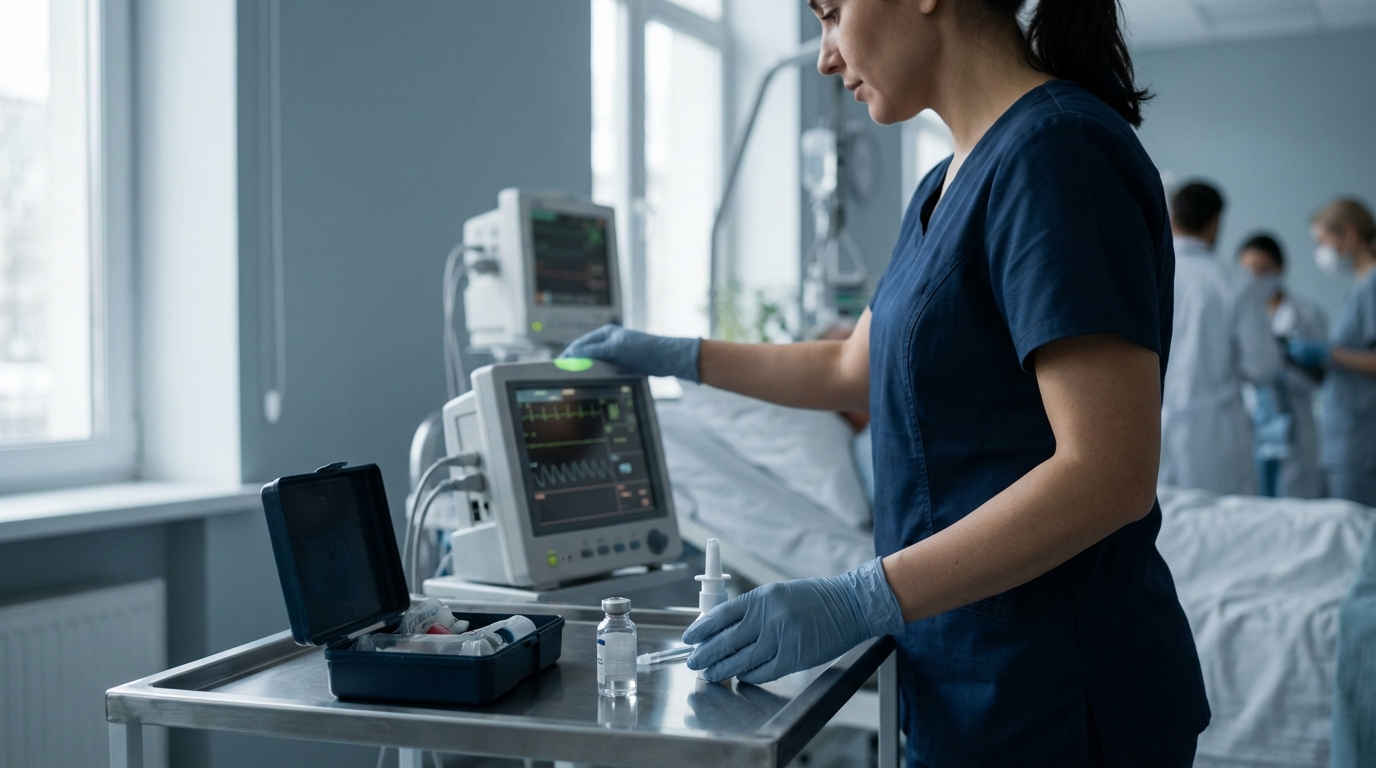
Opioid intoxication is one of the most common toxicological emergencies in both prehospital and in-hospital settings. Whether iatrogenic due to dosing errors, accidental in the context of chronic pain therapy, or related to substance abuse – rapid recognition and targeted antagonism with naloxone is the difference between life and death. At the same time, uncritical administration of naloxone carries its own risks: from acute withdrawal syndrome to hemodynamic collapse. This article provides you with the pharmacological fundamentals, specific dosing regimens for various routes of administration, the art of titration, and the frequently underestimated post-treatment care including monitoring duration.
The Opioid Triad: Recognizing It Before It Becomes Critical
The classic triad of opioid intoxication consists of three cardinal clinical symptoms:
- Decreased level of consciousness – ranging from somnolence to stupor to deep coma (GCS ≤ 8)
- Respiratory depression – respiratory rate < 12/min, frequently < 8/min, progressing to apnea
- Miosis – bilateral pinpoint pupils (Caution: mydriasis may be present in mixed intoxications or hypoxia)
Extended Clinical Signs
Beyond the classic triad, you should look for the following findings:
- Hypotension – particularly with high-potency opioids such as fentanyl or sufentanil
- Bradycardia – vagotonic response, common in higher-grade intoxication
- Hypothermia – due to central thermoregulatory dysfunction and immobilization
- Hyporeflexia to areflexia
- Nausea and emesis – particularly relevant during the awakening phase (aspiration risk!)
- Pulmonary edema – non-cardiogenic pulmonary edema as a feared complication, especially in heroin intoxication
Differential Diagnostic Considerations
Not every case of unconsciousness with miosis is an opioid poisoning. Consider the following differential diagnoses:
- Pontine hemorrhage (miosis + unconsciousness + respiratory disturbance)
- Organophosphate poisoning (miosis + hypersalivation + muscle fasciculations)
- Clonidine intoxication (miosis + bradycardia + hypotension)
- Mixed intoxications with benzodiazepines, alcohol, or antipsychotics
A trial dose of naloxone can be diagnostically informative – however, a lack of response should immediately prompt you to consider alternative causes.
Naloxone: Pharmacology Overview
Naloxone is a competitive antagonist at all opioid receptors (µ, κ, δ), with the highest affinity for the µ-receptor. It has no intrinsic agonistic activity and acts exclusively in the presence of opioids.
Key Pharmacokinetic Data
| Parameter | Value |
|---|---|
| Onset of action i.v. | 1–2 minutes |
| Onset of action i.m./s.c. | 3–5 minutes |
| Onset of action intranasal | 3–8 minutes |
| Duration of action | 30–90 minutes (dose-dependent) |
| Half-life | 30–80 minutes |
| Metabolism | Hepatic glucuronidation |
The critical clinical point: The duration of action of naloxone is shorter than the duration of action of most opioids. Methadone has a half-life of 24–36 hours, extended-release oxycodone formulations act for 8–12 hours, and even morphine outlasts naloxone by a significant margin. This mismatch is the basis for the feared rebound phenomenon.
Dosing and Routes of Administration
Intravenous Administration – Gold Standard for Titration
Intravenous administration allows the most precise control and is the preferred route when intravenous access is established.
Standard approach in adults:
- Initial dose: 0.04–0.1 mg (40–100 µg) i.v.
- Titration: Repeat every 2–3 minutes
- Titration endpoint: Adequate spontaneous breathing (RR > 12/min), NOT full alertness
- If no response: Dose escalation to 0.4 mg, then 2 mg i.v.
- Maximum dose: Up to 10 mg cumulative – if there is no response after 10 mg, the diagnosis of a pure opioid intoxication should be questioned
Practical tip for dilution: Draw up 1 ampoule of naloxone (0.4 mg/1 ml) and dilute with 9 ml of 0.9% NaCl to a concentration of 0.04 mg/ml (40 µg/ml). This allows you to titrate in 1 ml increments.
In opioid-naïve patients (e.g., postoperative respiratory depression in opioid-naïve patients, accidental overdose in children): Start with 0.04 mg i.v. and titrate carefully.
In opioid-tolerant patients (e.g., chronic pain patients, patients with substance use disorder): Particular caution is warranted here. Overly rapid or high-dose antagonism can trigger a severe acute withdrawal syndrome with life-threatening complications.
Intramuscular/Subcutaneous Administration
If no i.v. access is available – a common situation in the prehospital setting – i.m. or s.c. administration is a reliable alternative.
- Dose: 0.4 mg i.m. (preferably deltoid muscle or vastus lateralis)
- Repeat: Every 3–5 minutes if no effect
- Disadvantage: Slower onset of action, titration not possible
Intranasal Administration
Intranasal administration has gained considerable importance in recent years, particularly in lay first-responder programs and emergency medical services.
- Dose: 2–4 mg intranasal (depending on the product, as a single spray or divided between both nostrils)
- Bioavailability: Approximately 50% compared to i.m. administration
- Onset of action: 3–8 minutes
- Repeat: After 3–5 minutes if no response
The higher dose compensates for the lower bioavailability. In cases of heavily congested or bleeding nasal mucosa, absorption is unreliable – in such cases, prefer i.m. administration.
Special Situation: Continuous Naloxone Infusion
For long-acting opioids (methadone, extended-release formulations, buprenorphine in toxic doses) or in cases of repeated rebound, a continuous infusion may be appropriate:
- Calculating the infusion rate: Two-thirds of the effective initial bolus dose per hour
- Example: If 0.3 mg naloxone i.v. was clinically effective → infusion at 0.2 mg/h
- Preparation: Effective bolus dose in 500 ml 0.9% NaCl or 5% glucose via syringe pump
- Monitoring: Closely monitor respiratory rate, SpO₂, level of consciousness – adjust every 30–60 minutes
The Art of Titration: Why Less Is Often More
The goal of naloxone therapy is not complete antagonism of the opioid effect. The goal is restoration of adequate spontaneous breathing while preserving analgesia as much as possible and without triggering an acute withdrawal syndrome.
Acute Opioid Withdrawal Syndrome – A Preventable Catastrophe
Overly aggressive naloxone administration can trigger the following complications in opioid-tolerant patients:
- Cardiovascular: Massive catecholamine release → hypertensive crisis, tachycardia, ventricular fibrillation, acute coronary syndrome
- Pulmonary: Acute non-cardiogenic pulmonary edema (described even in young, cardiac-healthy patients)
- Gastrointestinal: Projectile vomiting with aspiration risk
- Neurological: Agitation, aggression, seizures
- Behavioral: Flight behavior, self-endangerment, removal of monitoring and intravenous lines
In practice, this means: If your patient wakes up after naloxone administration and screams while ripping out the IV line, you gave too much. If they are breathing calmly at a rate of 14/min and respond to verbal stimuli but are still slightly somnolent – then you titrated correctly.
Titration Algorithm
- Ensure airway management (have bag-valve-mask ventilation ready)
- Administer naloxone 0.04 mg i.v.
- Wait 2–3 minutes and assess respiratory rate
- If RR still < 12/min: administer next bolus of 0.04–0.08 mg
- Stepwise dose escalation until RR ≥ 12/min
- Stop once adequate spontaneous breathing is achieved
- Document the time and cumulative total dose
The Rebound Risk: The Underestimated Danger
Rebound (also referred to as re-narcotization or renarcotisation) describes the recurrence of opioid effects after the naloxone effect wears off. This phenomenon is highly clinically relevant and is repeatedly underestimated in practice.
When Is the Rebound Risk Particularly High?
- Long-acting opioids: Methadone (half-life 24–36 h), extended-release oxycodone, extended-release hydromorphone
- Large ingested quantities: Depot effect in the gastrointestinal tract with oral intake
- Body packing/body stuffing: Continuous absorption from ruptured or intact containers
- Transdermal systems: Fentanyl patches can continue to release drug from the skin depot for hours even after removal – always remove patches and clean the skin site!
Clinical Consequence
Every patient with opioid intoxication who has responded to naloxone must be monitored – even if they appear clinically unremarkable after naloxone administration.
Monitoring Duration: How Long Is Long Enough?
Determining the monitoring duration is one of the most difficult clinical decisions in opioid intoxication. There is no universal time specification, but the following provides guidance:
Minimum Monitoring Durations
| Scenario | Recommended Monitoring Duration |
|---|---|
| Short-acting opioid (e.g., heroin i.v.), single naloxone dose effective | At least 4 hours after the last naloxone dose |
| Intermediate- to long-acting opioid (e.g., oral morphine, extended-release oxycodone) | At least 6–8 hours |
| Very long-acting opioid (methadone, buprenorphine) | At least 12–24 hours, ICU monitoring may be required |
| Continuous naloxone infusion required | At least 8 hours after discontinuation of the infusion |
| Transdermal systems (fentanyl patch) | At least 12 hours after patch removal |
Discharge Criteria
Before discharge or transfer to a regular ward, the following criteria should be met:
- Respiratory rate stable > 12/min for at least 2 hours without naloxone
- SpO₂ > 94% on room air
- GCS 15
- Stable hemodynamics
- No further naloxone administration required in the last 2 hours
- Patient can be adequately mobilized and is cooperative
- No evidence of complications (aspiration pneumonia, pulmonary edema, rhabdomyolysis)
Special Situations
Mixed Intoxications
In reality, a pure opioid intoxication is rarely encountered. Common combinations include:
- Opioids + benzodiazepines: Naloxone only antagonizes the opioid component. Persistent respiratory depression after adequate naloxone administration → consider flumazenil (Caution: seizures with chronic benzodiazepine use)
- Opioids + alcohol: Increased aspiration risk, prolonged monitoring
- Opioids + stimulants (speedball): The stimulant effect can mask respiratory depression; after the stimulant effect wears off, delayed respiratory decompensation may occur
Synthetic Opioids and Fentanyl Analogs
The increasing prevalence of high-potency synthetic opioids (carfentanil, nitazenes) presents a particular challenge:
- Significantly higher naloxone requirements – standard doses may be insufficient
- Longer duration of action of some substances (particularly nitazenes with half-lives up to 10 hours)
- More rapid onset of action → patients are frequently found already apneic
- Recommendation: When high-potency synthetic opioids are suspected, start with a higher initial dose (0.4 mg i.v.) and escalate more rapidly
Buprenorphine Intoxication
Buprenorphine is a partial µ-agonist with extremely high receptor affinity. Naloxone can only displace buprenorphine from the receptor with great difficulty. In this case:
- Significantly higher naloxone doses required (up to 10 mg and above)
- Primary airway management with ventilation takes priority
- Continuous infusion is almost always necessary
Pediatric Dosing
- Naloxone dose in children: 0.01 mg/kg body weight i.v., i.m., or s.c.
- Maximum single dose: 0.1 mg in neonates, 2 mg in older children
- Repeat: Every 2–3 minutes as needed
- Caution: In neonates of opioid-dependent mothers, naloxone can trigger severe withdrawal seizures
Airway Management: Always the Basics First
Naloxone is not a substitute for adequate airway management. The sequence is:
- A – Airway: Clear the airway, recovery position if spontaneous breathing is preserved, suction equipment ready
- B – Breathing: In case of apnea or inadequate breathing → bag-valve-mask ventilation with 100% O₂
- Administer naloxone – during ventilation, not instead of ventilation
- Establish monitoring: SpO₂, ECG, blood pressure, capnography (if available)
Don't forget: A patient who is being adequately ventilated will not die from opioid intoxication. Naloxone buys you time and autonomy – but oxygen saves the brain.
Documentation and Handover
For structured handover and documentation, you should record the following:
- Suspected opioid (substance, dose, route of administration, time of ingestion)
- Initial vital signs and GCS on arrival
- Cumulative total naloxone dose and route of administration
- Time of first naloxone dose and clinical response
- Need for continuous infusion (yes/no, dosing)
- Co-ingested substances (mixed intoxication?)
- Complications (aspiration, pulmonary edema, withdrawal symptoms)
- Recommended monitoring duration
Practical Training
Opioid intoxication is an emergency where seconds count and, at the same time, differentiated pharmacological action is required. Titrating naloxone, airway management in comatose patients, and recognizing rebound are best practiced in realistic simulation scenarios. In the ACLS Refresher Course from Simulation Tirol, you practice exactly these situations in a safe learning environment, solidify your algorithm competence, and gain confidence for real-life emergencies. Find out more at simulation.tirol.
Want to practice this hands-on?
In our ACLS-Refresher you practice this topic hands-on with high-tech simulators and experienced instructors.
More Articles
Adenosine for SVT: Dosing, Technique, and Pitfalls
Supraventricular tachycardia is one of the most common emergency rhythms. This article describes the correct administration of adenosine using the rapid-flush technique, contraindications in WPW, and documentation of the diagnostic window.
Amiodarone vs. Lidocaine in Ventricular Fibrillation
Comparison of the two antiarrhythmics in shock-refractory ventricular fibrillation and pulseless ventricular tachycardia: dosing, evidence, and recommendations from current AHA guidelines.
Beta-Blocker and Calcium Channel Blocker Toxicity: Management
Overdoses of beta-blockers and calcium channel blockers cause severe bradycardia and shock. Stepwise management with high-dose insulin, lipid emulsion, and catecholamines explained in detail.