Nicotine Replacement Therapy Compared: Patch, Gum, Spray
Overview of available nicotine replacement products including pharmacological profiles, advantages and disadvantages, and evidence-based recommendations for selection. Helps patients and healthcare professionals find the right therapy for a successful smoking cessation.

Author: Dr. med. univ. Daniel Pehböck, DESA
Specialist in Anesthesiology and Intensive Care Medicine, AHA-certified ACLS/PALS Instructor, Course Director Simulation Tirol
Reading time approx. 9 min
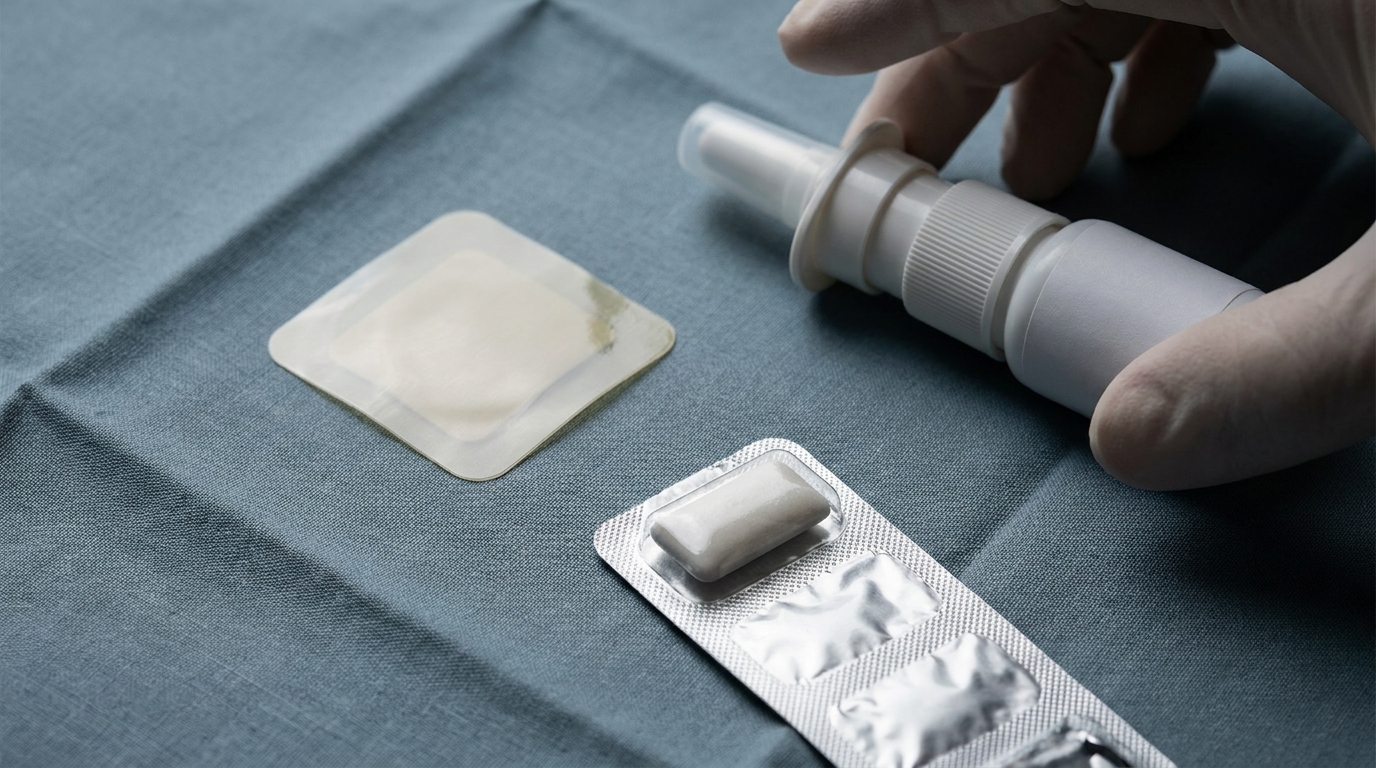
Smoking remains one of the leading preventable causes of death worldwide. A successful smoking cessation reduces cardiovascular risk, lowers the incidence of malignant diseases, and improves pulmonary function – facts that are well established in clinical practice. What is less clear for many patients and advising healthcare professionals is which nicotine replacement product is the best choice in which situation. This article provides you with an evidence-based overview of nicotine patches, nicotine gum, and nicotine spray, compares their pharmacological profiles, advantages and disadvantages, and offers concrete recommendations for individualized therapy management.
Basic Principle of Nicotine Replacement Therapy (NRT)
Nicotine replacement therapy is based on a simple yet effective principle: it delivers controlled amounts of nicotine to the body – without the more than 7,000 toxic combustion products of tobacco smoke. This alleviates withdrawal symptoms such as irritability, difficulty concentrating, craving, sleep disturbances, and weight gain, while drastically reducing the risk profile of nicotine delivery.
According to current evidence, NRT increases the likelihood of successful abstinence by 50–60% compared to placebo, regardless of the setting. The keys to success are the right product choice, adequate dosing, and the combination of baseline therapy with as-needed acute intervention.
Pharmacokinetic Fundamentals
The key to understanding the different NRT forms lies in their pharmacokinetics:
- Cigarette smoke delivers an arterial nicotine peak within 10–20 seconds (the so-called "bolus effect"). It is precisely this rapid rise that triggers the mesolimbic reward system and is responsible for the addictive potential.
- NRT products produce a slower, flatter rise in nicotine plasma levels. The faster the product reaches peak levels, the better it can break through acute craving – but the higher the residual addictive potential of the replacement product itself.
These differences in the speed of onset form the rational basis for differentiating between the dosage forms.
Nicotine Patch – the Baseline Therapy
Pharmacological Profile
The transdermal nicotine patch continuously releases nicotine through the skin over 16 or 24 hours. Absorption is slow: maximum plasma levels are reached only 4–8 hours after application. This creates a steady "nicotine baseline" that suppresses basal withdrawal without producing significant peaks.
Available Dosages
- High-dose patches: 21 mg/24 h or 25 mg/16 h
- Medium-dose patches: 14 mg/24 h or 15 mg/16 h
- Low-dose patches: 7 mg/24 h or 10 mg/16 h
The standard recommendation involves a stepwise tapering over 8–12 weeks: start with the highest level for smokers with a consumption of ≥ 10 cigarettes/day, then reduce every 2–4 weeks.
Advantages
- Simple, once-daily application → high adherence
- Steady nicotine levels → stable withdrawal suppression
- Discreet, no visible "addictive behavior"
- Low abuse potential due to slow onset
- No impact on oral mucosa or dental status
Disadvantages
- Cannot break through acute craving (onset too slow)
- Local skin reactions (erythema, pruritus) in up to 30% of users
- 24-hour patches can cause sleep disturbances and vivid dreams
- Not flexibly adjustable for situational increased demand
- Ineffective for sudden, intense cigarette cravings
Clinical Assessment
The patch is the backbone of any NRT strategy. It is excellently suited as baseline therapy but should be combined with a rapid-acting acute form in moderately to highly dependent smokers (Fagerström Test ≥ 5 points).
Nicotine Gum – the Classic for In-Between
Pharmacological Profile
Nicotine gum releases nicotine through the oral mucosa. When used correctly (chewing technique: chew – park – chew), plasma levels are reached after approximately 15–30 minutes. Bioavailability is approximately 50–70% of the declared dose, depending on chewing technique and salivary pH.
Available Dosages
- 4 mg – recommended for heavy dependence (≥ 20 cigarettes/day or first cigarette within 30 minutes of waking)
- 2 mg – recommended for lighter dependence
The maximum daily dose is 24 pieces (4 mg) or 24 pieces (2 mg). In practice, 8–12 pieces/day are recommended, distributed throughout the day at hourly intervals during the initial phase.
Correct Application Technique
A common reason for therapy failure is incorrect chewing technique. The so-called "chew-and-park" method is essential:
- Chew the gum slowly until a slightly peppery or tingling taste becomes noticeable
- "Park" the gum between the gum and cheek (do not continue chewing)
- When the taste fades: resume slow chewing
- Repeat the process over approximately 30 minutes
- Do not eat or drink (especially acidic beverages) 15 minutes before and during use – acidic pH inhibits buccal absorption
Advantages
- Can be used on demand → control over acute craving
- Oral and tactile substitute action (for smokers who miss "keeping busy")
- Flexible dose adjustment throughout the day
- Readily available, over-the-counter
Disadvantages
- Technique-dependent – significantly reduced efficacy with incorrect use
- Gastrointestinal side effects: nausea, heartburn, hiccups (from chewing too fast or swallowing nicotine-containing saliva)
- Unsuitable for temporomandibular joint problems, dental prostheses
- Taste perceived as unpleasant by some
- Potentially visible use → experienced as stigmatizing by some
Clinical Assessment
Nicotine gum is the classic acute intervention and an excellent combination partner with the patch. Smokers with strongly situation-dependent craving (e.g., after meals, during stress, in social situations) benefit particularly. Correct instruction on chewing technique is crucial for counseling success.
Nicotine Spray – the Fast-Acting Solution
Pharmacological Profile
The nicotine oral or nasal spray offers the fastest onset among NRT products. The oral spray achieves measurable plasma levels in approximately 2–5 minutes – a clear pharmacokinetic advantage over gum and patch. The nasal spray has an even slightly faster onset but is less commonly the first choice in practice due to more pronounced local side effects.
Available Dosages (Oral Spray)
- 1 mg per spray (most common formulation)
- 1–2 sprays when craving occurs
- Maximum dose: 4 sprays/hour, up to 64 sprays/day
- Recommended duration of use: 6 weeks at full dose, then gradual reduction over an additional 6 weeks
Application Technique
- Direct the spray into the oral cavity (inner cheek), do not inhale
- Do not swallow for a few seconds after spraying
- Do not eat or drink during and immediately after use
- If needed, apply a second spray after a few minutes
Advantages
- Fastest onset of all NRT forms → most effective acute intervention for strong craving
- Discreet application (oral spray)
- Flexible, on-demand dosing
- Proven superiority over placebo in highly dependent smokers
- No chewing required → suitable for dental problems or temporomandibular joint disorders
Disadvantages
- Local irritation: burning, tingling in mouth or nose, hiccups
- Higher dependence potential than patch or gum (due to rapid onset)
- Taste bothersome for some
- Higher cost per day of use compared to patch and gum
- Nasal spray: significant mucosal irritation, sneezing, rhinorrhea – limits acceptance
Clinical Assessment
The oral spray is the dosage form of choice for strong, difficult-to-control craving. It is particularly suited for highly dependent smokers who require rapid effect, and is a potent combination as an add-on to patch baseline therapy. Due to the higher dependence potential, the duration of use should be actively monitored and time-limited.
Comparative Overview
| Criterion | Patch | Gum | Oral Spray |
|---|---|---|---|
| Onset | Slow (4–8 h) | Moderate (15–30 min) | Fast (2–5 min) |
| Duration of action | 16–24 h | 30–60 min | 20–30 min |
| Withdrawal suppression | Excellent (basal) | Moderate (situational) | Moderate (situational) |
| Craving breakthrough | Low | Good | Very good |
| Adherence | High | Moderate | Moderate |
| Dependence potential | Very low | Low | Moderate |
| Ease of use | High | Moderate | High |
| Combination recommended | Yes (as baseline) | Yes (as add-on) | Yes (as add-on) |
Combination Therapy: the Gold Standard
The combination of a long-acting product (patch) with a short-acting product (gum or spray) shows a significantly higher abstinence rate than any monotherapy according to current evidence. The NNT (Number Needed to Treat) for combination therapy is approximately 15 – an excellent value for preventive medicine.
Recommended Combination Regimen
- Patch as baseline therapy at an adequate dose (highest level for ≥ 10 cigarettes/day)
- Gum OR spray as rescue medication for acute craving
- Dose adjustment: Dose generously during the first 1–2 weeks, then gradually reduce
- Duration of therapy: At least 8–12 weeks, longer if needed – premature discontinuation is one of the most common mistakes
When to Choose Which Acute Product?
- Prefer gum when: oral substitute action is desired, moderate cravings, good dental status, cost is a factor
- Prefer spray when: very strong craving, high dependence (Fagerström ≥ 7), dental prostheses, rapid effect as a psychological anchor is important
Special Patient Populations
Cardiovascular Comorbidities
NRT is considered safe even in cardiovascular risk patients. The risk of NRT use is orders of magnitude lower than the risk of continued smoking. According to current AHA recommendations, NRT should be actively offered to smokers with coronary artery disease, heart failure, or post myocardial infarction. Close monitoring is only advised during the first two weeks after an acute coronary syndrome.
Pregnancy
NRT may be considered during pregnancy when non-pharmacological measures alone are insufficient. The patch is preferred over oral forms (more consistent levels, lower peak fetal exposure). The 16-hour patch with an overnight break offers a more favorable risk profile than the 24-hour patch.
Inpatient Setting
In the inpatient setting – such as intensive care units, the perioperative phase, or after admission with acute coronary syndrome – NRT is an important, often underestimated tool. Nicotine withdrawal can promote hemodynamic instability, agitation, and delirium. Early administration of a nicotine patch in known smokers should be part of the standardized admission routine.
Common Mistakes in Counseling
In practice, NRT rarely fails due to pharmacology – but rather due to implementation errors:
- Underdosing: Many patients and also clinicians start with too low a dose. A smoker with 30 cigarettes/day most likely needs the highest patch level plus an acute product.
- Too short therapy duration: Discontinuation after 2–4 weeks instead of the recommended 8–12 weeks.
- Lack of combination: Patch-only therapy in highly dependent smokers.
- Incorrect gum technique: The most common reason for treatment failure and side effects with gum.
- Lack of accompanying counseling: NRT works better in combination with motivational interviewing or behavioral therapy approaches. Medication alone is only half the battle.
- Overestimating safety concerns: The fear of nicotine side effects from NRT is unfounded compared to the harm of continued smoking. "NRT is like a seatbelt – not perfect, but incomparably better than nothing."
Evidence at a Glance
The efficacy of NRT is supported by an extensive Cochrane evidence base:
- Patch, gum, spray, lozenge, and inhaler each significantly increase long-term abstinence rates compared to placebo (RR approximately 1.5–1.7).
- Combination therapy (patch + short-acting form) is superior to monotherapy (RR approximately 1.9 compared to placebo).
- Higher doses are more effective in highly dependent smokers than standard doses.
- Pre-cessation therapy (starting NRT 2 weeks before the planned quit date) shows an additional benefit in studies.
Practical Training
Counseling for smoking cessation and the competent use of nicotine replacement products require more than theoretical knowledge – they demand practical communication skills, confidence in dose selection, and routine handling of typical hurdles in everyday counseling. In the smoking cessation courses offered by Simulation Tirol, you can train exactly these competencies in a structured, evidence-based setting – from brief motivational interventions to individualized therapy planning. Details can be found at simulation.tirol/rauchentwoehnung.
Want to practice this hands-on?
In our Raucherentwöhnung – Evidenzbasiertes Seminar you practice this topic hands-on with high-tech simulators and experienced instructors.
More Articles
Motivational Interviewing for Smoking Cessation: A Technique for Physicians
How can physicians boost motivation to quit smoking in just a few minutes of conversation? This article presents the MI method, the 5 A's, and the 5 R's in a practical, hands-on way.
Passive Smoke Exposure in Children: Health Consequences and Counseling
Passive smoking is an underestimated risk factor for childhood respiratory diseases, SIDS, and otitis media. This article summarizes the evidence and shows physicians how to systematically motivate parents toward smoking cessation.
Smoking Cessation and Weight Gain: Evidence and Counterstrategies
Many smokers avoid quitting due to anticipated weight gain. This article examines the physiological causes, average weight gain according to studies, and evidence-based strategies to counteract it.