Magnesium Sulfate in Emergencies: Indications Beyond Eclampsia
From Torsade de Pointes to severe asthma and hypomagnesemia – an overview of dosing, infusion rates, and monitoring for emergency magnesium administration.

Author: Dr. med. univ. Daniel Pehböck, DESA
Specialist in Anesthesiology and Intensive Care Medicine, AHA-certified ACLS/PALS Instructor, Course Director Simulation Tirol
Reading time approx. 8 min
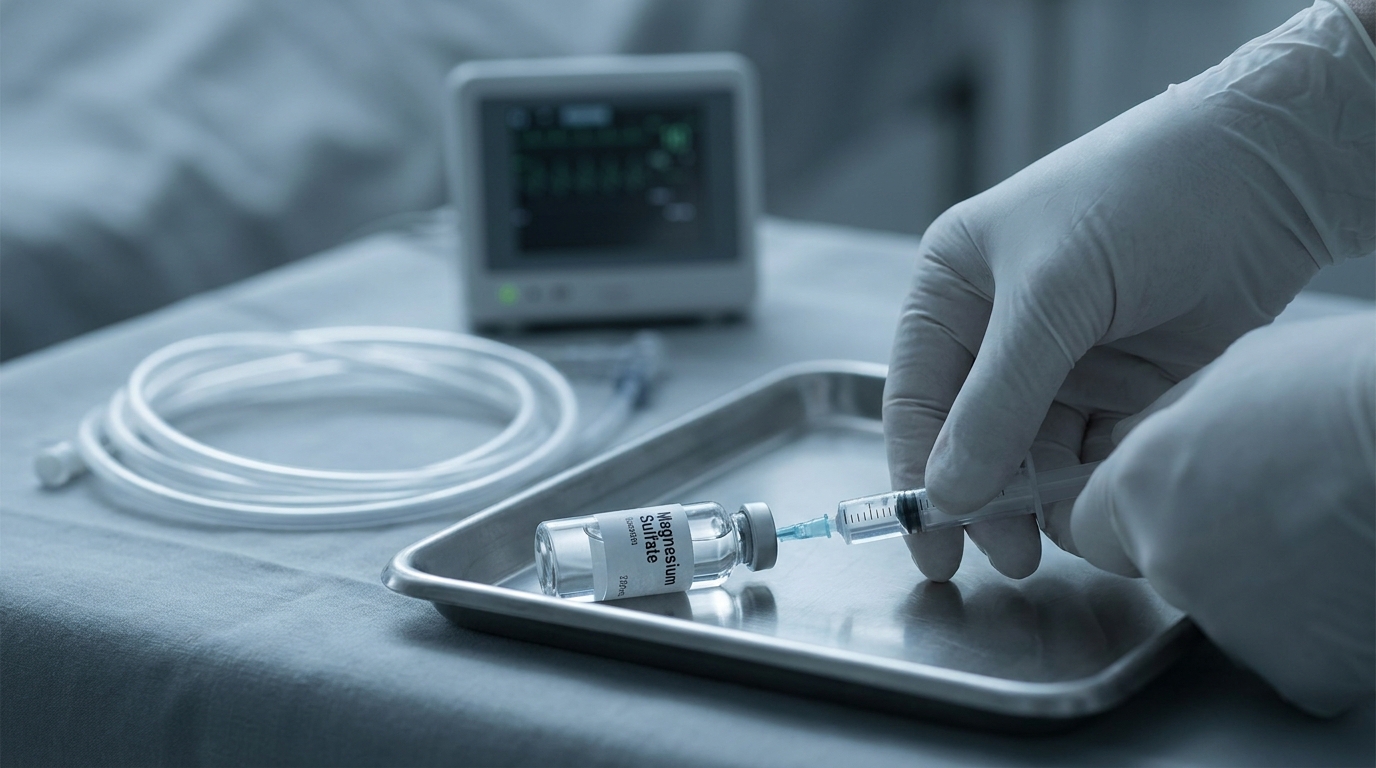
Magnesium sulfate is one of those emergency medications that is frequently underestimated in clinical practice. While most emergency physicians immediately think of eclampsia and preeclampsia, the spectrum of indications extends far beyond that. From life-threatening Torsade de Pointes tachycardia to treatment-refractory bronchial asthma to severe hypomagnesemia with hemodynamic instability – magnesium is a versatile tool in the emergency setting. This article gives you a systematic overview of the most important indications beyond obstetrics, specific dosing, infusion rates, and the necessary monitoring.
Pharmacology and Mechanism of Action
Magnesium is the fourth most abundant cation in the human body and serves as a cofactor in over 300 enzymatic reactions. In the emergency context, the following mechanisms of action are particularly relevant:
- Membrane stabilization: Magnesium blocks voltage-dependent calcium channels and modulates potassium channels on cardiomyocytes. This produces an antiarrhythmic effect, particularly in triggered activity caused by early afterdepolarizations.
- Bronchodilation: By inhibiting calcium influx into bronchial smooth muscle cells, magnesium causes relaxation of airway musculature. Additionally, it inhibits acetylcholine release at the neuromuscular junction.
- Vasodilation: Relaxation of vascular smooth muscle cells leads to peripheral vasodilation and can – depending on infusion rate – cause clinically significant hypotension.
- Neuroprotective effects: Magnesium is a physiological NMDA receptor antagonist and reduces excitatory neuronal transmission.
The therapeutic index of magnesium sulfate is comparatively wide; nevertheless, intravenous administration requires close monitoring. Renal elimination makes dose adjustment in patients with impaired renal function absolutely essential.
Serum Magnesium Levels and Their Interpretation
The normal range for serum magnesium is 0.7–1.05 mmol/L (1.7–2.5 mg/dL). However, serum levels are a poor marker of total body stores, as only approximately 1% of total body magnesium is extracellular. A normal serum level does not rule out a clinically relevant magnesium deficiency.
- Mild hypomagnesemia: 0.5–0.7 mmol/L – often asymptomatic or with nonspecific symptoms
- Moderate hypomagnesemia: 0.3–0.5 mmol/L – muscle cramps, tremor, hyperreflexia, cardiac arrhythmias
- Severe hypomagnesemia: < 0.3 mmol/L – life-threatening arrhythmias, seizures, coma
Torsade de Pointes – The First-Line Indication
Polymorphic ventricular tachycardia of the Torsade de Pointes (TdP) type is the classic cardiac emergency indication for magnesium sulfate and is recommended as first-line therapy in the current AHA guidelines – regardless of serum magnesium levels.
Pathophysiological Background
TdP typically develops on the basis of QT interval prolongation. Early afterdepolarizations (EADs) trigger the characteristic spindle-shaped polymorphic VT. Magnesium suppresses these EADs through membrane stabilization without significantly shortening the QT interval itself.
Dosing and Administration
- For hemodynamically unstable TdP or pulseless VT: 2 g (8 mmol) magnesium sulfate as a rapid IV bolus over 1–2 minutes, diluted in 10–20 mL of 0.9% NaCl
- For hemodynamically stable TdP: 2 g magnesium sulfate over 10–20 minutes IV, optionally followed by a maintenance infusion of 1–2 g/h over 4–6 hours
- For recurrence: Repeat bolus of 2 g is possible
Important Differential Diagnosis
Critically important is the differentiation from polymorphic VT without QT prolongation. This is typically ischemic in origin and does not respond to magnesium – revascularization is the key intervention here. Therefore, always check the preceding QT interval during sinus rhythm (QTc) in every case of polymorphic VT.
Severe Bronchial Asthma
Magnesium sulfate has established itself as a valuable adjunct in the treatment of severe bronchial asthma refractory to initial bronchodilator therapy. The AHA guidelines and international asthma recommendations list magnesium as an escalation therapy.
Indications
Magnesium is used in cases of:
- Failure to respond to repetitive inhaled beta-2 agonists and ipratropium bromide
- Persistent severe obstruction (peak flow < 25% of predicted)
- Impending respiratory exhaustion
- Need for intensive care unit admission
Dosing
- Intravenous: 2 g magnesium sulfate over 20 minutes, diluted in 100 mL of 0.9% NaCl
- Nebulized: 150–250 mg isotonic magnesium sulfate as a carrier solution for salbutamol (instead of NaCl) – evidence for this is less robust but can be considered as an additive measure
Evidence
Several randomized trials and meta-analyses demonstrate that intravenous magnesium in severe asthma reduces hospitalization rates and improves lung function. The effect is greatest in patients with the most severe obstruction (FEV₁ < 25% of predicted). In mild to moderate asthma, no benefit has been demonstrated.
Hypomagnesemia with Cardiovascular Instability
Severe hypomagnesemia occurs in the emergency setting more frequently than commonly assumed. At-risk groups include:
- Patients on loop diuretics or proton pump inhibitors
- Patients with alcohol dependence
- Patients with chronic diarrhea or malabsorption
- ICU patients with sepsis
- Patients receiving cisplatin chemotherapy
Clinical Manifestations
The symptoms of hypomagnesemia are varied and overlap with those of other electrolyte disturbances:
- Cardiovascular: Atrial fibrillation, ventricular arrhythmias, QT prolongation, ST segment changes, digitalis toxicity with concurrent digoxin therapy
- Neuromuscular: Tremor, hyperreflexia, tetany, generalized seizures
- Metabolic: Treatment-refractory hypokalemia and hypocalcemia (magnesium is a cofactor of Na⁺/K⁺-ATPase and regulates PTH secretion)
Dosing for Symptomatic Hypomagnesemia
- For life-threatening arrhythmias or seizures: 2 g IV over 2–5 minutes as a bolus, followed by 1–2 g/h as a continuous infusion
- For moderate symptomatic hypomagnesemia: 4–8 g over 12–24 hours as a continuous infusion
- Therapy monitoring: Serum magnesium levels every 6–8 hours, target > 0.7 mmol/L
The Hypokalemia Connection
A highly clinically relevant point: Approximately 40–60% of patients with hypomagnesemia have concurrent hypokalemia. This hypokalemia is often refractory to potassium replacement alone as long as the magnesium deficiency remains uncorrected. In every case of treatment-resistant hypokalemia, you should therefore always consider concomitant hypomagnesemia and replace magnesium in parallel.
Additional Emergency Indications
Pheochromocytoma Crisis
Magnesium sulfate can be used as second-line therapy for hypertensive crisis in the setting of pheochromocytoma. It inhibits catecholamine release from the adrenal medulla and reduces peripheral catecholamine sensitivity. Dosing: 2–4 g as a bolus, followed by 1–2 g/h as an infusion, titrated to blood pressure.
Digitalis Toxicity with Arrhythmias
Magnesium has a stabilizing effect on digitalis-induced arrhythmias, particularly when accompanied by hypokalemia. It does not replace administration of digitalis-specific antibodies (Digitalis-Fab) but can reduce arrhythmia susceptibility as a bridging measure. Dosing: 2 g over 20 minutes IV.
Acute Myocardial Infarction
Although older studies (LIMIT-2) suggested a benefit of magnesium in acute myocardial infarction, the significantly larger ISIS-4 trial failed to confirm this. Routine magnesium administration in STEMI is therefore not recommended. Magnesium remains indicated, however, in:
- Documented hypomagnesemia in the setting of ACS
- Occurrence of TdP or ventricular arrhythmias
- Treatment-refractory hypokalemia in the acute setting
Monitoring and Adverse Effects
Intravenous magnesium administration requires structured monitoring, as the therapeutic and toxic thresholds are closer together than often assumed.
Monitoring Parameters
| Parameter | Frequency | Target/Threshold |
|---|---|---|
| Blood pressure | Continuously during bolus | MAP > 65 mmHg |
| Heart rate/ECG | Continuously | Rhythm monitoring |
| Respiratory rate | Every 15 min during infusion | > 12/min |
| Patellar tendon reflexes | Every 30–60 min during high-dose therapy | Preserved reflexes |
| Serum magnesium | Every 6–8 h during continuous infusion | 0.7–1.5 mmol/L therapeutic |
| Urine output | Hourly during high-dose therapy | > 0.5 mL/kg/h |
Signs of Toxicity – Stepwise Escalation
Knowledge of concentration-dependent toxicity signs is essential:
- 1.5–2.5 mmol/L: Therapeutic range, nausea, warmth sensation, flushing (from vasodilation)
- 2.5–5.0 mmol/L: Hyporeflexia, somnolence, hypotension, bradycardia
- 5.0–7.5 mmol/L: Loss of patellar tendon reflexes, respiratory depression, AV block
- > 7.5 mmol/L: Respiratory arrest, asystole
Management of Magnesium Toxicity
- Immediate measure: Stop the infusion
- Antidote: 10% calcium gluconate – 10–20 mL (1–2 g) slow IV over 3–5 minutes; calcium directly antagonizes the neuromuscular and cardiac effects of magnesium
- For respiratory depression: Intubation and mechanical ventilation
- In renal insufficiency: Consider hemodialysis
Contraindications and Precautions
- Absolute contraindication: Severe renal insufficiency without dialysis capability (GFR < 15 mL/min) for non-life-threatening indications
- Relative contraindications: Myasthenia gravis (potential worsening of neuromuscular transmission), higher-degree AV block without pacemaker
- Use caution with: Concurrent administration of calcium channel blockers (additive hypotension and bradycardia), neuromuscular blocking agents (prolonged duration of action)
Dosing Overview for Emergency Practice
For quick reference in the acute setting:
| Indication | Dose | Infusion Rate | Special Considerations |
|---|---|---|---|
| TdP (pulseless) | 2 g IV | Bolus over 1–2 min | Within the ACLS algorithm |
| TdP (stable) | 2 g IV | Over 10–20 min | Maintenance of 1–2 g/h possible |
| Severe asthma | 2 g IV | Over 20 min | After unsuccessful first-line therapy |
| Symptomatic hypomagnesemia | 2 g IV bolus | Over 2–5 min | Maintenance 4–8 g over 12–24 h |
| Digitalis arrhythmia | 2 g IV | Over 20 min | Correct potassium in parallel |
| Pheochromocytoma crisis | 2–4 g IV | Bolus + 1–2 g/h | Titrated to blood pressure |
Practical mnemonic: The standard dose of magnesium sulfate is 2 g (equivalent to 8 mmol of magnesium) in nearly all emergency indications. What varies is primarily the infusion rate – fast for pulseless TdP, slow for all other indications.
Practical Tips for the Emergency Department
- Risk of confusion: Magnesium sulfate is supplied in various concentrations (10%, 20%, 50%). Always calculate the dose in grams, not milliliters. 2 g magnesium sulfate = 4 mL of the 50% solution = 10 mL of the 20% solution = 20 mL of the 10% solution.
- Dilution: For bolus administration, magnesium sulfate should always be diluted (at minimum to a 20% solution, preferably in 50–100 mL of 0.9% NaCl) to reduce venous irritation and pain at the injection site.
- Room temperature: Administer magnesium sulfate at room temperature – cold solutions increase venous pain.
- Combination therapy: When administering potassium and magnesium replacement concurrently, ensure both infusions do not run through the same IV access, as high potassium concentrations in combination with magnesium can be cardiotoxic.
Hands-On Training
The safe use of magnesium sulfate in emergencies – from Torsade de Pointes management within the ACLS algorithm to dosing decisions in treatment-refractory asthma – requires not only theoretical knowledge but above all clinical routine. In the ACLS course by Simulation Tirol, you train these and numerous other pharmacological decisions in realistic scenarios with structured debriefing. This is how knowledge becomes actionable competence that makes the difference in a real emergency.
Want to practice this hands-on?
In our ACLS-Kurs (Advanced Cardiac Life Support) you practice this topic hands-on with high-tech simulators and experienced instructors.
More Articles
Adenosine for SVT: Dosing, Technique, and Pitfalls
Supraventricular tachycardia is one of the most common emergency rhythms. This article describes the correct administration of adenosine using the rapid-flush technique, contraindications in WPW, and documentation of the diagnostic window.
Amiodarone vs. Lidocaine in Ventricular Fibrillation
Comparison of the two antiarrhythmics in shock-refractory ventricular fibrillation and pulseless ventricular tachycardia: dosing, evidence, and recommendations from current AHA guidelines.
Beta-Blocker and Calcium Channel Blocker Toxicity: Management
Overdoses of beta-blockers and calcium channel blockers cause severe bradycardia and shock. Stepwise management with high-dose insulin, lipid emulsion, and catecholamines explained in detail.