Capnography in Emergencies: How to Interpret CO₂ Waveforms Correctly
Capnography confirms tube placement and provides insight into CPR quality and ROSC. This article explains the interpretation of typical capnography waveforms, normal values, and clinical significance in various emergency situations.

Author: Dr. med. univ. Daniel Pehböck, DESA
Specialist in Anesthesiology and Intensive Care Medicine, AHA-certified ACLS/PALS Instructor, Course Director Simulation Tirol
Reading time approx. 8 min
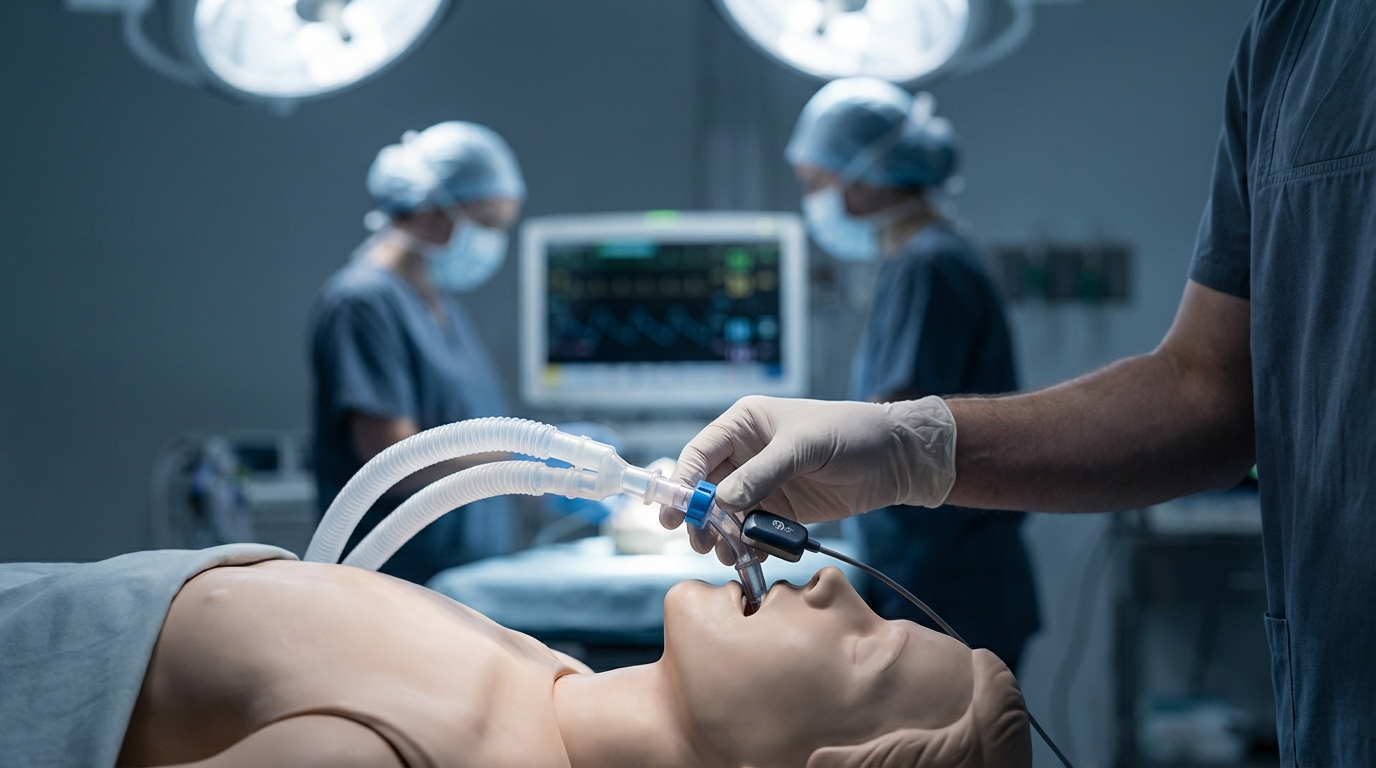
Capnography is one of the most important monitoring tools in emergency medicine – and yet it is frequently used below its full potential. If you understand the CO₂ waveform merely as a "tube position check," you are missing clinically relevant information. End-tidal CO₂ (etCO₂) provides real-time insight into CPR quality, metabolism, ventilation, and perfusion. In ACLS algorithms, continuous capnography is now firmly established – as the gold standard for tube position verification, as a surrogate parameter for cardiac output during CPR, and as the earliest indicator of ROSC. This article explores the physiological fundamentals, explains typical waveform patterns, and gives you concrete decision-making tools for clinical practice.
Physiological Fundamentals: What Does Capnography Measure?
Capnography measures the CO₂ concentration in exhaled air over time and displays it as a waveform (capnogram). End-tidal CO₂ (etCO₂) – the highest CO₂ value at the end of expiration – correlates closely with arterial pCO₂ (PaCO₂) under physiological conditions. The difference (PaCO₂ – etCO₂) is normally 2–5 mmHg.
CO₂ is produced in cellular metabolism, transported via venous blood to the lungs, and exhaled. The etCO₂ measurement is therefore an integrative parameter that reflects three systems simultaneously:
- Metabolism: CO₂ production (e.g., increased in fever, sepsis, malignant hyperthermia)
- Circulation: CO₂ transport to the lungs (dependent on cardiac output)
- Ventilation: CO₂ elimination (dependent on respiratory rate and tidal volume)
If any of these three factors changes, etCO₂ changes – often before other parameters react.
Normal Values and Measurement Principles
The physiological etCO₂ range is 35–45 mmHg (4.7–6.0 kPa). Two measurement principles are used:
- Mainstream sensors: Placed directly at the tube connector, fast response time, precise waveform
- Sidestream sensors: Aspirate gas through a thin tube, more versatile (can also be used with spontaneously breathing patients via nasal cannula), minimally delayed display
In the emergency setting, sidestream devices are more common because they can also be used with non-intubated patients. Waveform quality with both methods is sufficient for clinical decision-making.
The Normal Capnogram: The Four Phases
A normal capnogram shows a characteristic, nearly rectangular waveform with four clearly distinguishable phases:
- Phase I (inspiratory baseline): CO₂ ≈ 0 mmHg – this is dead space gas (fresh gas from the airways) that contains no CO₂.
- Phase II (expiratory upstroke): Steep rise in CO₂ concentration – transition from dead space gas to alveolar gas.
- Phase III (alveolar plateau): Nearly horizontal plateau – pure alveolar gas is being measured here. The highest point at the end of this plateau is the etCO₂ value.
- Phase 0 (inspiratory downstroke): Steep drop to zero – the patient inspires fresh gas.
A clean, rectangular capnogram with a flat plateau and sharp transitions indicates normal ventilation without significant obstruction and correct tube placement.
Clinical Scenarios: Recognizing and Acting on Waveform Patterns
Tube Position Verification
The AHA guidelines recommend continuous capnography as the most reliable method for confirming and monitoring endotracheal tube placement. It is superior to auscultation, clinical assessment, and colorimetric CO₂ detectors.
Correct tube placement:
- Persistent etCO₂ over multiple breaths (typically ≥ 6 breath cycles)
- Regular waveform with an alveolar plateau
Esophageal misplacement:
- Initially, small amounts of CO₂ may be detectable (swallowed gas, carbonated beverages)
- Characteristic: rapid drop to zero within a few breaths
- No alveolar plateau visible
Caution: In cardiac arrest, etCO₂ may be very low (< 10 mmHg) even with correct tube placement because very little CO₂ is being transported to the lungs. In this case, a low but present and rhythmically fluctuating etCO₂ during adequate chest compressions should be interpreted as confirmation of tube placement.
Capnography During CPR: Guiding Resuscitation Quality
During resuscitation, etCO₂ is the best available real-time surrogate parameter for the cardiac output generated by chest compressions. The better the compressions, the more CO₂ is transported to the lungs and exhaled.
Specific benchmarks per AHA guidelines:
- etCO₂ < 10 mmHg after 20 minutes of CPR: Can be used as one indicator of poor prognosis; however, it should never serve as the sole criterion for terminating resuscitation.
- etCO₂ persistently < 10 mmHg: Question CPR quality – compression depth (at least 5 cm, maximum 6 cm), compression rate (100–120/min), complete recoil, minimal interruptions.
- etCO₂ between 10 and 20 mmHg: Commonly observed range during adequate CPR without ROSC. Aim to optimize compression quality.
A continuously low etCO₂ despite seemingly good compressions should prompt you to critically evaluate your technique, consistently rotate compressors every two minutes, and actively search for reversible causes (4 Hs and 4 Ts).
Recognizing ROSC: The etCO₂ Surge
The sudden, significant increase in etCO₂ during resuscitation is one of the earliest and most reliable indicators of return of spontaneous circulation (ROSC).
Typical pattern:
- etCO₂ was at 10–15 mmHg during compressions
- Abrupt rise to ≥ 40 mmHg (often to values above 50–60 mmHg due to accumulated CO₂ load)
- Rise frequently occurs before a pulse becomes palpable
This etCO₂ surge is clinically extremely valuable because it can trigger a targeted pulse check without unnecessarily interrupting compressions. Conversely, an etCO₂ drop after initial suspicion of ROSC should raise concern that circulation has ceased again – immediate resumption of CPR is then indicated.
Bronchospasm and Obstruction: The "Shark Fin" Effect
In bronchospastic conditions (asthma, COPD exacerbation, anaphylactic bronchospasm), the capnogram shows a characteristic pattern:
- Upstroke (Phase II): Flattened, prolonged
- Alveolar plateau (Phase III): Rising instead of horizontal – the so-called "shark fin" (shark fin morphology)
- etCO₂ often elevated (> 45 mmHg) due to air trapping and prolonged expiration
This pattern arises from uneven lung emptying: well-ventilated areas empty early (lower CO₂), obstructed areas empty late (higher CO₂), resulting in a continuously rising plateau.
Clinical implication: Normalization of the waveform under therapy (e.g., salbutamol nebulization, epinephrine in anaphylaxis) is a more objective measure of treatment success than auscultation alone.
Hyperventilation and Hypoventilation
Hyperventilation:
- etCO₂ < 35 mmHg
- Normal waveform shape but reduced amplitude and increased respiratory rate
- Clinically relevant: unintentional hyperventilation in ventilated patients after ROSC – an etCO₂ < 30 mmHg is associated with worse neurological outcome
Hypoventilation:
- etCO₂ > 45 mmHg
- Normal waveform shape but increased amplitude and decreased respiratory rate
- Common in opioid overdose, sedation, central respiratory drive disorders
The AHA guidelines recommend etCO₂-guided ventilation after ROSC targeting an etCO₂ of 35–45 mmHg and a respiratory rate of 10–12/min in intubated patients.
Pulmonary Embolism
In acute pulmonary embolism (PE), a classic constellation is seen:
- etCO₂ abruptly decreased (due to increased dead space – embolized lung areas are ventilated but not perfused)
- PaCO₂–etCO₂ gradient widened (often > 10 mmHg)
- Waveform may appear normal, but the plateau is significantly lower
In a resuscitation scenario, a persistently very low etCO₂ despite optimal CPR quality should prompt consideration of a massive pulmonary embolism alongside other reversible causes.
Spontaneously Breathing Patients: Sedation Monitoring
Even in non-intubated patients, capnography via nasal cannula provides valuable information – particularly during procedural sedation or analgosedation:
- Early detection of respiratory depression (before SpO₂ drops!)
- Apnea alarm: Absent etCO₂ signal for > 15–20 seconds
- Hypoventilation: Rising etCO₂ with decreasing respiratory rate
Capnography detects ventilation disturbances a median of 60–90 seconds earlier than pulse oximetry, because SpO₂ responds with a delay due to the oxygen reserve and the oxygen dissociation curve.
Pitfalls and Limitations
As valuable as capnography is – you need to be aware of some potential sources of error:
- Leaks: Air leaks at the tube, mask, or sidestream tubing produce falsely low readings. Some degree of leakage is common, especially with supraglottic airway devices.
- Contamination: Secretions, blood, or vomitus in the sensor or tubing can produce falsely low or absent readings.
- Low-flow states: In cardiac arrest or severe shock, etCO₂ is primarily a circulation parameter – not primarily a ventilation parameter. A low etCO₂ here does not mean "hyperventilation" but rather "insufficient CO₂ transport."
- Sodium bicarbonate: Administration of sodium bicarbonate causes a transient etCO₂ rise (CO₂ release during buffering) that must not be confused with ROSC.
- Obesity and pregnancy: Be aware of altered baseline values – pregnant patients have physiologically lower PaCO₂ values (approximately 30–32 mmHg).
Integration into the ACLS Algorithm: Practical Approach
The following checklist summarizes the capnographic decision points during resuscitation:
- Immediately after intubation: Connect capnography – persistent etCO₂ over ≥ 6 breath cycles confirms tube placement.
- During CPR: Monitor etCO₂ continuously. Target through compression optimization: aim for etCO₂ > 10 mmHg, ideally > 20 mmHg.
- etCO₂ < 10 mmHg: Check CPR quality – compression depth, rate, complete recoil, compressor rotation.
- Abrupt etCO₂ rise (≥ 40 mmHg): ROSC likely → pulse check at next rhythm analysis.
- After ROSC: Guide ventilation by etCO₂ – target 35–45 mmHg, normoventilation, avoid hyperventilation.
- Prognostic assessment: etCO₂ < 10 mmHg after 20 minutes of adequate CPR as one component of the overall assessment – never as the sole criterion for terminating resuscitation.
Capnography in Children: Special Considerations in the PALS Context
The basic principles of capnography also apply in pediatric emergency medicine. Some special considerations should be noted:
- Higher respiratory rate: The faster respiratory rate in children can lead to underestimation of etCO₂ with sidestream sensors (washout effect). Mainstream sensors are preferred in intubated children.
- Tube placement: Capnography is essential in children, as auscultation on the small thorax is less reliable for differentiating between tracheal and esophageal placement.
- Lower tidal volume: Sidestream systems with low aspiration rates (50 ml/min instead of 150 ml/min) should be preferred in infants to avoid significantly reducing tidal volume.
Summary: The Five Most Important Take-Home Messages
- Tube position verification: Persistent etCO₂ over ≥ 6 breaths – no other parameter is more reliable.
- CPR quality marker: etCO₂ reflects compression-generated cardiac output – monitor continuously and adjust technique.
- Early ROSC indicator: A sudden etCO₂ rise to ≥ 40 mmHg is often the first sign of return of spontaneous circulation.
- Read the waveform: Shark fin morphology indicates obstruction; an absent plateau indicates leak or misplacement.
- Ventilation management after ROSC: Target normoventilation (etCO₂ 35–45 mmHg) – hyperventilation worsens neurological outcome.
Hands-On Training
Capnography is a tool whose full potential only becomes apparent when you have trained with it under realistic conditions – from interpreting various waveform patterns to guiding CPR to detecting ROSC in a team context. In the ACLS Refresher Course by Simulation Tirol, you work with high-fidelity simulators that display realistic capnography waveforms and practice integrating this monitoring into structured resuscitation scenarios. This turns theoretical knowledge into reliable clinical competence.
Want to practice this hands-on?
In our ACLS-Refresher you practice this topic hands-on with high-tech simulators and experienced instructors.
More Articles
Acute Heart Failure: Emergency Management and Differentiation
From pulmonary edema to cardiogenic shock – acute heart failure requires rapid hemodynamic classification. This article explains the clinical classification and first-line therapy with nitrates, diuretics, and vasopressors.
Acute Coronary Syndrome: Initial Management and the MONA Approach
ACS is one of the most common cardiac emergencies. This article covers initial diagnostics (12-lead ECG, troponin), risk stratification, pharmacological first-line treatment, and decision pathways for reperfusion therapy.
ECG Rhythm Interpretation: The Most Important Emergency Rhythms
From ventricular fibrillation to pulseless electrical activity to third-degree AV block – this article presents typical ECG patterns of the most critical emergency cardiac arrhythmias with recognition criteria and immediate therapy.