Recognizing Ventricular Fibrillation: ECG Features and Immediate Therapy
Ventricular fibrillation is the most common shockable rhythm in cardiac arrest. This article explains ECG morphology, differentiation from fine VF and asystole, optimal defibrillation strategy, and common recognition errors.

Author: Dr. med. univ. Daniel Pehböck, DESA
Specialist in Anesthesiology and Intensive Care Medicine, AHA-certified ACLS/PALS Instructor, Course Director Simulation Tirol
Reading time approx. 9 min
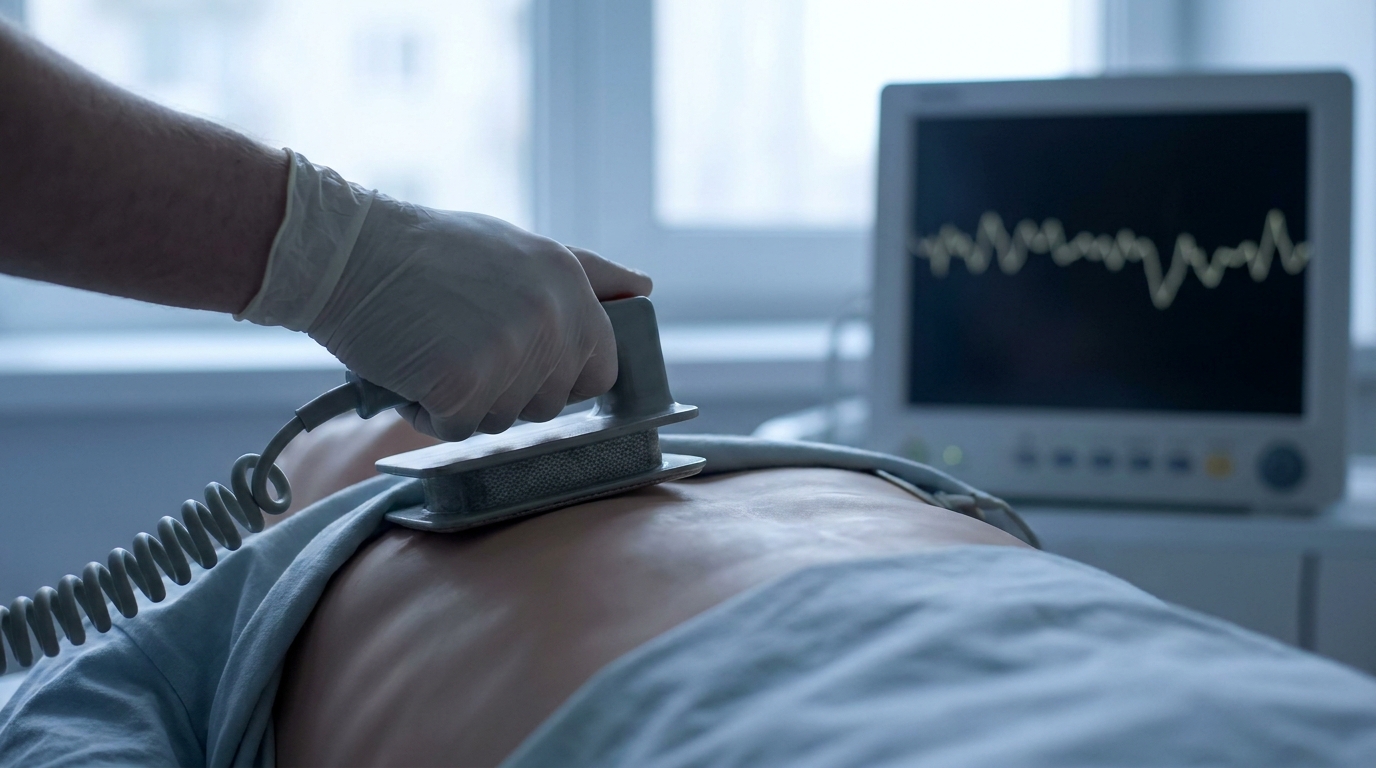
Ventricular fibrillation (VF) is the cardiac rhythm where survival chances depend most heavily on the speed of your response. No other arrhythmia in cardiac arrest benefits as directly from correct recognition and immediate therapy. At the same time, distinguishing between coarse ventricular fibrillation, fine ventricular fibrillation, and asystole is by no means trivial in clinical practice – misinterpretations cost valuable seconds and thus survival chances. This article systematically guides you through the ECG morphology of ventricular fibrillation, the most common differential diagnoses, the optimal defibrillation strategy according to current AHA guidelines, and the typical recognition errors you should know and avoid.
Pathophysiology in Brief
Ventricular fibrillation is caused by multiple, uncoordinated reentry circuits in the ventricular myocardium. Unlike ventricular tachycardia (VT), where a dominant reentry circuit is still identifiable, VF lacks any organized depolarization. The result: the ventricles no longer contract as a functional unit but instead "fibrillate" – no meaningful stroke volume is generated, and circulation ceases.
Electrophysiologically, ventricular fibrillation typically progresses through three phases:
- Electrical phase (approximately first 4–5 minutes): The myocardial cells still have sufficient energy reserves. Defibrillation during this phase has the highest probability of success.
- Circulatory phase (approximately 5–10 minutes): Myocardial energy reserves are depleted. Effective chest compressions are now essential to restore coronary perfusion before defibrillation.
- Metabolic phase (> 10 minutes): Global ischemia, acidosis, and cellular damage dominate. Prognosis is significantly reduced at this stage.
This phase model explains why defibrillation alone is not enough and why high-quality CPR is the critical accompanying factor.
ECG Morphology of Ventricular Fibrillation
Coarse Ventricular Fibrillation (Coarse VF)
Coarse ventricular fibrillation is the rhythm you should recognize most quickly because it carries the best prognosis among all cardiac arrest rhythms. The ECG features are:
- Irregular, chaotic waveforms without identifiable QRS complexes, P waves, or T waves
- Amplitude > 0.2 mV (typically much larger, often several millivolts)
- Fibrillation wave frequency: usually 150–500/min, variable
- No identifiable baseline – the isoelectric line is entirely replaced by irregular oscillations
- Changing morphology: shape, amplitude, and frequency of the waves change from second to second
The diagnosis is a spot diagnosis in most cases: you see a "chaotic zigzag" without any regularity. When in doubt: if it looks like VF and the patient has no pulse, treat it as VF.
Fine Ventricular Fibrillation (Fine VF)
Fine ventricular fibrillation represents the true diagnostic challenge. The fibrillation waves are low-amplitude here – typically < 0.2 mV – and can easily be confused with asystole on the monitor.
Features of fine VF:
- Low amplitude of fibrillation waves, sometimes barely distinguishable from baseline noise
- Recognizable, albeit small oscillations that differ from a truly flat line
- Irregularity is preserved – the waves are chaotic but present
Fine VF frequently represents ventricular fibrillation in a later phase, where myocardial energy reserves are already significantly reduced. The amplitude roughly correlates with myocardial ATP concentration and thus with the probability of successful defibrillation.
Differentiation from Asystole
The distinction between fine VF and asystole is clinically relevant because asystole is classified as a non-shockable rhythm. In practice, the following approach will help you:
- Increase gain on the monitor: Turn up the gain. True fine VF will become visible as oscillations at higher gain, while true asystole remains flat.
- Change leads: Check at least a second lead. VF can appear isoelectric in one lead (perpendicular to the vector sum) but clearly visible in another.
- Electrode check: Loose electrodes, cable breaks, or dried-out contact gel can produce a flatline artifact.
- Asystole protocol: The AHA recommends treating the rhythm as asystole when uncertain and continuing high-quality CPR, rather than repeatedly defibrillating a potentially non-shockable signal. The rationale: defibrillation in true asystole is ineffective and interrupts CPR.
Remember: The decision "shockable vs. non-shockable" must be made within a maximum of 10 seconds. Longer rhythm analysis pauses reduce chest compression time.
Differential Diagnoses on the Monitor
Not every chaotic waveform is ventricular fibrillation. The most important differential diagnoses you should keep in mind:
- Artifacts from chest compressions: During CPR, compressions generate rhythmic artifacts that can mimic VF. Therefore, always perform rhythm analysis during compression pauses.
- Torsades de Pointes: A polymorphic ventricular tachycardia with spindle-shaped amplitude variation. Unlike VF, a certain "organization" of the morphology is often recognizable – the classic spindle shape. Therapeutically relevant: magnesium for Torsades.
- Polymorphic VT without QT prolongation: Can look very similar to ventricular fibrillation but frequently degenerates into VF. In cardiac arrest, the therapeutic consequence is identical: defibrillation.
- Motion artifacts: In patients who do not require resuscitation, muscle tremor, patient movements, or external electrical interference can produce VF-like patterns. Clinical correlation is decisive here – a conscious, responsive patient does not have ventricular fibrillation.
Optimal Defibrillation Strategy
Time Factor
Every minute without defibrillation reduces the probability of survival in ventricular fibrillation by approximately 7–10%. With effective CPR, this rate drops to approximately 3–4% per minute. The message is clear: defibrillate as early as possible, but interrupt chest compressions as little as possible.
Energy Selection
The AHA guidelines recommend the following energy levels:
- Biphasic defibrillators: First shock according to the manufacturer's recommendation (typically 120–200 J). If the optimal energy is unknown, use the maximum energy of the device.
- Monophasic defibrillators: 360 J for all shocks (increasingly rare in practice).
- Escalation: With biphasic devices, energy can be escalated for persistent VF if the device allows it. A fixed escalation protocol is not mandated – what matters more is minimal interruption of CPR.
Shock-CPR Sequence
The current AHA guidelines recommend a single-shock strategy:
- Rhythm analysis (< 10 seconds CPR pause)
- A single shock – no more stacked shocks
- Immediate resumption of CPR for 2 minutes (5 cycles of 30:2), without prior rhythm or pulse check
- Repeat rhythm analysis after 2 minutes of CPR
The rationale behind immediately resuming CPR after shock delivery: even after successful defibrillation, it takes seconds to minutes for the myocardium to develop a hemodynamically effective contraction. During this phase, the heart needs coronary perfusion through chest compressions.
Minimizing Perishock Pause
The perishock pause – the time between the last compression before the shock and the first compression after the shock – is one of the strongest modifiable predictors of defibrillation outcome. The goal is a perishock pause of < 10 seconds, ideally < 5 seconds.
Practical tips for minimization:
- Continue compressions during charging: The defibrillator can be charged while chest compressions are ongoing. Hands are only removed for the actual shock delivery.
- Clear announcement: "Charging – keep compressing – everyone clear – shock – resume compressions." This verbal sequence should be standardized within the team.
- Pads instead of paddles: Self-adhesive defibrillation pads allow hands-free defibrillation and eliminate the time needed to position paddles.
Adjunctive Pharmacotherapy
Medications in cardiac arrest do not replace defibrillation and high-quality CPR but can support the probability of successful rhythm conversion.
Epinephrine (Adrenaline)
- Dosage: 1 mg IV/IO every 3–5 minutes
- Timing in VF/pVT: Only after the second unsuccessful shock (i.e., during the third CPR cycle), to avoid delaying defibrillation by interrupting CPR for IV access
- Mechanism of action: Alpha-1-mediated peripheral vasoconstriction → increased coronary and cerebral perfusion pressure
Amiodarone
- First dose: 300 mg IV/IO as a bolus after the third unsuccessful shock
- Second dose: 150 mg IV/IO for continued refractory VF
- Mechanism of action: Class III antiarrhythmic with additional Class I, II, and IV properties; prolongs the refractory period and stabilizes the membrane
Lidocaine
- Can be used as an alternative to amiodarone when the latter is unavailable
- First dose: 1–1.5 mg/kg IV/IO
- Subsequent doses: 0.5–0.75 mg/kg every 5–10 minutes (maximum dose 3 mg/kg)
Magnesium
- Indicated for Torsades de Pointes or suspected hypomagnesemia
- Dosage: 1–2 g IV/IO over 15–20 minutes (given as a bolus in cardiac arrest)
- Routine use in ordinary VF is not recommended
Common Recognition Errors and How to Avoid Them
Error 1: Diagnosing VF During Ongoing CPR
Chest compressions generate artifacts that can both mimic VF and obscure VF. Solution: Always perform rhythm analysis only during compression pauses. Filter functions on modern defibrillators can reduce CPR artifacts but do not replace the pause for reliable rhythm assessment.
Error 2: Treating Fine VF as Asystole
A common scenario: the monitor shows a nearly flat line, and the team decides against defibrillation. Solution: Increase gain, change leads, check electrodes. When in doubt: if you are truly uncertain and cannot make a clear decision even after these measures, treat as asystole – but repeat the analysis conscientiously during the next cycle.
Error 3: Not Recognizing VF Quickly Enough
A rhythm analysis that takes longer than 10 seconds is too long. In the stress of a cardiac arrest, teams tend to stare at the monitor for too long. Solution: Train the binary decision – "shockable or non-shockable" – until it becomes reflexive. The exact rhythm diagnosis is secondary during resuscitation.
Error 4: Misinterpreting Artifacts as VF
Muscle tremor, toothbrush artifacts (in hypothermia), or loose electrodes produce patterns that resemble VF. Solution: Clinical correlation. Does the patient have a pulse? Is the patient conscious? Are the cables moving? Look at the patient first, then the monitor.
Error 5: Delayed Defibrillation Due to Excessive Preparation
Some teams delay the first defibrillation because they want to establish IV access, intubate, or prepare medications first. Solution: The priority sequence is clear: High-quality CPR → Defibrillation → Medications → Airway management. IV access and epinephrine are important, but not more important than a rapid first shock.
Refractory Ventricular Fibrillation
Refractory ventricular fibrillation is defined as VF that persists despite repeated defibrillation attempts and pharmacotherapy. In this situation, you should systematically consider the following:
- Reversible causes (Hs and Ts): Hypovolemia, hypoxia, hydrogen ions (acidosis), hypo-/hyperkalemia, hypothermia, thrombosis (coronary or pulmonary), tamponade, toxins, tension pneumothorax. Any of these causes can perpetuate VF that will only terminate after correction.
- Change pad position: Switching from anterolateral to anteroposterior can direct defibrillation energy more favorably through the myocardium.
- Double Sequential Defibrillation (DSD): The use of two defibrillators with near-simultaneous shock delivery has been described in case series. Evidence is limited, and there is no general AHA recommendation – however, the method may be considered as a last resort in desperate situations.
- ECPR (Extracorporeal CPR): In specialized centers, extracorporeal membrane oxygenation (ECMO) can be established during resuscitation. This requires appropriate infrastructure, a trained team, and clear patient selection criteria.
Post-Defibrillation Management
After successful termination of ventricular fibrillation, post-cardiac arrest care begins, which significantly influences prognosis:
- Hemodynamic stabilization: Target blood pressure (systolic ≥ 90 mmHg, MAP ≥ 65 mmHg), vasopressors and volume administration as needed
- 12-lead ECG: Look for ST elevations indicating ST-elevation myocardial infarction (STEMI) as the cause of VF → emergent cardiac catheterization if indicated
- Targeted Temperature Management (TTM): Maintaining a constant target temperature for at least 24 hours in comatose survivors of cardiac arrest
- Antiarrhythmic maintenance therapy: If amiodarone was administered during resuscitation, a maintenance infusion may be considered
- Etiology investigation and treatment: Systematically evaluate electrolyte abnormalities, ischemia, structural heart disease, and toxicological causes
Practical Training
Recognizing ventricular fibrillation and executing the correct defibrillation strategy are skills that must work under stress – and that is only achievable through regular, realistic training. In the ACLS course from Simulation Tirol, you train rapid rhythm analysis on the monitor, the optimal shock-CPR sequence with minimal perishock pause, and adjunctive pharmacotherapy in realistic megacode scenarios. You practice not only the technical procedures but also team communication and structured decision-making that make the difference in a real emergency. AHA-certified, hands-on, and with immediate feedback – so that in the next cardiac arrest, you can make the most of the seconds that matter.
Want to practice this hands-on?
In our ACLS-Kurs (Advanced Cardiac Life Support) you practice this topic hands-on with high-tech simulators and experienced instructors.
More Articles
Acute Heart Failure: Emergency Management and Differentiation
From pulmonary edema to cardiogenic shock – acute heart failure requires rapid hemodynamic classification. This article explains the clinical classification and first-line therapy with nitrates, diuretics, and vasopressors.
Acute Coronary Syndrome: Initial Management and the MONA Approach
ACS is one of the most common cardiac emergencies. This article covers initial diagnostics (12-lead ECG, troponin), risk stratification, pharmacological first-line treatment, and decision pathways for reperfusion therapy.
ECG Rhythm Interpretation: The Most Important Emergency Rhythms
From ventricular fibrillation to pulseless electrical activity to third-degree AV block – this article presents typical ECG patterns of the most critical emergency cardiac arrhythmias with recognition criteria and immediate therapy.