Hyperkalemia in the Emergency Setting: ECG Signs and Stepwise Therapy
Hyperkalemia can rapidly lead to life-threatening cardiac arrhythmias. This article describes typical ECG changes (peaked T-waves to sine wave), the stepwise therapy with calcium, insulin/glucose, and salbutamol, as well as indications for dialysis.

Author: Dr. med. univ. Daniel Pehböck, DESA
Specialist in Anesthesiology and Intensive Care Medicine, AHA-certified ACLS/PALS Instructor, Course Director Simulation Tirol
Reading time approx. 8 min
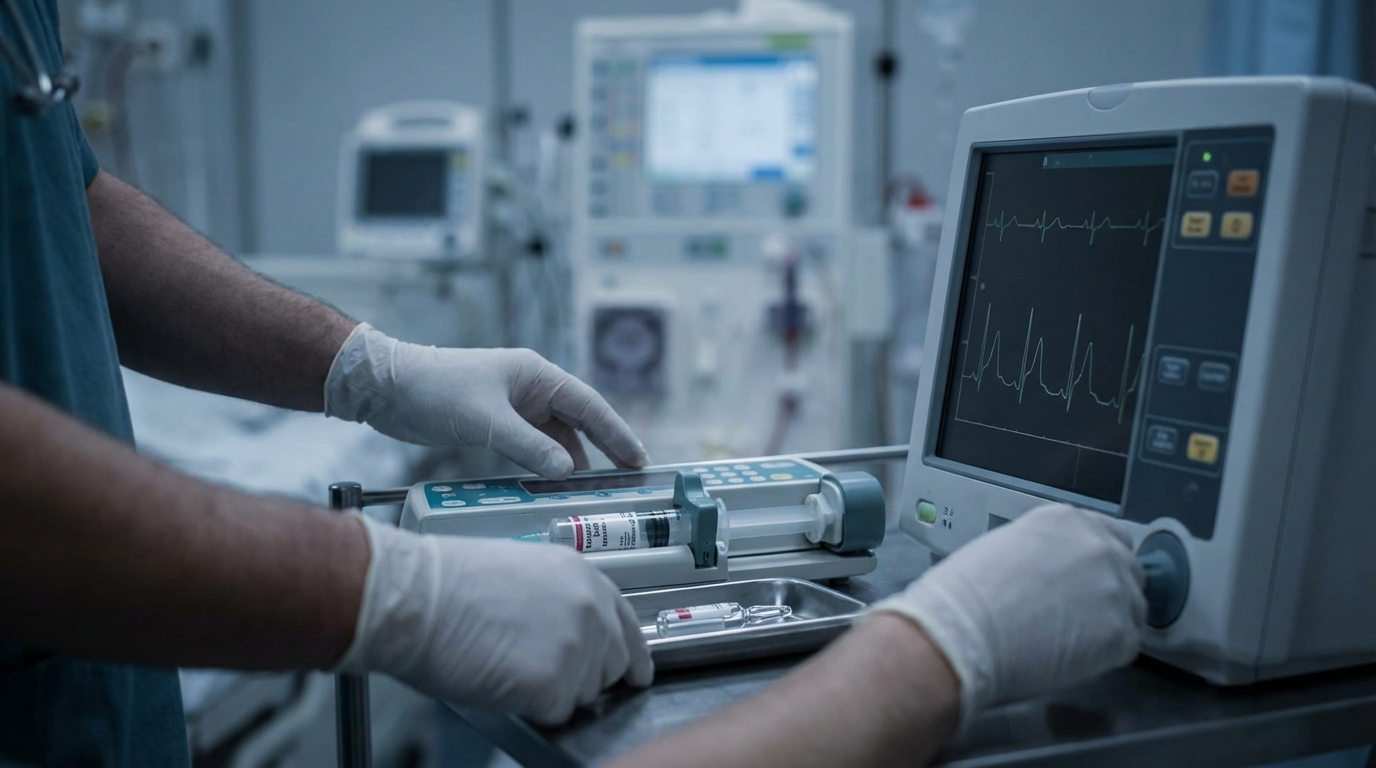
Hyperkalemia is one of the few metabolic derangements that can lead to cardiac arrest within minutes. In clinical practice, you encounter it regularly – in dialysis patients, after massive transfusions, in rhabdomyolysis, or drug-induced by ACE inhibitors, potassium-sparing diuretics, or NSAIDs. The treacherous part: symptoms are nonspecific, and the transition from "mild abnormality" to "pulseless arrhythmia" can be insidious or abrupt. What matters is that you reliably recognize the ECG changes and master the stepwise therapy before the lab results come back – because in hyperkalemia, you treat the ECG, not the lab value.
Pathophysiology in Brief
Potassium is the quantitatively most important intracellular cation. The resting membrane potential of cardiomyocytes is largely determined by the potassium gradient between the intracellular and extracellular space. When the extracellular potassium concentration rises, this gradient decreases, and the resting membrane potential becomes less negative (cell depolarization).
The consequences on the heart follow a characteristic cascade:
- Initial hyperexcitability: The resting membrane potential approaches the threshold potential → the cell becomes more easily excitable.
- Slowed conduction: Sodium channels become increasingly inactivated → the upstroke velocity of the action potential (phase 0) decreases → QRS widens.
- Shortened repolarization: Increased potassium conductance accelerates repolarization → the action potential becomes shorter → the T-wave becomes peaked and narrow.
- Terminal sine wave: In extreme hyperkalemia, the widened QRS complex and T-wave merge into an undulating sine wave – a pre-terminal sign.
Importantly: The correlation between absolute potassium level and ECG changes is highly variable between individuals. A chronic dialysis patient may still show a nearly normal ECG at 7.0 mmol/l, while a patient with an acute potassium rise may already develop severe changes at 6.0 mmol/l. The rate of rise, pH, calcium and sodium concentrations, and body temperature significantly modulate cardiac toxicity.
ECG Signs of Hyperkalemia – Recognizing the Sequence
The ECG changes with rising potassium follow a typical, though not always strictly linear, progression. You should be able to confidently identify each stage:
Mild Hyperkalemia (approx. 5.5–6.5 mmol/l)
- Peaked, narrow T-waves (so-called "tented T-waves"): symmetrical, high-amplitude, narrow-based – in contrast to the rather broad-based T-waves seen in ischemia.
- Best visible in precordial leads V2–V4 and limb leads II and III.
- The QT interval may be shortened (accelerated repolarization).
Moderate Hyperkalemia (approx. 6.5–7.5 mmol/l)
- Flattening to loss of the P-wave: The sinus node continues to fire, but atrial conduction is so slowed that no discrete P-wave is visible (sinoventricular conduction).
- Prolongation of the PR interval (first-degree AV block, occasionally second- or third-degree).
- QRS widening: initially subtle, then progressive – the morphology may resemble a bundle branch block.
Severe Hyperkalemia (approx. 7.5–9.0 mmol/l)
- Markedly widened QRS complex with bizarre morphology that can be confused with a bundle branch block, a ventricular rhythm, or even a STEMI.
- Merging of QRS and T-wave: The boundaries between depolarization and repolarization become blurred.
- Sine wave pattern: The classic, life-threatening waveform – a wide, undulating rhythm without identifiable P-wave, without clear separation between QRS and T.
Terminal Stage
- Ventricular fibrillation or pulseless electrical activity (PEA)
- Asystole
A critical point for practice: The sine wave can mimic a slow ventricular rhythm and is occasionally misinterpreted as an "agonal rhythm." If you see such an ECG in a patient with a corresponding history, your first thought should be hyperkalemia – and therapy should begin immediately.
Differential Diagnoses of ECG Changes
Not every peaked T-wave is hyperkalemia. You should consider the following differential diagnoses:
- Acute STEMI (hyperacute T-waves, but typically broader-based and associated with ST elevation)
- Benign early repolarization (J-point elevation, concave ST elevation)
- Cerebrovascular events (various T-wave changes possible)
- Hypothermia (Osborn waves, bradycardia)
When in doubt: Treat for hyperkalemia if the clinical context fits. Empirical administration of calcium in the absence of hyperkalemia is generally less harmful than untreated hyperkalemia is to the patient.
Stepwise Therapy for Hyperkalemia
Therapy follows a clear three-step principle: Stabilize the myocardium – shift potassium intracellularly – eliminate potassium from the body. In practice, the three steps often run in parallel rather than strictly sequentially.
Step 1: Membrane Stabilization with Calcium
Calcium directly antagonizes the electrophysiological effects of hyperkalemia on the myocardium without lowering the potassium level itself. It restores the normal gradient between resting and threshold potential.
- Calcium gluconate 10% – 10–20 ml (equivalent to 2.25–4.5 mmol Ca²⁺) slow IV over 2–3 minutes
- Alternative: Calcium chloride 10% – 5–10 ml IV (contains three times more elemental calcium per ml, but is a venous irritant → preferably via central venous catheter)
- Onset of action: within 1–3 minutes
- Duration of action: approx. 30–60 minutes
- Repeat: If ECG changes persist, the dose can be repeated after 5–10 minutes
- ECG monitoring during administration is mandatory
Caution with digitalis: In patients with digitalis toxicity, calcium can theoretically potentiate toxicity. In acutely life-threatening hyperkalemia, the benefit of calcium administration still outweighs the risk – but administer more slowly (over 20–30 minutes diluted in an infusion) and under close monitoring.
Step 2: Potassium Shift Intracellularly
These measures temporarily lower the serum potassium level by shifting potassium into cells. They buy time until definitive elimination can take place.
Insulin-Glucose Combination
- 10 IU regular insulin (short-acting insulin) IV as a bolus together with 25–50 g glucose (e.g., 50 ml glucose 50% or 250 ml glucose 20%)
- Onset of action: 15–30 minutes
- Duration of action: 4–6 hours
- Potassium reduction: approx. 0.5–1.2 mmol/l
- Caution – hypoglycemia: frequent blood glucose checks for at least 4–6 hours. The risk of hypoglycemia is frequently underestimated in practice – depending on the study, it ranges from 10–75%. In patients with already elevated blood glucose (> 250 mg/dl), glucose administration can initially be omitted.
Nebulized Salbutamol
- 10–20 mg via nebulizer (i.e., 4 to 8 times the dose used for asthma therapy!)
- Onset of action: 15–30 minutes
- Potassium reduction: approx. 0.5–1.0 mmol/l
- Additive effect to insulin/glucose – the combination of both measures lowers potassium more than either measure alone
- Caution: Tachycardia, tremor. Use with caution in patients with unstable coronary artery disease. Approximately 40% of dialysis patients are non-responders to beta-agonists.
Sodium Bicarbonate
- Indication: Primarily in the setting of concomitant metabolic acidosis (pH < 7.2)
- Dosage: 50–100 mmol (= 50–100 ml NaHCO₃ 8.4%) IV over 15–30 minutes
- As monotherapy with normal pH, it is only marginally effective – should not be used as a sole measure for potassium lowering
- Caution: Do not administer in the same line as calcium (precipitation!)
Step 3: Potassium Elimination from the Body
Here, potassium is actually removed from the body – this is the only causal therapy.
Loop Diuretics
- Furosemide 40–80 mg IV (with preserved renal function)
- Only effective with adequate GFR – ineffective in anuric patients
- Concurrent volume administration (0.9% NaCl) optimizes renal potassium excretion
Cation Exchange Resins
- Sodium polystyrene sulfonate (Kayexalate®) oral or rectal: 15–30 g
- Newer alternatives: Patiromer or Sodium zirconium cyclosilicate (SZC) – they have a faster onset of action and a more favorable side effect profile
- Onset of action of classic resins: hours to days – therefore not an acute intervention in the strict sense
- In the emergency setting, relevant at most as bridging therapy until dialysis
Hemodialysis
Hemodialysis is the most effective method for potassium elimination and the definitive therapy in:
- Severe hyperkalemia (> 6.5 mmol/l) with ECG changes and failure to respond to medical therapy
- Anuria or severely impaired renal function
- Life-threatening hyperkalemia in the setting of cardiac arrest (resuscitation situation)
- Underlying disease requiring dialysis
In a resuscitation situation with suspected hyperkalemia, the possibility of emergency dialysis should be considered early. Contact with nephrology/dialysis services should be made in parallel with stepwise therapy.
Hyperkalemia in the Resuscitation Algorithm
Hyperkalemia is one of the reversible causes within the framework of the 4 H's and HITS (or internationally the 4 H's and 4 T's). In the AHA ACLS algorithm, it is listed among the treatable causes of PEA and asystole.
Practical approach when hyperkalemia is suspected during resuscitation:
- Do not interrupt CPR and the standard ACLS algorithm
- Calcium gluconate 10% – 30 ml (or calcium chloride 10% – 10 ml) IV as a bolus – higher doses than outside of resuscitation are justified
- Insulin 10 IU + glucose 50% 50 ml IV
- Sodium bicarbonate 50 mmol IV (especially if acidosis is suspected)
- Salbutamol 10–20 mg nebulized – if practically feasible during the resuscitation situation (endotracheal tube/SGA)
- Organize dialysis as early as possible – there are case reports of successful resuscitations after more than 60 minutes of CPR when hyperkalemia was corrected by dialysis
Remember: In PEA with wide QRS and a fitting history (dialysis patient, crush injury, relevant medications), empirical treatment of hyperkalemia should begin without laboratory confirmation.
Pitfalls and Common Errors
- Pseudohyperkalemia: Hemolysis during blood sampling (needle too thin, excessive suction, prolonged tourniquet application) can produce falsely elevated potassium values. If potassium is unexpectedly high without ECG changes: repeat from a cleanly drawn sample.
- Bicarbonate as sole therapy: Sodium bicarbonate as monotherapy barely lowers potassium at normal pH – it should always be used in combination with insulin/glucose and salbutamol.
- Forgotten blood glucose monitoring: Hypoglycemia after insulin administration is one of the most common complications of hyperkalemia therapy. Blood glucose checks every 30–60 minutes for at least 6 hours are mandatory.
- Rebound hyperkalemia: All shift measures are temporary. Without elimination (diuretics, dialysis, cation exchangers), potassium will rise again. Monitoring must continue for hours.
- Forgetting calcium: When ECG changes are present, calcium is the first and most important measure – not insulin, not salbutamol. It stabilizes the myocardium and buys the critical minutes.
Summary as an Emergency Algorithm
| Step | Measure | Dose | Onset of Action | Effect |
|---|---|---|---|---|
| 1 | Calcium gluconate 10% | 10–20 ml IV over 2–3 min | 1–3 min | Membrane stabilization |
| 2a | Insulin + Glucose | 10 IU regular insulin + 25 g glucose IV | 15–30 min | K⁺ shift intracellularly |
| 2b | Nebulized salbutamol | 10–20 mg | 15–30 min | K⁺ shift intracellularly |
| 2c | Sodium bicarbonate | 50–100 mmol IV (if pH < 7.2) | 15–30 min | K⁺ shift intracellularly |
| 3a | Furosemide | 40–80 mg IV | 30–60 min | Renal elimination |
| 3b | Cation exchange resins | Variable | Hours | GI elimination |
| 3c | Hemodialysis | – | Immediately after initiation | Most effective elimination |
Practical Training
Hyperkalemia is a prime example of how metabolic emergencies and ACLS algorithms intertwine. Recognizing ECG changes under time pressure, correctly dosing the stepwise therapy, and integrating it into the resuscitation algorithm are best practiced in realistic simulation scenarios. In the ACLS courses offered by Simulation Tirol, you practice exactly these situations – from the first glance at the monitor to the decision for emergency dialysis – as a team and under expert guidance. This way, theoretical knowledge becomes a reliable action plan you can count on in a real emergency.
Want to practice this hands-on?
In our ACLS-Kurs (Advanced Cardiac Life Support) you practice this topic hands-on with high-tech simulators and experienced instructors.
More Articles
Acute Heart Failure: Emergency Management and Differentiation
From pulmonary edema to cardiogenic shock – acute heart failure requires rapid hemodynamic classification. This article explains the clinical classification and first-line therapy with nitrates, diuretics, and vasopressors.
Acute Coronary Syndrome: Initial Management and the MONA Approach
ACS is one of the most common cardiac emergencies. This article covers initial diagnostics (12-lead ECG, troponin), risk stratification, pharmacological first-line treatment, and decision pathways for reperfusion therapy.
ECG Rhythm Interpretation: The Most Important Emergency Rhythms
From ventricular fibrillation to pulseless electrical activity to third-degree AV block – this article presents typical ECG patterns of the most critical emergency cardiac arrhythmias with recognition criteria and immediate therapy.